Rachel Maddow - Drift
Здесь есть возможность читать онлайн «Rachel Maddow - Drift» весь текст электронной книги совершенно бесплатно (целиком полную версию без сокращений). В некоторых случаях можно слушать аудио, скачать через торрент в формате fb2 и присутствует краткое содержание. Город: New York, Год выпуска: 2012, ISBN: 2012, Издательство: Crown Publishers, Жанр: Публицистика, на английском языке. Описание произведения, (предисловие) а так же отзывы посетителей доступны на портале библиотеки ЛибКат.
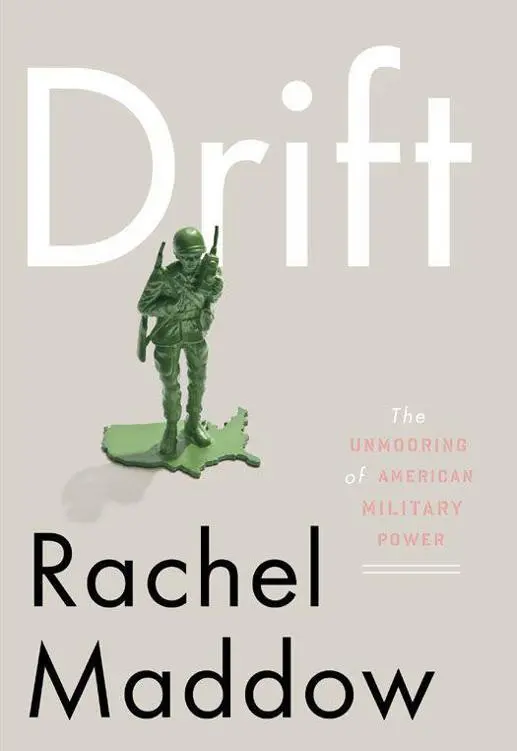
- Название:Drift
- Автор:
- Издательство:Crown Publishers
- Жанр:
- Год:2012
- Город:New York
- ISBN:978-0-307-46100-1
- Рейтинг книги:4 / 5. Голосов: 1
-
Избранное:Добавить в избранное
- Отзывы:
-
Ваша оценка:
Drift: краткое содержание, описание и аннотация
Предлагаем к чтению аннотацию, описание, краткое содержание или предисловие (зависит от того, что написал сам автор книги «Drift»). Если вы не нашли необходимую информацию о книге — напишите в комментариях, мы постараемся отыскать её.
Written with bracing wit and intelligence, Rachel Maddow’s
argues that we’ve drifted away from America’s original ideals and become a nation weirdly at peace with perpetual war, with all the financial and human costs that entails. To understand how we’ve arrived at such a dangerous place, Maddow takes us from the Vietnam War to today’s war in Afghanistan, along the way exploring the disturbing rise of executive authority, the gradual outsourcing of our war-making capabilities to private companies, the plummeting percentage of American families whose children fight our constant wars for us, and even the changing fortunes of G.I. Joe. She offers up a fresh, unsparing appraisal of Reagan’s radical presidency. Ultimately, she shows us just how much we stand to lose by allowing the priorities of the national security state to overpower our political discourse.
Sensible yet provocative, dead serious yet seriously funny,
will reinvigorate a “loud and jangly” political debate about how, when, and where to apply America’s strength and power—and who gets to make those decisions.
http://www.youtube.com/watch?v=Y9xoM7TMiTA
Drift — читать онлайн бесплатно полную книгу (весь текст) целиком
Ниже представлен текст книги, разбитый по страницам. Система сохранения места последней прочитанной страницы, позволяет с удобством читать онлайн бесплатно книгу «Drift», без необходимости каждый раз заново искать на чём Вы остановились. Поставьте закладку, и сможете в любой момент перейти на страницу, на которой закончили чтение.
Интервал:
Закладка:
Not many mainstream American publications gave much play to the statement of Soviet General Secretary Leonid Brezhnev a month after Reagan’s first Soviet Military Power was issued: “It is dangerous madness to try to defeat each other in the arms race and to count on victory in nuclear war. I shall add that only he who has decided to commit suicide can start a nuclear war in the hope of emerging a victor from it. No matter what the attacker might possess, no matter what method of unleashing nuclear war he chooses, he will not attain his aims. Retributions will ensue ineluctably.” Nor that of Brezhnev’s deputy Konstantin Chernenko, who said nuclear war “must not be permitted…. It is criminal to look upon nuclear war as a rational, almost legitimate continuation of policy.” Nor that of Brezhnev’s other deputy, Yuri Andropov, who said that “any attempt to resolve the historic conflict between these systems by means of military clash would be fatal for mankind.”
But, hey, those guys were liars. The president said so. And in 1981 Reagan went on the record with a dark warning, saying, “Unlike us, the Soviet Union believes that a nuclear war is possible and they believe it is winnable.”
America’s actor president and his hard-right turn looked like madness to the Soviets. What Team B was making up about the Soviet mind-set actually seemed true about the American one. The Soviets saw the US defense budget go up by 10 percent a year; they saw us rolling out ever more lethal strategic weapons and investing in new military technology. They watched with growing alarm as Reagan convinced NATO to plant nuclear-armed missiles all over Western Europe. And they watched as Reagan convinced a skeptical but apparently spineless Congress to fund General Graham’s defense system designed to knock down any missiles the Soviets fired, a system popularly known as Star Wars, as in the blockbuster film. Star Wars was as much a fantasy as Ewoks and lightsabers. Thirty years later we’re still futzing with it and it doesn’t really work, or even really make sense. But from the point of view of the Soviets, who had no way of knowing how close to science fiction Star Wars was, this signaled an alarming move by Reagan to free the United States from the fearsome but stabilizing deterrent of Mutually Assured Destruction. With Star Wars defenses in place, the Soviets feared, our nukes would hit Russia first, but then any retaliatory missiles from them would be shot out of the sky before they even entered American airspace. It would take the safety off America’s nuclear trigger.
The Soviets put their own intelligence services on high alert, watching for any and every sign of American military movement. And their ambassador to the United States, Anatoly Dobrynin, who spent much of his adult life in Washington, was gently passing the word to his bosses in the Kremlin that Reagan really did believe what he was saying. Dobrynin later wrote in his memoir that “considering the continuous political and military rivalry and tension between the two superpowers, and an adventurous president such as Reagan, there was no lack of concern in Moscow that American bellicosity and simple human miscalculation could combine with fatal results.”
In 1983, when fear at the Kremlin was at an all-time high, the Reagan administration was more or less oblivious to it. “While we in American intelligence saw the tension,” Deputy CIA Director Robert Gates (yes, that Robert Gates) wrote in his memoir, “we did not really grasp just how much the Soviet leadership felt increasingly threatened by the U.S. and by the course of events.”
There was, remarkably, according to Dobrynin’s later memoir, one article of faith inside the Kremlin that gave the Soviets some measure of solace: the American system of government. They understood that a president had a lot of hoops to jump through before he could take the United States to war. Dobrynin had been in Washington to watch the Congress erect the would-be barrier to presidential war making that was the War Powers Act. Reagan’s Soviet counterparts—Brezhnev, Chernenko, Gorbachev—believed, as Dobrynin wrote, that the “political and social structure of the United States was the best guarantee against an unprovoked strike.” Yuri Andropov, who was Soviet general secretary in 1983, that year of living most dangerously, was not so sanguine. “Reagan is unpredictable,” a nervous Andropov confided to Dobrynin. “You should expect anything from him.”
Plenty of Americans will always believe that it was the economic and psychological pressure of the arms race that hastened or even caused the collapse of the Soviet Union in 1991, two years after Reagan left office. And there might be some truth to that. It is certainly the narrative the Reagan hagiographers have sold us. But it’s also true that the Soviet Union was already teetering badly by the time Reagan took office. And it’s impossible to say how Russia might look today if we had spent more of our national energy helping Gorbachev find his way toward democracy and less time convincing Western European leaders to point the world’s most potent weapons of mass destruction at Red Square.
Counterfactuals aside, what is demonstrably clear and empirically measurable is the damage that our country suffered from the enormity of the defense spending of the Reagan presidency. David Stockman’s initial dire deficit projections, it turns out, were rosy; Reagan’s annual budget deficit ballooned from 2 percent to a record 6.3 percent of GDP in his first two years in office, a fiscal sinkhole it would take us nearly twenty years to climb out of. But as the yearly budget shortfalls grew from $50 billion to $100 billion to $150 billion to $220 billion, the Reagan administration waved them off like so many anti-nuke protesters. The self-proclaimed fiscal conservatives just kept asking for and getting more dollars for more weapons. Reagan’s continual appeals to American strength and pride, his vivid emotional doomsaying, all his overhyped talk about the Commies enslaving the world… it worked. He conjured for us an enemy worthy of our cause, something big to push back against. And he convinced us to reach deep, deep, deep into our pockets to fund that push.
“For more than a third of a century, assertions of Soviet superiority created calls for the United States to ‘re-arm.’ In the 1980s, the call was heeded so thoroughly that the United States embarked on a trillion dollar defense buildup,” Anne Hessing Cahn wrote in 1993. “As a result, the country neglected its schools, cities, roads and bridges and health care system. From the world’s greatest creditor nation, the United States became the world’s greatest debtor—in order to pay for the arms to counter the threat of a nation that was collapsing.”
A lot of important things got back-burnered to make way for “re-arming.” After Carter’s insistence that “our dependence on foreign oil will be stopped dead in its tracks right now and then reversed as we move through the 1980s,” American oil consumption grew in the Reagan years, and in George H. W. Bush’s, and in Bill Clinton’s, and in George W. Bush’s. Our oil imports, which took a big jump in Reagan’s second term, just kept rising. In 1973, the United States of America imported a third of the oil we consumed; by 2005 we imported about 60 percent.
But again, who got excited about joining Jimmy Carter in the fight against energy dependence, or against his unspoken national malaise? Who wanted to be told our most threatening enemy was our own lack of faith and fortitude, our commitment to competing with the world on terms beyond shooting at them? Reagan convinced us that there was a world full of evildoers to fight out there, and not just behind the Iron Curtain. There were also bad guys who were a lot more convenient to get to.
Читать дальшеИнтервал:
Закладка:
Похожие книги на «Drift»
Представляем Вашему вниманию похожие книги на «Drift» списком для выбора. Мы отобрали схожую по названию и смыслу литературу в надежде предоставить читателям больше вариантов отыскать новые, интересные, ещё непрочитанные произведения.









Обсуждение, отзывы о книге «Drift» и просто собственные мнения читателей. Оставьте ваши комментарии, напишите, что Вы думаете о произведении, его смысле или главных героях. Укажите что конкретно понравилось, а что нет, и почему Вы так считаете.