Rachel Maddow - Drift
Здесь есть возможность читать онлайн «Rachel Maddow - Drift» весь текст электронной книги совершенно бесплатно (целиком полную версию без сокращений). В некоторых случаях можно слушать аудио, скачать через торрент в формате fb2 и присутствует краткое содержание. Город: New York, Год выпуска: 2012, ISBN: 2012, Издательство: Crown Publishers, Жанр: Публицистика, на английском языке. Описание произведения, (предисловие) а так же отзывы посетителей доступны на портале библиотеки ЛибКат.
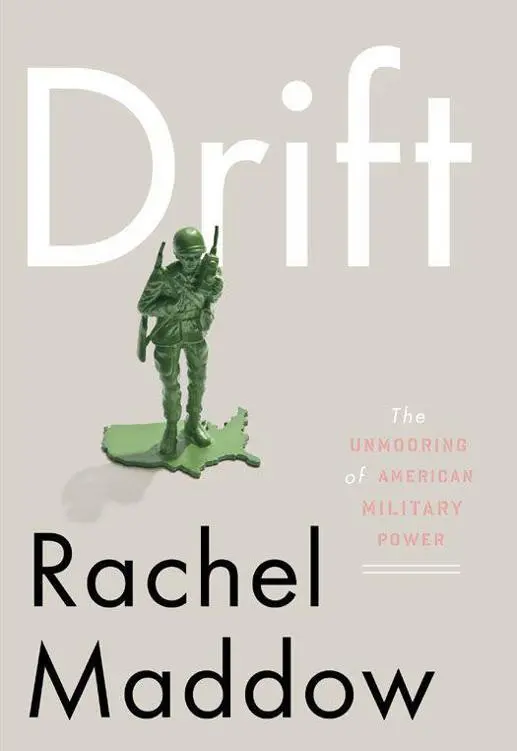
- Название:Drift
- Автор:
- Издательство:Crown Publishers
- Жанр:
- Год:2012
- Город:New York
- ISBN:978-0-307-46100-1
- Рейтинг книги:4 / 5. Голосов: 1
-
Избранное:Добавить в избранное
- Отзывы:
-
Ваша оценка:
Drift: краткое содержание, описание и аннотация
Предлагаем к чтению аннотацию, описание, краткое содержание или предисловие (зависит от того, что написал сам автор книги «Drift»). Если вы не нашли необходимую информацию о книге — напишите в комментариях, мы постараемся отыскать её.
Written with bracing wit and intelligence, Rachel Maddow’s
argues that we’ve drifted away from America’s original ideals and become a nation weirdly at peace with perpetual war, with all the financial and human costs that entails. To understand how we’ve arrived at such a dangerous place, Maddow takes us from the Vietnam War to today’s war in Afghanistan, along the way exploring the disturbing rise of executive authority, the gradual outsourcing of our war-making capabilities to private companies, the plummeting percentage of American families whose children fight our constant wars for us, and even the changing fortunes of G.I. Joe. She offers up a fresh, unsparing appraisal of Reagan’s radical presidency. Ultimately, she shows us just how much we stand to lose by allowing the priorities of the national security state to overpower our political discourse.
Sensible yet provocative, dead serious yet seriously funny,
will reinvigorate a “loud and jangly” political debate about how, when, and where to apply America’s strength and power—and who gets to make those decisions.
http://www.youtube.com/watch?v=Y9xoM7TMiTA
Drift — читать онлайн бесплатно полную книгу (весь текст) целиком
Ниже представлен текст книги, разбитый по страницам. Система сохранения места последней прочитанной страницы, позволяет с удобством читать онлайн бесплатно книгу «Drift», без необходимости каждый раз заново искать на чём Вы остановились. Поставьте закладку, и сможете в любой момент перейти на страницу, на которой закончили чтение.
Интервал:
Закладка:
By the time that first massive defense appropriation passed, coupled with the largest tax cuts in American history, Reagan’s budget director, David Stockman, was already trying to flag to the president a new threat. The projected annual budget deficit had ballooned to $62 billion, Stockman advised, and—at current taxing and spending levels—was sure to hit $112 billion within five years. The yearly deficit, which had generally hovered around 2 percent of GDP in the postwar years, would jump to unprecedented peacetime levels, as much as 4 or 5 percent. When Stockman suggested that the country’s financial situation would benefit from a small reduction to the planned increase of the annual defense budget in the coming years, Reagan would have none of it. “When I was asked during the campaign about what I would do if it came down to a choice between defense and deficits,” he explained to Stockman, “I always said national security had to come first, and the people applauded every time.”
Reagan had plenty of politically astute advisers on his team who knew that they could not count on the president’s personal popularity for the long haul. And they knew they could not count on Americans to forever turn a blind eye to exploding budget deficits. Key to managing public expectations and acceptance of this massive defense spending spree was to manage the public’s perception of the need for it.
The more or less paranoid contention that America was a nation under existential threat was the propulsive force of the Reagan presidency. The threat that Reagan exalted above all others—the Enemy—remained an important and lasting mental bedfellow for the president, even as other things faded for him. Just a year after he left office, while reluctantly testifying at the federal criminal trial of one of his former staff members, Reagan could no longer place the name of the man who served him for more than three years as chairman of the Joint Chiefs of Staff (“Oh dear. I have to ask for your help here. His name is very familiar”) or recognize the leader of the Nicaraguan military group he’d pledged to support “body and soul.” He could not recall the specifics of a single meeting with the defendant, Adm. John Poindexter, with whom he’d met one-on-one every day for nearly a year. He had virtually no recollection of signing the momentous presidential finding that could have led to his impeachment in the Iran-Contra scandal.
Looking back now, it is sadly apparent that this was not simply a legal tactic but a physical manifestation of the Alzheimer’s disease that had already begun to eat away his mind. When attorneys presented him with transcripts of his speeches and press statements, Reagan beheld them with the delight of first discovery. But in the middle of this arduous and, as he admitted, confusing day and a half of back-and-forth with lawyers, in an instant of unexpected and shocking clarity, Reagan offered an unsolicited reminder to these young attorneys of just what he’d been up against as president: “We only had to heed the words of Lenin, which was what was guiding them, when Lenin said that the Soviet Union would take Eastern Europe, it would organize the hordes of Asia and then it would move on Latin America. And, once having taken that, it wouldn’t have to take the last bastion of capitalism, the United States. The United States would fall into their outstretched hand like overripe fruit. Well, history reveals that the Soviet Union followed that policy.” It was a stirring moment in an otherwise sad and dreary courtroom exercise, when the ex-president let loose with his eloquent little peroration and showed a flash of the ol’ Gipper. He could still remember his best lines. And deliver them too.
Never mind that Lenin didn’t ever say or write this. Reagan likely got the quote from The Blue Book of the John Birch Society , circa 1958, which had cribbed it from the fanciful US Senate testimony of a youngish Russian exile by the name of Nicholas Goncharoff, who was just three years old when Lenin died. The fake Lenin quote in the original Goncharoff-Bircher rendering did not in fact mention Latin America, but Reagan was never shy about ad-libbing an update here, an improvement there. His point was, when he walked into the Oval Office, the Soviet Union, “the evil empire” bent on world domination, was out to enslave the citizens of the United States. And the Soviets had fellow travelers lurking right here on our own continent: the Cuban strongman Fidel Castro and a growing contingent of Marxist revolutionaries who were working hard to make Communist satellites of El Salvador, Honduras, Costa Rica, Nicaragua. There was a Bolshevik in every baño .
When Team Reagan started down the road to military buildup, its ideological and quasi-intellectual backup came from the post–World War II phenomenon of the permanent national security hawk nest, the out-of-power roost for ex-military, ex-intelligence, ex-Capitol Hill, defense industry, academic, and self-proclaimed experts on threats to the United States and how (inevitably) those threats were being ignored by the naïve government apparatchiks these restless hawks were eager to replace. The Think Tanks and Very Important Committees of the permanent national security peanut gallery are now so mature and entrenched that almost no one thinks they’re creepy anymore, and national security liberals have simply decided it’s best to add their own voices to them rather than criticize them. But like we lefties learned in trying (and failing) to add a liberal network to the all-right-wing, decades-old medium of political talk radio, the permanent defense gadfly world can’t really grow a liberal wing. It’s an inherently hawkish enterprise. Where’s the inherent urgency in arguing that the threats aren’t as bad as the hype, that military power is being overused, that the defense budget could safely and wisely be scaled back, that maybe this next war doesn’t need us? The only audience for defense wonkery is defense enthusiasts, and they’re not paying the price of admission to hear that defense is overrated.
Even before President Carter was losing the nation’s attention with his talk of “a nation that is at peace tonight everywhere in the world,” the oh-no-you-don’t defense-igentsia’s alternate position was being proclaimed by a cabal of academics, military officials, and businessmen (a director of the defense contractor Boeing, for instance), who liked to meet for lunch over the starched white tablecloths of Washington’s exclusive Metropolitan Club; they called themselves the Committee on the Present Danger. Among the committee members were the rabid anti-communists Paul “Missile Gap” Nitze, who was well known for his frightening and incorrect assertions in the 1950s that the Soviets had achieved superiority in offensive nuclear missiles; Gen. Daniel O. Graham, Reagan’s go-to guy on Panama and godfather of the Star Wars defense shield; James R. Schlesinger, who was at that moment eloquently and vociferously sick and tired of the nation’s neurotic hand-wringing; and historian Richard Pipes, who liked to bash his lefty academic colleagues while using his Harvard faculty credentials as proof of his own intellectual bona fides. The mélange of suit-and-tie warriors fancied themselves latter-day Paul Reveres, and in the spring of 1976, in the cosseted world of the Metropolitan Club, they began scripting the dire warning that the Russians were coming, the Russians were coming—that the Soviet Union had surpassed the West in both nuclear and conventional force capabilities. The Russians were building their strategic (aka offensive) capabilities, they said, toward not just starting and not just fighting, but starting and fighting and winning a nuclear war. And there was nobody in the United States intelligence apparatus clever enough to understand it, not like the Present Danger luncheoneers.
Читать дальшеИнтервал:
Закладка:
Похожие книги на «Drift»
Представляем Вашему вниманию похожие книги на «Drift» списком для выбора. Мы отобрали схожую по названию и смыслу литературу в надежде предоставить читателям больше вариантов отыскать новые, интересные, ещё непрочитанные произведения.









Обсуждение, отзывы о книге «Drift» и просто собственные мнения читателей. Оставьте ваши комментарии, напишите, что Вы думаете о произведении, его смысле или главных героях. Укажите что конкретно понравилось, а что нет, и почему Вы так считаете.