Rachel Maddow - Drift
Здесь есть возможность читать онлайн «Rachel Maddow - Drift» весь текст электронной книги совершенно бесплатно (целиком полную версию без сокращений). В некоторых случаях можно слушать аудио, скачать через торрент в формате fb2 и присутствует краткое содержание. Город: New York, Год выпуска: 2012, ISBN: 2012, Издательство: Crown Publishers, Жанр: Публицистика, на английском языке. Описание произведения, (предисловие) а так же отзывы посетителей доступны на портале библиотеки ЛибКат.
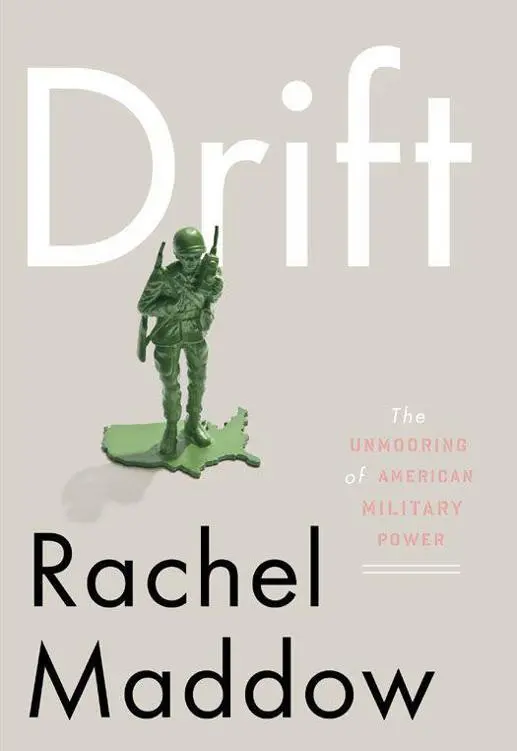
- Название:Drift
- Автор:
- Издательство:Crown Publishers
- Жанр:
- Год:2012
- Город:New York
- ISBN:978-0-307-46100-1
- Рейтинг книги:4 / 5. Голосов: 1
-
Избранное:Добавить в избранное
- Отзывы:
-
Ваша оценка:
Drift: краткое содержание, описание и аннотация
Предлагаем к чтению аннотацию, описание, краткое содержание или предисловие (зависит от того, что написал сам автор книги «Drift»). Если вы не нашли необходимую информацию о книге — напишите в комментариях, мы постараемся отыскать её.
Written with bracing wit and intelligence, Rachel Maddow’s
argues that we’ve drifted away from America’s original ideals and become a nation weirdly at peace with perpetual war, with all the financial and human costs that entails. To understand how we’ve arrived at such a dangerous place, Maddow takes us from the Vietnam War to today’s war in Afghanistan, along the way exploring the disturbing rise of executive authority, the gradual outsourcing of our war-making capabilities to private companies, the plummeting percentage of American families whose children fight our constant wars for us, and even the changing fortunes of G.I. Joe. She offers up a fresh, unsparing appraisal of Reagan’s radical presidency. Ultimately, she shows us just how much we stand to lose by allowing the priorities of the national security state to overpower our political discourse.
Sensible yet provocative, dead serious yet seriously funny,
will reinvigorate a “loud and jangly” political debate about how, when, and where to apply America’s strength and power—and who gets to make those decisions.
http://www.youtube.com/watch?v=Y9xoM7TMiTA
Drift — читать онлайн бесплатно полную книгу (весь текст) целиком
Ниже представлен текст книги, разбитый по страницам. Система сохранения места последней прочитанной страницы, позволяет с удобством читать онлайн бесплатно книгу «Drift», без необходимости каждый раз заново искать на чём Вы остановились. Поставьте закладку, и сможете в любой момент перейти на страницу, на которой закончили чтение.
Интервал:
Закладка:
More than thirty years earlier, Holmes had fought in the Civil War, in what remain, to this day, America’s most terrifying and costly battles. He was shot through the neck and left to die at Antietam, where nearly twenty thousand of his countrymen were killed or wounded in a single afternoon. Nearly two years later, he was still up and in the fight. In the Wilderness campaign, he saw a man instantaneously decapitated by flying shrapnel and noted in his diary the carnage at the Bloody Angle: “the dead of both sides lay piled in the trenches 5 or 6 deep—wounded often writhing under the superincumbent dead.” And only then, aged twenty-three years and two months, did Holmes finally choke on the blood. He walked away from that war before the outcome was decided, with little concern for which side won or lost. “I have felt for sometime,” he wrote to his parents in May 1864, “that I didn’t any longer believe in this being a duty.”
But as he delivered “A Soldier’s Faith” thirty years later, Oliver Wendell Holmes had been enveloped by the practiced amnesia of a willful romantic. “It is not well for soldiers to think much about wounds,” he said that day. “Sooner or later we fall, but meantime it is for us to fix our eyes upon the point to be stormed, and to get there if we can.” After walking away from his own war when he lost his sense of its purpose, decades later, Holmes made that purpose war itself; war, regardless of its cause, as its own reward, its own sublime virtue, an inevitable consequence simply of life as man, and man’s need for a reason to need one another. He continued:
As long as man dwells upon the globe, his destiny is battle. I do not know what is true. I do not know the meaning of the universe. But in the midst of doubt, in the collapse of creeds, there is one thing I do not doubt, that no man who lives in the same world with most of us can doubt, and that is that the faith is true and adorable which leads a soldier to throw away his life in obedience to a blindly accepted duty, in a cause which he little understands, in a plan of campaign of which he has no notion, under tactics of which he does not see the use….
Perhaps it is not vain for us to tell the new generation what we learned in our day, and what we still believe. That the joy of life is living, is to put out all one’s powers as far as they will go; that the measure of power is obstacles overcome; to ride boldly at what is in front of you, be it fence or enemy; to pray, not for comfort, but for combat; to keep the soldier’s faith against the doubts of civil life, more besetting and harder to overcome than all the misgivings of the battlefield, and to remember that duty is not to be proved in the evil day, but then to be obeyed unquestioning; to love glory more than the temptations of wallowing ease….
We have shared the incommunicable experience of war; we have felt, we still feel, the passion of life to its top.
If the eighty years that followed Holmes’s ode to soldiering is any guide, Americans share his suspicion of peace and his conviction that battle can be a source of existential meaning and personal uplift. This country developed a serious war jones. Even a bookish and bespectacled Princeton professor named Woodrow Wilson cheered “the young men who prefer dying in the ditches of the Philippines to spending their lives behind the counters of a dry-goods store in our eastern cities. I think I should prefer that myself.” We’d got in the habit of being at war, and not against some economic crisis, but real war—big, small, hot, cold, air, sea, or ground—and against real enemies. Sometimes they’d attacked us, and sometimes we’d gone out of our way to find them. It had got to the point that being “at peace everywhere in the world, with unmatched economic power and military might” was a condition to be downplayed, a losing political message, as if being at peace, in our “snug, over-safe corner of the world,” made us edgy, as if we no longer knew, absent an armed conflict, how to be our best selves.
CHAPTER 3
Let ’Er Fly
JOHN TRAVOLTA’S APPEARANCE IN AN ARMY PUBLIC SERVICE announcement—with production values on a par with early public-access cable television—is an oddly reassuring artifact from the ’70s, and a useful marker to show just how deeply Ronald Reagan changed the way Americans think about their military. Here was the not-yet-famous teenage Travolta, a fresh-faced if slightly confused-looking new recruit not long removed from the hallways of his New Jersey high school, pillow-lipped, goofily coiffed, weaponless, with his future star wattage tucked neatly into Army-issue olive drabs, receiving a ceremonial lei and a kiss on the cheek from a lovely and inviting Asian American woman. He was all smiles at the bargain the Army was offering him: free housing, thirty days of paid vacation (could be Hawaii!), a starting salary of $288 a month (“ every month”), and, with so much paid for, enough cash left over to finance a new car.
The military marketers had started retooling their sales pitch when the unspooling Vietnam disaster had convinced politicians the time had come to end the draft. The Army brass had to get people to volunteer for military service, and they found themselves thrown into the business of devising new ways to improve its sagging public image and to showcase its most alluring features to potential recruits—give it “some romantic appeal,” as old Hap Arnold used to say. The good news was that recruiters no longer had to trundle their reels of film around to high schools and colleges; they could get to the boys right in their own living rooms while they watched popular TV shows like Laugh-In, Bonanza, Mannix , and—“Here come da Judge! Here come da Judge!”— The Flip Wilson Show .
“To achieve the goal of voluntary accessions, it will be necessary to greatly increase the reach and frequency of our advertising delivery, particularly against the prime target audience of young men,” the Army’s director of advertising and information confessed. “We must follow the lead of the razor blades, shaving creams, and automobiles, and buy the time necessary to deliver the audiences we need to reach.” Recruiting specialists found $10 million in the Army’s annual budget to begin selling itself in this mod new way, and handed the account to the venerable old agency N. W. Ayer & Son, who convinced the generals that they knew just how to talk to civilians. The officers in charge, however, were less than pleased when the admen pitched them the slogan “Today’s Army Wants to Join You.”
“Do you have to say it that way?” said the Army chief of staff. The retired general in charge of the Defense Manpower Commission was more blunt: “God, I just wanted to vomit.” But they grudgingly signed off, surprising even some of the ad executives at Ayer.
The “Today’s Army Wants to Join You” campaign flipped on its head the old ethos. The message was no longer about what you could do for Uncle Sam. Honor, Duty, Country? The fire from your guns is the fire of freedom? Whatever. Gunnery wasn’t a big part of the pitch. The Army was now selling all the wonderful ways Uncle Sam and the military could improve your life. And he wouldn’t even make you cut your hair that short. “We care more about how you think than how you cut your hair,” the Army reassured potential recruits. The initial test run of paid television advertising turned out to be a success—recruitment in the period jumped by four thousand over the previous year—but the ads also induced nausea in the chairman of the House Armed Services Committee. He cut off funding for the advertising campaign, and the Army fell back to its mainstays: public service announcements and print ads.
Читать дальшеИнтервал:
Закладка:
Похожие книги на «Drift»
Представляем Вашему вниманию похожие книги на «Drift» списком для выбора. Мы отобрали схожую по названию и смыслу литературу в надежде предоставить читателям больше вариантов отыскать новые, интересные, ещё непрочитанные произведения.










Обсуждение, отзывы о книге «Drift» и просто собственные мнения читателей. Оставьте ваши комментарии, напишите, что Вы думаете о произведении, его смысле или главных героях. Укажите что конкретно понравилось, а что нет, и почему Вы так считаете.