Rachel Maddow - Drift
Здесь есть возможность читать онлайн «Rachel Maddow - Drift» весь текст электронной книги совершенно бесплатно (целиком полную версию без сокращений). В некоторых случаях можно слушать аудио, скачать через торрент в формате fb2 и присутствует краткое содержание. Город: New York, Год выпуска: 2012, ISBN: 2012, Издательство: Crown Publishers, Жанр: Публицистика, на английском языке. Описание произведения, (предисловие) а так же отзывы посетителей доступны на портале библиотеки ЛибКат.
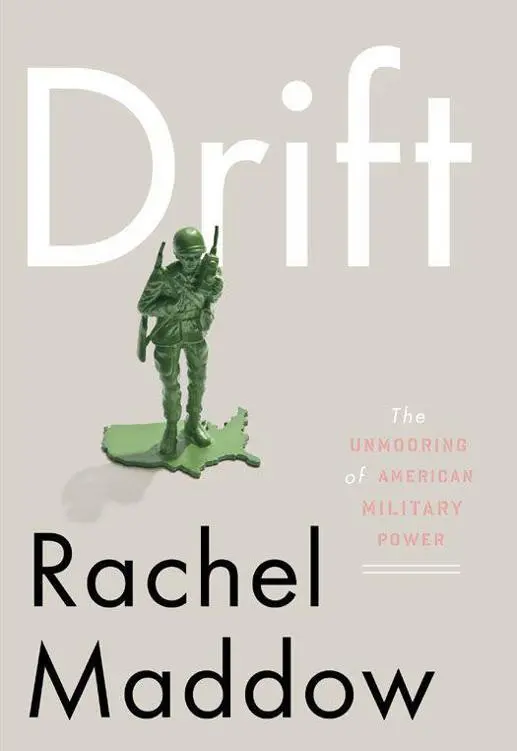
- Название:Drift
- Автор:
- Издательство:Crown Publishers
- Жанр:
- Год:2012
- Город:New York
- ISBN:978-0-307-46100-1
- Рейтинг книги:4 / 5. Голосов: 1
-
Избранное:Добавить в избранное
- Отзывы:
-
Ваша оценка:
Drift: краткое содержание, описание и аннотация
Предлагаем к чтению аннотацию, описание, краткое содержание или предисловие (зависит от того, что написал сам автор книги «Drift»). Если вы не нашли необходимую информацию о книге — напишите в комментариях, мы постараемся отыскать её.
Written with bracing wit and intelligence, Rachel Maddow’s
argues that we’ve drifted away from America’s original ideals and become a nation weirdly at peace with perpetual war, with all the financial and human costs that entails. To understand how we’ve arrived at such a dangerous place, Maddow takes us from the Vietnam War to today’s war in Afghanistan, along the way exploring the disturbing rise of executive authority, the gradual outsourcing of our war-making capabilities to private companies, the plummeting percentage of American families whose children fight our constant wars for us, and even the changing fortunes of G.I. Joe. She offers up a fresh, unsparing appraisal of Reagan’s radical presidency. Ultimately, she shows us just how much we stand to lose by allowing the priorities of the national security state to overpower our political discourse.
Sensible yet provocative, dead serious yet seriously funny,
will reinvigorate a “loud and jangly” political debate about how, when, and where to apply America’s strength and power—and who gets to make those decisions.
http://www.youtube.com/watch?v=Y9xoM7TMiTA
Drift — читать онлайн бесплатно полную книгу (весь текст) целиком
Ниже представлен текст книги, разбитый по страницам. Система сохранения места последней прочитанной страницы, позволяет с удобством читать онлайн бесплатно книгу «Drift», без необходимости каждый раз заново искать на чём Вы остановились. Поставьте закладку, и сможете в любой момент перейти на страницу, на которой закончили чтение.
Интервал:
Закладка:
The Committee on the Present Danger might have finished its career as a forgotten lot of kooks if it weren’t for Ronald Reagan. The first thing he did for them was to prove that you could get real political traction with their kind of scare tactics. “The evidence mounts that we are Number Two in a world where it’s dangerous, if not fatal, to be second best,” Reagan had said on the campaign trail, on his way to nearly upsetting sitting president Gerald Ford in the primaries. When Reagan began roughing up Ford in that election season, Ford’s new CIA head decided he could provide the president some political cover from the tough-talking right by acquiescing to the Present Danger luncheoneers’ demand to participate in the government’s official top secret estimate of Soviet military and political strength. “Let ’er fly!” Director George H. W. Bush wrote, inviting this group of “outside experts” (they would be called Team B) to look over the shoulder of his agency analysts and come up with a parallel assessment of the Soviet threat.
From the start, Team B was much more interested in the political and public relations benefits of participating in the National Intelligence Estimate than in the final product itself. When Team B looked at the intelligence data, it was sure to misread it, and not by a matter of slight degree. Team B wildly overhyped the flight range of the Soviets’ Backfire bomber, rendering it a threat to America’s East Coast when in fact it had a proven combat radius that left it about three thousand miles short. Their estimate of future production numbers of the bomber was off by more than 100 percent. They asserted, falsely, that the Soviets were working furiously on laser-beam weapons that were nearing deployment. Because the United States had developed acoustic devices for tracking nuclear subs, Team B assumed the Soviets had them too. When it was unable to find a whit of evidence that the Russians had developed these acoustic devices, Team B simply invented for the Soviets “non-acoustic” devices. As Anne Hessing Cahn, a former Defense Department official who wrote a book about the Team B fiasco, noted: “They’re saying, ‘We can’t find any evidence that they’re doing it the way everyone thinks they’re doing it, so they must be doing it a different way. We don’t know what that different way is, but they must be doing it.’ ”
The obfuscations and make-believe continued for fifty-five breathless pages. The Team B report incorrectly asserted that Soviet military spending, especially on new nuclear weapons, was on a steady upward trajectory. Team B was so wrong about the Soviets, so invested in hyperinflating the Soviet threat, that they even claimed that the USSR was exempt from the basic guns-versus-butter tradeoff that everyone learns on day one of macroeconomics class. In Team B’s imaginings, the Soviets were so all-powerful that they didn’t have to trade off anything. “Soviet strategic forces have yet to reflect any constraining effect of civil economy competition, and are unlikely to do so in the foreseeable future,” wrote Team B, conjuring a world in which the Soviets could build all the tanks and tractors they wanted, without limit. In this, Team B simply brushed aside the settled historical fact that the Politburo could hardly keep its own people fed. “The spectacle,” noted an official CIA analysis in 1964, “of the USSR, after boastful claims and plans a few years ago, coming to the West hat in hand to buy wheat and ask for long-term credits… These phenomena are not passing difficulties, nor are they merely consequences of misfortune. The source is deeper, and the problem will not soon go away.” In fact, at the time Team B imagined for the Soviets an impossible sustained upward arc, Soviet military expenditures were flat or even falling.
Team B further asserted, with no hard evidence, that the Soviet Union had “hardened” its command-and-control structure to permit the Communists to win a nuclear war against the United States, and was training its citizenry in a civil defense system that would ensure the survival of a large enough cohort of its population to maintain a viable nation after that war. Team B was apparently unaware of the joke among Muscovites about Soviet civil defense:
“What do you do in the event of a nuclear attack?”
“Wrap yourself in a white sheet and crawl slowly to the cemetery.”
“Why slowly?”
“To avoid causing a panic.”
In Team B’s defense, not that many ordinary Russians made it to the Metropolitan Club for lunch in those days.
The umbrella assertion made by Team B—and the most inflammatory—was that the previous National Intelligence Estimates “substantially misperceived the motivations behind Soviet strategic programs, and thereby tended consistently to underestimate their intensity, scope, and implicit threat.” Soviet military leaders weren’t simply trying to defend their territory and their people; they were readying a First Strike option, and the US intelligence community had missed it. What led to this “grave and dangerous flaw” in threat assessment, according to Team B, was an overreliance on hard technical facts, and a lamentable tendency to downplay “the large body of soft data.” This “soft” data, the ideological leader of Team B, Richard Pipes, would later say, included “his deep knowledge of the Russian soul.”
Historian Pipes had not lived for any extended time in Eastern Europe since his family fled Poland at the beginning of World War II when he was still a teenager, and his area of expertise in Russian history stopped somewhere around 1923. America’s self-proclaimed Kremlinologist never claimed any real sources of information inside the Kremlin. But that didn’t mean he was shy about explaining “the grand strategy” of the Soviet leaders circa 1976; neither was he shy about parsing their psyches without a license. The Soviet Union, according to Pipes, was more than ever hell-bent on world domination. The old aristocracy sympathetic to the West had been killed off long ago; the people in charge were descended from a mindless and bitter peasantry, and they were wielding a lot more than pitchforks these days.
The Team B report may have been an exhilarating exercise for its members, allowing them the endorphin-producing experience of beating on the crania of the CIA’s analysts, but the nation that Team B meant to wholly reorient to the… uh… “present danger” remained unaware of Team B’s warnings. Their entire output was for the eyes of the president and his intelligence hands only. Pipes’s efforts to get Team B’s addendum to the NIE report declassified and into the widest possible circulation were rebuffed.
But that could be fixed: somebody from Team B started leaking its findings to the press, and then the Committee on the Present Danger published their own white-linen manifesto: “The principal threat to our nation, to world peace and to the cause of human freedom is the Soviet drive for dominance based upon an unparalleled military build-up.”
They also published articles under unforgettable headlines such as “Why the Soviet Union Thinks It Could Fight & Win a Nuclear War” by Richard Pipes, who now had the imprimatur of his recent participation in the National Intelligence Estimate, and who therefore had, as far as his readers believed, the inside dope. The Committee on the Present Danger had gotten their message out there: The Soviet Union was actively trying to off us. Now . While the naïve among us thought we were at peace!
Ronald Reagan was a big fan of the Present Danger crowd; they would later claim he was a member. And it is certainly true that he hired on many Present Danger men to serve in his administration, and not as bureaucratic pikers but as national security adviser (Richard Allen), as director of Eastern European and Soviet Affairs (Richard Pipes), as chief negotiator on the Intermediate Range Nuclear Forces Treaty and later special adviser on arms control (Paul Nitze), and as director of Central Intelligence (William Casey). Casey, in particular, represented an incredible shift to the… well, incredible. Willard C. Matthias, one of the CIA’s best-known and best-respected analysts going back to the 1950s, a man who tried to warn the Johnson administration in 1964 that a war in Vietnam was not winnable, summed it up like this: “With Casey’s arrival at the CIA, the campaign to shift control of national estimates to the hard-line anti-Communist faction of the intelligence community was over. The rational approach, with its commitment to keeping Soviet behavior under continuing review, was replaced by one that simply identified the USSR as an implacable and changeless enemy determined to enslave the world. The only question was when and how the Soviets would attempt to do so. The issue was ‘slavery’ versus ‘freedom.’”
Читать дальшеИнтервал:
Закладка:
Похожие книги на «Drift»
Представляем Вашему вниманию похожие книги на «Drift» списком для выбора. Мы отобрали схожую по названию и смыслу литературу в надежде предоставить читателям больше вариантов отыскать новые, интересные, ещё непрочитанные произведения.










Обсуждение, отзывы о книге «Drift» и просто собственные мнения читателей. Оставьте ваши комментарии, напишите, что Вы думаете о произведении, его смысле или главных героях. Укажите что конкретно понравилось, а что нет, и почему Вы так считаете.