Rachel Maddow - Drift
Здесь есть возможность читать онлайн «Rachel Maddow - Drift» весь текст электронной книги совершенно бесплатно (целиком полную версию без сокращений). В некоторых случаях можно слушать аудио, скачать через торрент в формате fb2 и присутствует краткое содержание. Город: New York, Год выпуска: 2012, ISBN: 2012, Издательство: Crown Publishers, Жанр: Публицистика, на английском языке. Описание произведения, (предисловие) а так же отзывы посетителей доступны на портале библиотеки ЛибКат.
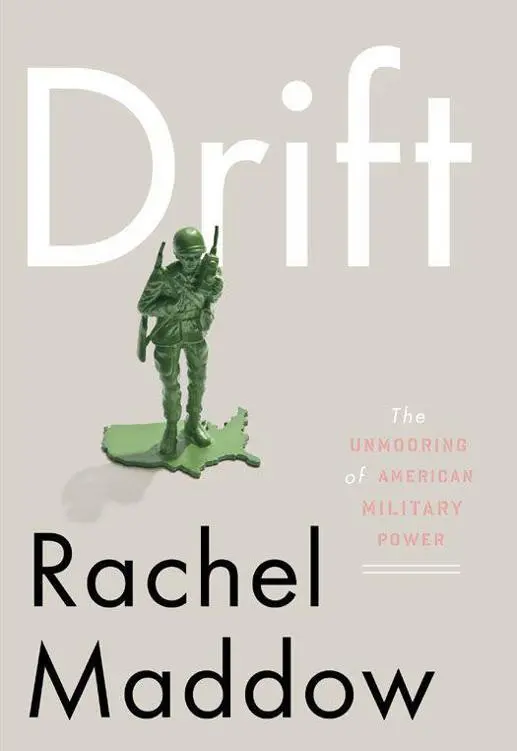
- Название:Drift
- Автор:
- Издательство:Crown Publishers
- Жанр:
- Год:2012
- Город:New York
- ISBN:978-0-307-46100-1
- Рейтинг книги:4 / 5. Голосов: 1
-
Избранное:Добавить в избранное
- Отзывы:
-
Ваша оценка:
Drift: краткое содержание, описание и аннотация
Предлагаем к чтению аннотацию, описание, краткое содержание или предисловие (зависит от того, что написал сам автор книги «Drift»). Если вы не нашли необходимую информацию о книге — напишите в комментариях, мы постараемся отыскать её.
Written with bracing wit and intelligence, Rachel Maddow’s
argues that we’ve drifted away from America’s original ideals and become a nation weirdly at peace with perpetual war, with all the financial and human costs that entails. To understand how we’ve arrived at such a dangerous place, Maddow takes us from the Vietnam War to today’s war in Afghanistan, along the way exploring the disturbing rise of executive authority, the gradual outsourcing of our war-making capabilities to private companies, the plummeting percentage of American families whose children fight our constant wars for us, and even the changing fortunes of G.I. Joe. She offers up a fresh, unsparing appraisal of Reagan’s radical presidency. Ultimately, she shows us just how much we stand to lose by allowing the priorities of the national security state to overpower our political discourse.
Sensible yet provocative, dead serious yet seriously funny,
will reinvigorate a “loud and jangly” political debate about how, when, and where to apply America’s strength and power—and who gets to make those decisions.
http://www.youtube.com/watch?v=Y9xoM7TMiTA
Drift — читать онлайн бесплатно полную книгу (весь текст) целиком
Ниже представлен текст книги, разбитый по страницам. Система сохранения места последней прочитанной страницы, позволяет с удобством читать онлайн бесплатно книгу «Drift», без необходимости каждый раз заново искать на чём Вы остановились. Поставьте закладку, и сможете в любой момент перейти на страницу, на которой закончили чтение.
Интервал:
Закладка:
Reagan could be amused by the goings-on at Fort Roach—“a completely unofficial title, and one, I think, that was not intended to be complimentary,” he wrote in his autobiography. He always got a chuckle out of seeing some visiting regular Army colonel saluting an actor-private who was costumed as a general. But the mission of Fum-Poo was no joke to Reagan. Even the simplest training films required mastery of both the craft of filmmaking and the technical know-how of flying and maintaining America’s expensive new weapons—an array of advanced high-altitude bombers and aerobatic fighter planes with the latest electronic control systems.
But the real Hollywood magic was reserved, in the dark days after Pearl Harbor, for the Big Sell. At the beginning of the war, Army Air Corps chief Hap Arnold figured he needed fifty thousand pilots and maybe triple that number of crewmen. The general needed a recruiting tool, and wanted movies with heart-thumping scenes of the “full inspirational splendor of roaring engines,” he said, “of tight bomber formations gliding through the clouds,” to be distributed in target-rich environments like high schools and colleges. Pilots signed up by the droves. Reagan’s future vice president enlisted right out of high school, against his own father’s advice. But when the Air Corps fell short of the enlistment quota for its most notoriously dangerous assignment, rear gunner, Arnold turned to Jack Warner and Fum-Poo to help him invest that job with “some romantic appeal.”
The result was a twenty-six-minute short film, Rear Gunner , starring Burgess Meredith as milquetoast Kansas farm boy Pee Wee Williams and Ronald Reagan as an eagle-eye lieutenant who thought Private Pee Wee might have bigger things in store for him than aircraft maintenance. “Pee Wee,” Reagan asks, “how’d you like to go to gunnery school?” In short order, Pee Wee would be molded into an ice-veined, steel-eyed warrior—“one of aviation’s mightiest little men… a Galahad of gunnery”—and then shipped off to the Pacific to serve on the flight crew headed by that same eagle-eyed lieutenant. By the time the film ended, Pee Wee had won the Distinguished Service Medal, and potential recruits had been reminded that “the fire from your guns is the fire of freedom.”
Rear Gunner worked on a variety of levels. American audiences knew nothing of Reagan’s trepidation about actual flying, but they’d seen his previous turns as a hero pilot in movies such as Secret Service of the Air, International Squadron , and Desperate Journey . And publicity for Rear Gunner noted that both Meredith and Reagan were active-duty lieutenants: “Perhaps they were more than acting their parts in the film—perhaps they were living them.”
Reagan really never did more than act the part of a combat soldier. He spent his entire war at that Culver City back lot, with Hollywood’s once and future stars, directors, and producers, helping the 1,200-man-strong motion-picture unit churn out more than four hundred training, recruiting, or booster films. He never busted out to fly combat missions like Clark Gable or Jimmy Stewart; he never got a chance to fight the Japs like his actor friend Eddie Albert did. But Reagan took pride in the fact that he’d done what was asked of him, and he’d taken to heart one of Fum-Poo’s central missions: to keep reminding the folks at home (the ones who could buy the war bonds, for instance) that the United States and its military power was all that stood between our freedoms and the maniacal world-enslaving designs of Adolf Hitler and his Japanese allies. Nearly forty years later, he’d hauled himself into the White House by reminding the folks at home that US military might was all that stood between our freedoms and the maniacal world-enslaving designs of the Soviets and their energetic and ruthless agent in the Western Hemisphere, Fidel Castro.
By the time Reagan became president he’d long since come to understand that good enemies (even welfare queens and tinhorn dictators) make good politics. The two previous Oval Office inhabitants had made plenty of hay with war metaphors, but they never really set up suitably threatening or concrete antagonists. Gerald Ford had declared war on the high cost of living (“Whip Inflation Now!”)… and lost the presidency. His successor, Jimmy Carter, had declared war on our national dependence on foreign oil. Carter’s renowned 1979 “malaise speech”—the one in which he never uttered the word “malaise”—is little remembered as what it actually was: a call to arms for fixing our nation’s dire energy future. “Beginning this moment, this nation will never use more foreign oil than we did in 1977—never,” President Carter said in his nationally televised address to the nation. “The generation-long growth in our dependence on foreign oil will be stopped dead in its tracks right now and then reversed as we move through the 1980s, for I am tonight setting the further goal of cutting our dependence on foreign oil by one-half by the end of the next decade.” Carter was going to use all the weapons at his disposal: import quotas, public investment in coal, solar power and alternative fuel, and—drum-roll, please—“a bold conservation program” where “every act of energy conservation… is more than just common sense; I tell you it is an act of patriotism.” He tried to make it all sound as martial as possible: “Just as a similar synthetic rubber corporation helped us win World War II, so will we mobilize American determination and ability to win the energy war…. We must deal with the energy problem on a war footing… the moral equivalent of war… a fundamental threat to American democracy… the threat… the crisis… threatening to destroy the social and the political fabric of America… a clear and present danger to our nation.” Name-checking the world wars repeatedly, Carter declared that “energy… can also be the standard around which we rally!”
But somehow Carter’s “battlefield of energy” never really filled up with eager American combatants. It just never felt like anybody was going to be draped in glory for taking public transportation, or carpooling, or turning down the thermostat and wearing a cardigan.
Lost in President Carter’s ten-car pileup of war metaphors was a line that probably should have been his headline that night: that America was “a nation that is at peace tonight everywhere in the world.” But Jimmy Carter did not try to sell that; instead, he declared a “war” on the energy crisis… and lost the presidency.
The founders were onto something with their cautions about that whole military vainglory thing. There really is nothing that approaches war’s political potency. Carter proved this point in failure—shouting into the void that something other than a war, if maybe you called it a war, “can rekindle our sense of unity, our confidence in the future, and give our nation and all of us individually a new sense of purpose.” No, it can’t. Or at least, no, it hasn’t.
In 1895, at a time when America had enjoyed peace for more than a generation, a fifty-five-year-old Massachusetts judge named Oliver Wendell Holmes Jr. delivered a Memorial Day speech called “A Soldier’s Faith” that, as well as anything before or since, described Americans’ attraction to war. It’s not just the mistake of kings—even in a government that is by, for, and of the people, the people’s own understandable, emotional inclination to war can make it hard for a country to remain peaceable.
“War, when you are at it, is horrible and dull. It is only when time has passed that you see that its message was divine…. In this snug, over-safe corner of the world we need it that we may realize that our comfortable routine is no eternal necessity of things, but merely a little space of calm in the midst of the tempestuous, untamed streaming of the world, and in order that we may be ready for danger.” Thousands of citizens had assembled to hear Holmes’s Memorial Day oration, but the judge was speaking mainly for the benefit of the stooped and grizzled old soldiers in the crowd that day.
Читать дальшеИнтервал:
Закладка:
Похожие книги на «Drift»
Представляем Вашему вниманию похожие книги на «Drift» списком для выбора. Мы отобрали схожую по названию и смыслу литературу в надежде предоставить читателям больше вариантов отыскать новые, интересные, ещё непрочитанные произведения.





Обсуждение, отзывы о книге «Drift» и просто собственные мнения читателей. Оставьте ваши комментарии, напишите, что Вы думаете о произведении, его смысле или главных героях. Укажите что конкретно понравилось, а что нет, и почему Вы так считаете.