Rachel Maddow - Drift
Здесь есть возможность читать онлайн «Rachel Maddow - Drift» весь текст электронной книги совершенно бесплатно (целиком полную версию без сокращений). В некоторых случаях можно слушать аудио, скачать через торрент в формате fb2 и присутствует краткое содержание. Город: New York, Год выпуска: 2012, ISBN: 2012, Издательство: Crown Publishers, Жанр: Публицистика, на английском языке. Описание произведения, (предисловие) а так же отзывы посетителей доступны на портале библиотеки ЛибКат.
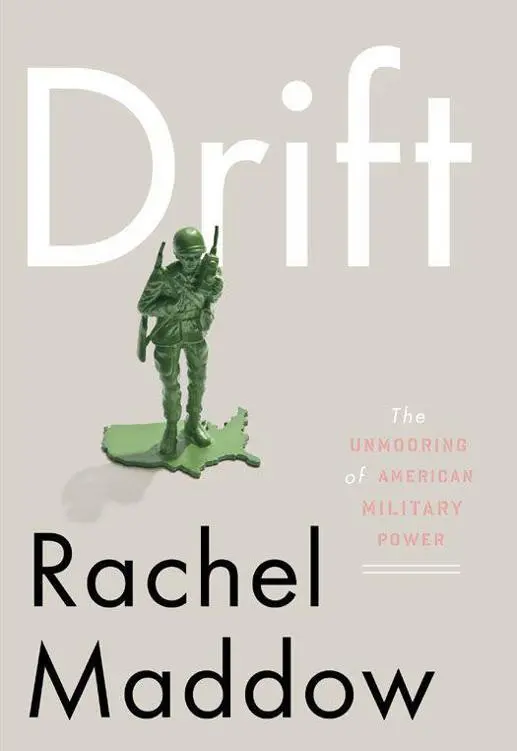
- Название:Drift
- Автор:
- Издательство:Crown Publishers
- Жанр:
- Год:2012
- Город:New York
- ISBN:978-0-307-46100-1
- Рейтинг книги:4 / 5. Голосов: 1
-
Избранное:Добавить в избранное
- Отзывы:
-
Ваша оценка:
Drift: краткое содержание, описание и аннотация
Предлагаем к чтению аннотацию, описание, краткое содержание или предисловие (зависит от того, что написал сам автор книги «Drift»). Если вы не нашли необходимую информацию о книге — напишите в комментариях, мы постараемся отыскать её.
Written with bracing wit and intelligence, Rachel Maddow’s
argues that we’ve drifted away from America’s original ideals and become a nation weirdly at peace with perpetual war, with all the financial and human costs that entails. To understand how we’ve arrived at such a dangerous place, Maddow takes us from the Vietnam War to today’s war in Afghanistan, along the way exploring the disturbing rise of executive authority, the gradual outsourcing of our war-making capabilities to private companies, the plummeting percentage of American families whose children fight our constant wars for us, and even the changing fortunes of G.I. Joe. She offers up a fresh, unsparing appraisal of Reagan’s radical presidency. Ultimately, she shows us just how much we stand to lose by allowing the priorities of the national security state to overpower our political discourse.
Sensible yet provocative, dead serious yet seriously funny,
will reinvigorate a “loud and jangly” political debate about how, when, and where to apply America’s strength and power—and who gets to make those decisions.
http://www.youtube.com/watch?v=Y9xoM7TMiTA
Drift — читать онлайн бесплатно полную книгу (весь текст) целиком
Ниже представлен текст книги, разбитый по страницам. Система сохранения места последней прочитанной страницы, позволяет с удобством читать онлайн бесплатно книгу «Drift», без необходимости каждый раз заново искать на чём Вы остановились. Поставьте закладку, и сможете в любой момент перейти на страницу, на которой закончили чтение.
Интервал:
Закладка:
Still, those print ads were stylish four-color magazine deals, featuring shirtless young men playing touch football on the beach, promising the opportunity to enlist with your buddies and go through basic training together… guaranteed in writing. “The Army wants to accommodate you. And the guys.” There were ads featuring the exotic emoluments of an extended European vacation: here you are in a green velvet jacket, high collar, long sideburns, sitting intime in a fashionable Parisian café with a beautiful blonde (could she be Swedish?), sporting a comely crocheted beret. This could be available to you from your posting with “one of seven crack outfits stationed in Germany… within easy reach of any free weekend, Italy and the Riviera are just a few hours away…. If you want to live and work where tourists only visit, drop us the coupon.”
For teenagers less enticed by continental savoir faire, like the guys who might have gone in for the old G.I. Joe Adventure Team, there were the ads in Field & Stream (“You get 12 matches, a knife, some twine, and 3 days to enjoy yourself”) that made military service appear to be a minimally weaponized Boy Scout troop where you could design your own special training mission. “And if your unit commander likes the idea,” promised the Army, “we’ll even supply the equipment.”
The Army’s new pitch was simple. Good pay, good benefits, a manageable amount of adventure… but don’t worry, we’re not looking to pick fights these days. For a country that had paid so dear a price for its recent military buccaneering, the message was comforting. We still had the largest and most technologically advanced standing army in the world, the most nuclear weapons, the best and most powerful conventional weapons systems, the biggest navy. At the same time, to the average recruit the promise wasn’t some imminent and dangerous combat deployment; it was 288 bucks a month ( every month), training, travel, and experience. Selling the post-Vietnam military as a career choice meant selling the idea of peacetime service. It meant selling the idea of peacetime. Barf.
Ronald Reagan’s election in 1980 changed all that in a hurry. Although it’s laughable enough in retrospect to have been deliberately forgotten by a Reagan-worshipping country only one thin generation later, “Reagan did not forget the impact, especially among conservatives, of his stand on the Panama Canal,” William F. Buckley would write in The Reagan I Knew . Reagan knew provocations to American strength and pride (“Uncle Sam putting his tail between his legs and creeping away rather than face trouble”) could easily mow down commonsense arguments where national security was concerned. Revving the American fighting machine into high idle, he’d discovered by the time he entered the Oval Office, made very good politics. And he was trained to be good at it.
During World War II, the Army Air Corps film unit had not only shown the Gipper the importance of public relations, it had made him a practiced hand at stirring America’s martial moxie. That had been his part to play, and he was proud of it. He’d starred in the Fum-Poo training short Jap Zero (“How soon do I get a chance to knock one of ’em down?”). He’d narrated Target Tokyo , the film story of the bomber crews who flew, as he intoned, “almost halfway around the world, to return a visit that had been paid to Pearl Harbor three years before. Pearl Harbor was on their minds now: the two thousand American men dead. Hickam Field in flames… there were other things on their minds. There was a triumphant feeling of being first, the advance guard of a long procession of superforts that would smash Tokyo.” Here was a spokesman who could utter, without betraying a hint of self-consciousness, lines such as “It’s shooting like this that will knock them on their axis” or “The Japanese—a people we used to think of as small, dainty, polite, concerning themselves only with floral arrangements and rock gardens, and the cultivation of silk worms.”
In his inaugural address in 1981, President Reagan got up and thrummed for all it was worth that old tried-and-not-quite-true Holmesian melody about duty and soldiering. He even made a point to buck tradition and make his speech from the back side of the Capitol Building, facing west, so that, near the end of that talk, he could steer the nation’s gaze toward
the sloping hills of Arlington National Cemetery with its row on row of simple white markers…. They add up to only a tiny fraction of the price that has been paid for our freedoms. Each one of those markers is a monument to the kinds of hero I spoke of earlier. Their lives ended in places called Belleau Wood, the Argonne, Omaha Beach, Salerno… on Guadalcanal, Tarawa, Pork Chop Hill, the Chosin Reservoir, and in a hundred rice paddies and jungles of a place called Vietnam. Under one such marker lies a young man—Martin Treptow—who left his job in a small-town barber shop in 1917 to go to France with the famed Rainbow Division. There, on the Western Front, he was killed trying to carry a message between battalions under heavy artillery fire. We are told that on his body was found a diary. On the flyleaf under the heading “My Pledge,” he had written these words: “America must win this war. Therefore, I will work, I will save, I will sacrifice, I will endure, I will fight cheerfully and do my utmost, as if the issue of the whole struggle depended on me alone.”
Private Treptow, it turns out, is actually buried back home in Bloomer, Wisconsin, and nobody on Reagan’s team was able to verify the contents of this battlefield diary. These problematic actualities had been pointed out to Reagan before he gave the speech. But he waved off the fact-checkers. He wasn’t going to let them get in the way of a useful bit of salesmanship.
Our military leaders heard this new tune and instantly recognized it as something they could dance to. They’d grown weary of falling short of recruitment quotas, and they chafed at the news that the public approval ratings of the military, as measured by Gallup pollsters, were at an all-time low. The general in charge of Army recruiting had already read the riot act to the boys at the N. W. Ayer agency. The era of selling velvet jackets and vacation pay was coming to an end. “I got it straight with them that I was in charge of the advertising,” he later said. “They weren’t in charge of it, I was.”
Beginning in 1981, the Army started spending money on high-production-value, high-testosterone action ads featuring airborne jumps, attack helicopters, tanks with laser-guided firing systems and the latest computers, stirring music with one-off lyrics (“There’s a hungry kind of feeling, and every day it grows”), can-do copy (“In the Army, we do more before nine a.m. than most people do all day”), and, of course, the toe-tapping jingle you couldn’t get out of your head: “Be… all that you can be… ’cause we need you… in the Aaaaaaaar-my.” And just at the moment the Army sales force took this bold and combative new tack, the Reagan administration buried them in money; the Army’s ad budget arced to more than $100 million during Reagan’s years in office.
The new president was ready to put our money where his mouth was; he was anxious to expend enormous pots of the national resources to improve our war-making capabilities. And it was an easy sell at first. He’d run on cutting taxes, gutting welfare programs, and spending big on the military. By the time his first budget came up for a vote, Ronald Reagan was also riding a wave of public popularity, largely on the strength of having survived a near-fatal assassination attempt with remarkable grace, at least according to the information released by the White House public relations officers. His personal approval rating in the country was more than 70 percent. So Congress—its members could read a poll—overwhelmingly passed Reagan’s initial defense appropriation request, which clocked in at a nearly 20 percent increase. In something as huge as the Pentagon budget, a 5 percent increase would have been enough to rattle desks all over Washington; 10 percent was almost unimaginable; getting up toward 20 percent was fantasy talk. That kind of enormous one-year jump was unprecedented—at least it was without our troops actively fighting on a battlefield somewhere. And that play-money request from Reagan came with a promise of more: the administration’s announced strategy was to double the defense budget in five years.
Читать дальшеИнтервал:
Закладка:
Похожие книги на «Drift»
Представляем Вашему вниманию похожие книги на «Drift» списком для выбора. Мы отобрали схожую по названию и смыслу литературу в надежде предоставить читателям больше вариантов отыскать новые, интересные, ещё непрочитанные произведения.










Обсуждение, отзывы о книге «Drift» и просто собственные мнения читателей. Оставьте ваши комментарии, напишите, что Вы думаете о произведении, его смысле или главных героях. Укажите что конкретно понравилось, а что нет, и почему Вы так считаете.