Rachel Maddow - Drift
Здесь есть возможность читать онлайн «Rachel Maddow - Drift» весь текст электронной книги совершенно бесплатно (целиком полную версию без сокращений). В некоторых случаях можно слушать аудио, скачать через торрент в формате fb2 и присутствует краткое содержание. Город: New York, Год выпуска: 2012, ISBN: 2012, Издательство: Crown Publishers, Жанр: Публицистика, на английском языке. Описание произведения, (предисловие) а так же отзывы посетителей доступны на портале библиотеки ЛибКат.
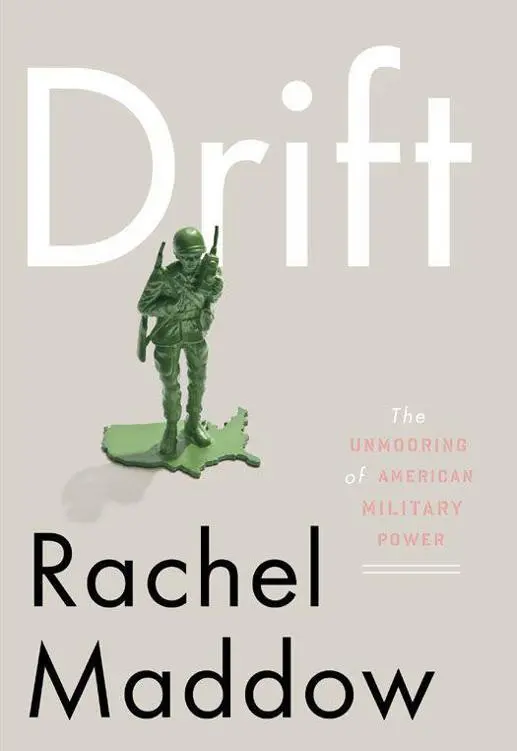
- Название:Drift
- Автор:
- Издательство:Crown Publishers
- Жанр:
- Год:2012
- Город:New York
- ISBN:978-0-307-46100-1
- Рейтинг книги:4 / 5. Голосов: 1
-
Избранное:Добавить в избранное
- Отзывы:
-
Ваша оценка:
Drift: краткое содержание, описание и аннотация
Предлагаем к чтению аннотацию, описание, краткое содержание или предисловие (зависит от того, что написал сам автор книги «Drift»). Если вы не нашли необходимую информацию о книге — напишите в комментариях, мы постараемся отыскать её.
Written with bracing wit and intelligence, Rachel Maddow’s
argues that we’ve drifted away from America’s original ideals and become a nation weirdly at peace with perpetual war, with all the financial and human costs that entails. To understand how we’ve arrived at such a dangerous place, Maddow takes us from the Vietnam War to today’s war in Afghanistan, along the way exploring the disturbing rise of executive authority, the gradual outsourcing of our war-making capabilities to private companies, the plummeting percentage of American families whose children fight our constant wars for us, and even the changing fortunes of G.I. Joe. She offers up a fresh, unsparing appraisal of Reagan’s radical presidency. Ultimately, she shows us just how much we stand to lose by allowing the priorities of the national security state to overpower our political discourse.
Sensible yet provocative, dead serious yet seriously funny,
will reinvigorate a “loud and jangly” political debate about how, when, and where to apply America’s strength and power—and who gets to make those decisions.
http://www.youtube.com/watch?v=Y9xoM7TMiTA
Drift — читать онлайн бесплатно полную книгу (весь текст) целиком
Ниже представлен текст книги, разбитый по страницам. Система сохранения места последней прочитанной страницы, позволяет с удобством читать онлайн бесплатно книгу «Drift», без необходимости каждый раз заново искать на чём Вы остановились. Поставьте закладку, и сможете в любой момент перейти на страницу, на которой закончили чтение.
Интервал:
Закладка:
When the news hit that something was afoot in Grenada (just nine days after the secret presidential directive was issued), Reagan’s national security adviser for Latin American Affairs immediately brought up the possible perils to the Americans living on the island. “In crises there is opportunity,” he said later, “and I believed that this emergency just might present an excellent chance to restore democracy to Grenada while assuring the safety of our citizens.” What better way to do all that—and to prove that America was back—than military action. Military action in Grenada was a first resort for the Reagan team, not a last resort. It’s not like they tried much else. They didn’t even bother to get good information about what was actually happening on the island, or to verify what little they did get. They were under the spell of their old Team B Soviet-military hype. The Russians were running a takeover in Grenada.
And frankly, this was an administration eager to use the military in a way that would let the president say things like “America is back.” He had been using the idea of military strength to political effect for years; now he could use actual military strength. The purported justification sold to the American people about Grenada—the rescue of these American medical students—was so far from the operational point of Urgent Fury that the White House would send the president out to make his victory speech even before all the students were secure.
As the Grenadian government tore itself apart over the next week, Reagan’s administration made plans for the “rescue” of the British queen’s representative in Grenada, Governor-General Paul Scoon, a ceremonial figurehead who governed nothing and didn’t know we were coming. The military rescue team for Scoon would also include a US State Department representative who made sure that the governor-general went up on the island’s radio network and said all the right things about how the Americans had been officially invited in to restore order and good government. There was considerably less diplomatic push to ensure the actual safety of the American students living on the island. Little or no effort was made to contact anybody in student housing or to talk to the faculty and staff of St. George’s University, whose bursar had been receiving personal assurances from Grenadian government officials that the students were safe and would be assured a safe departure if they wished to leave. (The retired chief actuary of the US Social Security system flew out of the small airport on the northeast part of the island the day that SEAL Team Six made its second attempt to infiltrate the island.)
No, the real energy inside the Reagan administration was expended on preparing a full-out combat operation, and preparing to justify it after the fact. Every branch of the military was anxious to get a piece of the action: the SEAL teams, an Army Ranger battalion, a second Army Ranger battalion, the Air Force for transport, the Navy for air and gun support. Everybody had a piece of the little spice island. The Marines didn’t get much, but they did get a little real estate to take up north.
But then, less than thirty hours before the invasion was to commence, events on the other side of the world changed the plans in a big way. On the morning of October 23, 1983, a suicide bomber drove a truck containing six tons of explosives and a variety of highly flammable gases into the US Marine barracks at the airport in Beirut, Lebanon, killing 241 soldiers there on a don’t-shoot peacekeeping mission. Fourteen months into the deployment, and after an earlier suicide bombing at the US embassy in Beirut, Reagan was still unable to make clear to the American people exactly why US Marines were there. Were we keeping the peace in the civil war there, or were we taking sides with the Christians against the Muslims? The Reagan administration was still mixed on that message in the wake of the bombing, but the president was damned sure not going to let anybody question American resolve. Reagan dispatched Vice President Bush to Beirut to make sure the world knew we were going to be staying the course in Lebanon, that we weren’t going to be frightened off by terrorists.
That afternoon the chairman of the Joint Chiefs of Staff suggested that perhaps the Grenada operation was a dangerous exercise, at least where the president’s political standing was involved. Reagan was headed into reelection season, the chairman reminded him, and he didn’t need a double whammy of military complications. It might be less fraught to let the diplomats work out a deal to extricate the American students from Grenada. But Reagan was not about to back down. Not now. This was not the time to show weakness.
Word of a change in plans for Operation Urgent Fury started to filter through the chain of command within eight hours of the Lebanon bombing. “Now that the Marines had been bloodied in Beirut, they wanted an active role,” SEALs commander Robert Gormly wrote later. “Politics took over and the island was divided down the middle, with the Joint Headquarters retaining the southwest part and the Marines given the go-ahead to make an amphibious landing at the smaller airfield in the northeast.” The next day, as Gormly mourned his four dead SEAL colleagues and continued planning for the rescue of the governor-general, he found himself in a meeting with the State Department official who was going to go along on the operation. “[He] offered me some interesting information: that the Cuban ‘engineers’ on the island wouldn’t be a problem, because their government had informally agreed to keep its people in their barracks during our incursion. In other words, the Cubans knew we were coming.”
Funny thing, that secrecy business. Our putative enemy, Fidel Castro, knew about the invasion well before the Speaker of the United States House of Representatives. In fact, when President Reagan finally had a group of congressional leaders to the White House residence on the night of October 24, 1983, secretly, to explain the plans for Grenada, the Army Rangers were already collecting their ammo and loading into their transport planes. The secretary of state briefed the three Democratic leaders and two Republicans on the situation on the ground in Grenada, and the chairman of the Joint Chiefs laid out plans for a military operation involving two thousand American soldiers, sailors, and Marines. Only House Republican leader Bob Michel offered unquestioning support. The majority leader in the Senate, Tennessee Republican Howard Baker, wondered if Reagan was making a serious political mistake, and perhaps a military one. House Democratic majority leader Jim Wright thought the situation called for a stronger diplomatic effort, not military force. Senate Minority Leader Robert Byrd said point-blank he was against the invasion, and he’d say so in public.
Tip O’Neill, the venerable old big-city liberal and the Democratic Speaker of the House, was torn. He was sympathetic to Reagan’s worry that American hostages would be taken in Grenada; the 444-day hostage crisis in Iran just a few years earlier had been a grim national nightmare, and Jimmy Carter’s inability to free them had torpedoed his presidency. But O’Neill, like the other Democrats at the meeting, thought diplomacy was the wiser course to take in Grenada. There were no reports of Americans being menaced on the island, let alone being taken hostage. He saw no compelling reason for the United States military to execute a full-scale regime change; and he knew of no compelling constitutional argument that permitted Reagan to launch the operation simply on presidential say-so. Even if Operation Urgent Fury wrapped up within the sixty-day window that compelled Reagan, under the War Powers Resolution, to consult Congress and secure specific statutory authority for the war, it was hard to make the case that Grenada represented a “national emergency created by an attack upon the United States, its territories or possessions, or its armed forces.” At the very least, the president should have begun the process of seeking approval from Congress before hitting the Go button. “You are informing us,” O’Neill pointedly told the president at the end of the administration’s presentation, “not asking us.”
Читать дальшеИнтервал:
Закладка:
Похожие книги на «Drift»
Представляем Вашему вниманию похожие книги на «Drift» списком для выбора. Мы отобрали схожую по названию и смыслу литературу в надежде предоставить читателям больше вариантов отыскать новые, интересные, ещё непрочитанные произведения.









Обсуждение, отзывы о книге «Drift» и просто собственные мнения читателей. Оставьте ваши комментарии, напишите, что Вы думаете о произведении, его смысле или главных героях. Укажите что конкретно понравилось, а что нет, и почему Вы так считаете.