Rachel Maddow - Drift
Здесь есть возможность читать онлайн «Rachel Maddow - Drift» весь текст электронной книги совершенно бесплатно (целиком полную версию без сокращений). В некоторых случаях можно слушать аудио, скачать через торрент в формате fb2 и присутствует краткое содержание. Город: New York, Год выпуска: 2012, ISBN: 2012, Издательство: Crown Publishers, Жанр: Публицистика, на английском языке. Описание произведения, (предисловие) а так же отзывы посетителей доступны на портале библиотеки ЛибКат.
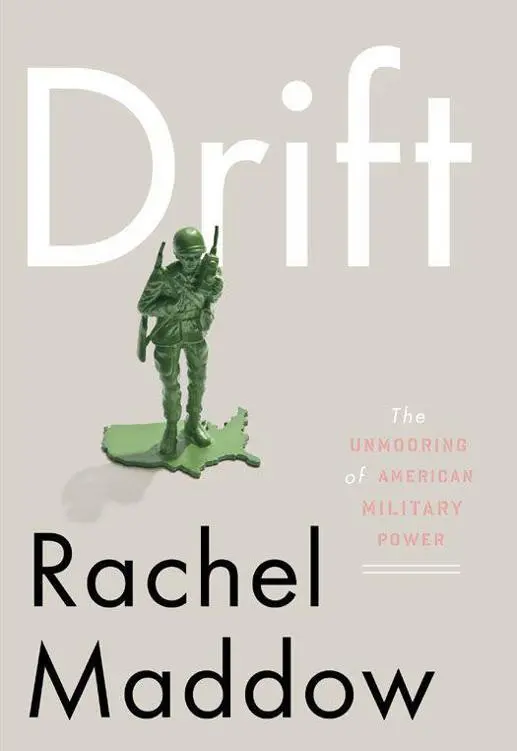
- Название:Drift
- Автор:
- Издательство:Crown Publishers
- Жанр:
- Год:2012
- Город:New York
- ISBN:978-0-307-46100-1
- Рейтинг книги:4 / 5. Голосов: 1
-
Избранное:Добавить в избранное
- Отзывы:
-
Ваша оценка:
Drift: краткое содержание, описание и аннотация
Предлагаем к чтению аннотацию, описание, краткое содержание или предисловие (зависит от того, что написал сам автор книги «Drift»). Если вы не нашли необходимую информацию о книге — напишите в комментариях, мы постараемся отыскать её.
Written with bracing wit and intelligence, Rachel Maddow’s
argues that we’ve drifted away from America’s original ideals and become a nation weirdly at peace with perpetual war, with all the financial and human costs that entails. To understand how we’ve arrived at such a dangerous place, Maddow takes us from the Vietnam War to today’s war in Afghanistan, along the way exploring the disturbing rise of executive authority, the gradual outsourcing of our war-making capabilities to private companies, the plummeting percentage of American families whose children fight our constant wars for us, and even the changing fortunes of G.I. Joe. She offers up a fresh, unsparing appraisal of Reagan’s radical presidency. Ultimately, she shows us just how much we stand to lose by allowing the priorities of the national security state to overpower our political discourse.
Sensible yet provocative, dead serious yet seriously funny,
will reinvigorate a “loud and jangly” political debate about how, when, and where to apply America’s strength and power—and who gets to make those decisions.
http://www.youtube.com/watch?v=Y9xoM7TMiTA
Drift — читать онлайн бесплатно полную книгу (весь текст) целиком
Ниже представлен текст книги, разбитый по страницам. Система сохранения места последней прочитанной страницы, позволяет с удобством читать онлайн бесплатно книгу «Drift», без необходимости каждый раз заново искать на чём Вы остановились. Поставьте закладку, и сможете в любой момент перейти на страницу, на которой закончили чтение.
Интервал:
Закладка:
This new barrier erected by Congress—the Boland Amendment—was no garden-variety, cut-off-some-funding restriction but rather an explicit legislative move to block the president from doing exactly what he wanted to do, to stop him from doing what he was already doing: conducting a secret, CIA-funded, CIA-run war fought by a CIA-created, CIA-led army of local insurgents to overthrow the Nicaraguan government. The Reagan administration had been training those insurgents—called Contras—in Honduras, as well as running attacks on Nicaraguan military patrols, on fuel tanks at Nicaraguan ports, and even on the airport in Managua. When a secret CIA-led operation to mine Nicaraguan harbors became public in the spring of 1984, the chairman of the Senate Intelligence Committee, Barry Goldwater, blew up. Goldwater was as much of an anti-Communist badass as anyone in the Senate, but the fact that what Reagan was doing was anti-Communist didn’t trump that what Reagan was doing seemed to Goldwater anti-American. The Reagan team had been legally obligated to inform Goldwater, the Senate Intelligence chairman, that these covert missions were happening, and they’d been violating that law, among others. “The President has asked us to back his foreign policy. Bill, how can we back his foreign policy when we don’t know what the hell he is doing?” Senator Goldwater wrote to the director of Central Intelligence, William Casey. “Lebanon, yes, we all know that he sent troops over there. But mine the harbors in Nicaragua? This is an act violating international law. It is an act of war. For the life of me, I don’t see how we are going to explain it.”
Senior senators muscled Director Casey into making a pilgrimage to Capitol Hill to apologize to a closed session of the entire Senate Intelligence Committee. The full Senate voted 84–12 to condemn the mining; even staunch anti-Communist Republicans stood up to be counted. The message was clear: no president was vested with this kind of power. That summer, both houses of Congress debated the merits of Reagan’s secret war in Nicaragua, and that fall, the Democratic-controlled House and the Republican-controlled Senate voted to put the brakes on it.
“During fiscal year 1985,” read the Boland Amendment of October 12, 1984, “no funds available to the Central Intelligence Agency, the Department of Defense, or any other agency or entity of the United States involved in intelligence activities may be obligated or expended for the purpose or which would have the effect of supporting, directly or indirectly, military or paramilitary operations in Nicaragua by any action, group, organization, movement or individual.” The amendment was written in purposefully broad language (“any other agency or entity of the United States involved in intelligence activities,” “purpose or… effect of supporting,” “directly or indirectly,” “military or paramilitary”) to make sure the Reagan team could not evade congressional will. “There are no exceptions to the prohibition” was how the amendment’s author explained it.
And yet in a separate provision of the amendment, Congress gave Reagan a way to try to win back the funding for his secret war; they invited the president to make his case for his Nicaraguan operation. To them. Maintaining their constitutional prerogative as the arbiter of war, they asked the administration, in effect, to ask them; to submit to Congress the evidence that Nicaragua was exporting Communist revolution to other Central American countries, to make a formal and specific dollar request of Congress for US support of Contra military or paramilitary operations, to justify the need and the amount, and to explain in full the goal of this effort.
When asked years later about congressional requests for this sort of information, Reagan explained them as a clever political maneuver by Tip O’Neill and his soft-on-Communism liberal chums in Congress: “Well, frankly,” Reagan said, “I just believe it was part of the constant effort of the Congress to discredit those who wanted to support the Contras.”
Actually, it was a wide-open invitation for Reagan to make his case to Congress about why they, too, should support the Contras. But Reagan refused to see it that way. The president’s nearly unprecedented electoral romp in 1984—Reagan had won forty-nine of fifty states and 525 electoral votes to Walter Mondale’s paltry thirteen—hardened his conviction that Congress shouldn’t be sticking its nose into his business (like into Nicaragua, for instance).
His commitment to act in Nicaragua despite Congress was both procedural and substantive. He could not have been more certain that he was on the right side of history. “The Contras,” Reagan liked to say, “wanted to have what we had in our own country, and that was [that] the result of the revolution would be democracy.” In March 1986 he told a group of elected officials at the White House, “So I guess in a way [the Nicaraguan rebels] are counterrevolutionary, and God bless them for being that way. And I guess that makes them Contras, and so it makes me a Contra too.” To a president who saw not only George Washington as a Contra, but saw himself as a Contra too, the Congress and the American people being opposed to helping those freedom fighters was simply a nuisance to be got around, not a real impediment to action.
By the time he embarked on his second term, Ronald Reagan had moved well beyond the built-in resentment and disdain presidents have for members of the Senate or the House or the press. (Which one of them had received fifty million votes ?) Somewhere along the way, Reagan had taken the remarkable posture that even just public debate on issues of war and peace was detrimental to our national security. Reagan had said it plain in the days after he’d grudgingly pulled US military troops from the misbegotten mission he had ordered in Lebanon: “When you’re engaged in this kind of a diplomatic attempt and you have forces there, and there is an effort made to oust them, a debate as public as was conducted here, raging, with the Congress demanding, ‘Oh, bring our men home, take them away.’ All this can do is stimulate the terrorists and urge them on to further attacks because they see a possibility of success in getting the force out, which is keeping them from having their way. It should be understood by everyone in government that once this is committed, you have rendered [our military] ineffective when you conduct that kind of a debate in public.”
In other words, according to Reagan, having a spirited argument about where, when, and why to put United States soldiers in harm’s way (as well as how long to keep them there) and forcing a president to engage in a real argument about the wisdom of his foreign policy initiatives, to make his case in public, was akin to giving aid and comfort to the enemy—to Communists and terrorists.
By the middle of his second term, this radical ethic had become fully operational in the White House. Forget open debate. Forget making your case to Congress or the public. Even a congressional request for information on a matter like Nicaragua was an offense to the presidency. Reagan didn’t need a permission slip from anyone. He wouldn’t even take one if offered. Forget the Boland Amendment. He was the president! He had personally approved all the covert activities in Nicaragua. His administration had not always met the legal requirements of keeping Congress up to speed on this secret war, but that was his call. He didn’t trust the legislature. And frankly, Congress needed a brushback.
Reagan was convinced that a president needed unconstrained authority on national security. He was also convinced that he knew best (after all, he was the only person getting that daily secret intelligence briefing). These twin certainties led him into two unpopular and illegal foreign policy adventures that became a single hyphenated mega-scandal that nearly scuttled his second term and his legacy, and created a crisis from which we still have not recovered. In his scramble to save himself from that scandal, Reagan’s after-the-fact justification for his illegal and secret operations left a nasty residue of official radicalism on the subjects of executive power and how America cooks up its wars.
Читать дальшеИнтервал:
Закладка:
Похожие книги на «Drift»
Представляем Вашему вниманию похожие книги на «Drift» списком для выбора. Мы отобрали схожую по названию и смыслу литературу в надежде предоставить читателям больше вариантов отыскать новые, интересные, ещё непрочитанные произведения.







Обсуждение, отзывы о книге «Drift» и просто собственные мнения читателей. Оставьте ваши комментарии, напишите, что Вы думаете о произведении, его смысле или главных героях. Укажите что конкретно понравилось, а что нет, и почему Вы так считаете.