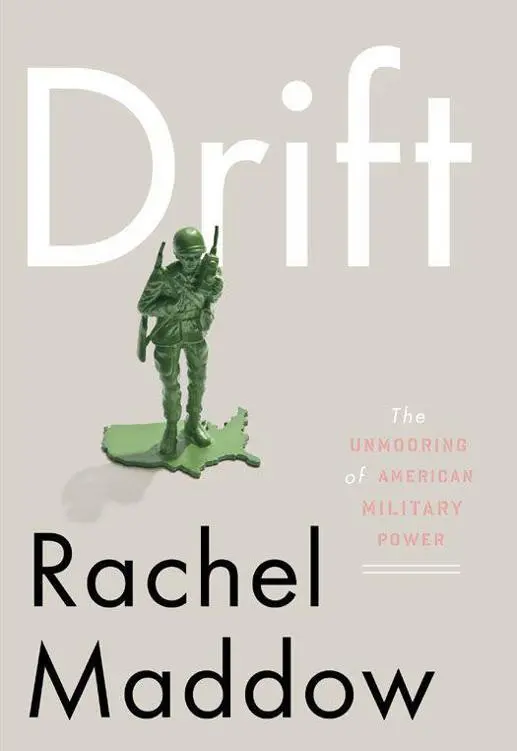
Rachel Maddow - Drift
Здесь есть возможность читать онлайн «Rachel Maddow - Drift» весь текст электронной книги совершенно бесплатно (целиком полную версию без сокращений). В некоторых случаях можно слушать аудио, скачать через торрент в формате fb2 и присутствует краткое содержание. Город: New York, Год выпуска: 2012, ISBN: 2012, Издательство: Crown Publishers, Жанр: Публицистика, на английском языке. Описание произведения, (предисловие) а так же отзывы посетителей доступны на портале библиотеки ЛибКат.
- Название:Drift
- Автор:
- Издательство:Crown Publishers
- Жанр:
- Год:2012
- Город:New York
- ISBN:978-0-307-46100-1
- Рейтинг книги:4 / 5. Голосов: 1
-
Избранное:Добавить в избранное
- Отзывы:
-
Ваша оценка:
Drift: краткое содержание, описание и аннотация
Предлагаем к чтению аннотацию, описание, краткое содержание или предисловие (зависит от того, что написал сам автор книги «Drift»). Если вы не нашли необходимую информацию о книге — напишите в комментариях, мы постараемся отыскать её.
Written with bracing wit and intelligence, Rachel Maddow’s
argues that we’ve drifted away from America’s original ideals and become a nation weirdly at peace with perpetual war, with all the financial and human costs that entails. To understand how we’ve arrived at such a dangerous place, Maddow takes us from the Vietnam War to today’s war in Afghanistan, along the way exploring the disturbing rise of executive authority, the gradual outsourcing of our war-making capabilities to private companies, the plummeting percentage of American families whose children fight our constant wars for us, and even the changing fortunes of G.I. Joe. She offers up a fresh, unsparing appraisal of Reagan’s radical presidency. Ultimately, she shows us just how much we stand to lose by allowing the priorities of the national security state to overpower our political discourse.
Sensible yet provocative, dead serious yet seriously funny,
will reinvigorate a “loud and jangly” political debate about how, when, and where to apply America’s strength and power—and who gets to make those decisions.
http://www.youtube.com/watch?v=Y9xoM7TMiTA
Drift — читать онлайн бесплатно полную книгу (весь текст) целиком
Ниже представлен текст книги, разбитый по страницам. Система сохранения места последней прочитанной страницы, позволяет с удобством читать онлайн бесплатно книгу «Drift», без необходимости каждый раз заново искать на чём Вы остановились. Поставьте закладку, и сможете в любой момент перейти на страницу, на которой закончили чтение.
Интервал:
Закладка:
The day after President Reagan complained in his diary about that old Vietnam syndrome, in March 1985, the militant Islamic group Hezbollah abducted an American journalist in Lebanon, bringing the total number of US hostages there to four. “Was shown the photo recently taken by the bastards who are holding our kidnap victims in Lebanon,” Reagan wrote five days later. “Heartbreaking, there is no question but that they are being badly treated.” Hezbollah grabbed two more Americans living in Beirut over the next few months, so that by the summer of 1985, the group was holding a journalist, a Catholic priest, a Presbyterian minister, and two administrators from the American University in Beirut. Reagan’s national security team was especially concerned about the other known hostage: the CIA station chief in Beirut.
This was Reagan’s worst nightmare—American hostages, and in the Middle East again. Nothing was more politically resonant to him than how the long, drawn-out, 444-day water torture of a hostage situation in Iran had worn away what remained of the Carter presidency, demoralized the American people, and made the country look weak. Those fifty-two hostages had been freed in the hours after Reagan’s inauguration, and the new president welcomed them to his White House a week later. “It’s the most emotional experience of our lives,” said Reagan’s vice president, George H. W. Bush, of the ceremony in the Blue Room. “You could feel it build until the point it hurt inside.” And President Reagan’s wife, Nancy, a woman with a reputation for keeping a cool distance from the hoi polloi, could not maintain her composure: “Oh I can’t stand this,” she exclaimed, and began hugging and kissing the returning victims of Ayatollah Khomeini and his Iranian henchmen.
“Those thenceforth in the representation of this nation will be accorded every means of protection that America can offer,” Mr. Reagan said from the Blue Room that day, for the world to hear. “Let terrorists be aware that when the rules of international behavior are violated, our policy will be one of swift and effective retribution…. Let it also be understood, there are limits to our patience.”
Three years later, the president, in the triumph of bringing home those might-have-been hostages from Grenada, was still speaking it aloud: “The nightmare of our hostages in Iran must never be repeated.” But here was Reagan in 1985, in the hostage soup, and with no real channel of communication to Hezbollah. So when the president’s national security adviser, Bud McFarlane, came to him in July 1985 with a hush-hush plan that might just free the captive Americans, the president grabbed it and held on for dear life.
“Bud, I’ve been thinking about this,” he said in one call, according to McFarlane. “Couldn’t you use some imagination and try to find a way to make it work?”
“Mr. President,” McFarlane had answered, “your secretary of state and secretary of defense were against this.”
“I know, but I look at it differently. I want to find a way to do this.”
The main agent in the hostage-release scheme was a Paris-based exiled Iranian arms dealer, Manucher Ghorbanifar, who claimed to have ties to a buzzing nest of moderates inside Iran’s military. These army officers, according to the tale Ghorbanifar told, wanted to overthrow the madman Khomeini and make a fresh start with the United States. As a show of good faith among new future friends, the United States would open up the spigot for weapons sales to Iran, and the Iranian moderates would convince Hezbollah to release all of the American hostages in Beirut.
By the time Ghorbanifar presented his tantalizing arms-for-hostages plot, he was already well known in US intelligence circles. A lengthy CIA report described him as “personable, convincing… speaks excellent American-style English.” (Not even intelligence guys are immune to the charms of excellent American-style English.) However, the report concluded, Ghorbanifar “had a history of predicting events after they happened and was seen as a rumor-monger…. The information collected by him consistently lacked sourcing and detail notwithstanding his exclusive interest in acquiring money…. Subject should be regarded as an intelligence fabricator and a nuisance. Any further approaches by subject or his brother Ali should be reported but not taken seriously.” In fact, on the occasions the CIA had subjected Ghorbanifar to a polygraph test, he generally proved himself to be a liar on any question more complicated than his name and his place of residence. But still, under cover of secrecy, Reagan decided it would be good policy to get in bed with Ghorbanifar and his French silk jammies.
As the deal unfolded—badly—assessments of Ghorbanifar within Reagan’s White House national security team included “corrupt,” “devious,” “duplicitous,” “not to be trusted,” and “one of the world’s leading sleazebags.” National Security Adviser Bud McFarlane even called him a “borderline moron.” There was pretty good evidence that Ghorbanifar’s main goal was money. And still, Reagan decided it would be good policy to continue to pursue the Ghorbanifar plan.
The way the first arms-for-hostages deal was designed, Israel would sell US-made weapons to Iran, and the US government would replace Israel’s weapons from its own stocks. As a favor to us, Israel was allowing itself to be used as a pass-through for America sending missiles to Iran. It was a shame that the first arms shipment of ninety-six TOW antitank missiles to Iran ended up (and this was truly unfortunate, everybody agreed) in the hands of Khomeini’s loyal Revolutionary Guard. Worse, no hostage was released. It turned out to be arms-for-no-hostages.
Reagan was undeterred, and, as ever, optimistic. “It seems a man high up in the Iranian govt believes he can deliver all or part of the 7 Am kidnap victims in Lebanon sometime in early Sept,” Reagan recorded in his diary a few days after the first failure. “They will be delivered to a point on the beach north of Tripoli & we’ll take them off to our 6th fleet. I had some decisions to make about a few points—but they were easy to make. Now we wait.”
In spite of Reagan’s high hopes, the second weapons delivery of more TOW missiles, also via Israel, shook loose only one hostage, and not the one McFarlane requested. In planning the third shipment, eighteen Hawk antiaircraft missiles, Reagan’s operatives managed to piss off Portugal, endanger Turkey, get the CIA illegally involved, raise protests from the Defense Department, and move Secretary of State George Shultz to think about resigning… and all for nothing. This time, according to Ghorbanifar, there would be no hostages released at all, because the Iranians were upset at having received substandard weapons. In fact, they’d like to return the Hawks.
Nearly six months and millions of dollars of weapons into the arms-for-hostages deal, Reagan had yet to inform Congress about the status or existence of the operation. The president had his reasons. The way Reagan told it to himself, the success of it hinged on secrecy. The president had kept his secretaries of state and defense largely out of the loop; hell, he withheld information from his own personal record of the events of his presidency. “I won’t even write in the diary what we’re up to.” No one could know, most especially Tip O’Neill and the Democrats in the House; Reagan didn’t want them to run crying to the press.
This insistence on secrecy was fueled in part by Reagan’s fear that the hostages or the men inside Iran doing the talking would be killed if details of the negotiations became public. Nobody in the Reagan administration had good enough contacts to know if this fear had any basis in reality. Hard data had never been—and would never be—a controlling factor in the Reagan administration’s decision-making process. But there was also just the embarrassment factor. Given a choice between secrecy and the public finding out about the operation’s Laurel-and-Hardy-worthy failures (up to and including the Iranians sending our weapons back, dissatisfied!), who wouldn’t choose secrecy? Finally, there was the fact that much of what Team Reagan was doing was not simply flying in the face of their own stated policy against dealing with terrorists (“We make no concessions,” Reagan had said. “We make no deals”) or state sponsors of international terrorism (Iran was a gold-plated designee on that list); it was not just shredding the president’s own executive orders and national security directives; it was not simply executing a spectacular and hypocritical affront to good sense and good diplomacy; but, in fact, much of this arms-for-hostages operation was quite flagrantly against the law. Flat-out illegal.
Читать дальшеИнтервал:
Закладка:
Похожие книги на «Drift»
Представляем Вашему вниманию похожие книги на «Drift» списком для выбора. Мы отобрали схожую по названию и смыслу литературу в надежде предоставить читателям больше вариантов отыскать новые, интересные, ещё непрочитанные произведения.












Обсуждение, отзывы о книге «Drift» и просто собственные мнения читателей. Оставьте ваши комментарии, напишите, что Вы думаете о произведении, его смысле или главных героях. Укажите что конкретно понравилось, а что нет, и почему Вы так считаете.