Rachel Maddow - Drift
Здесь есть возможность читать онлайн «Rachel Maddow - Drift» весь текст электронной книги совершенно бесплатно (целиком полную версию без сокращений). В некоторых случаях можно слушать аудио, скачать через торрент в формате fb2 и присутствует краткое содержание. Город: New York, Год выпуска: 2012, ISBN: 2012, Издательство: Crown Publishers, Жанр: Публицистика, на английском языке. Описание произведения, (предисловие) а так же отзывы посетителей доступны на портале библиотеки ЛибКат.
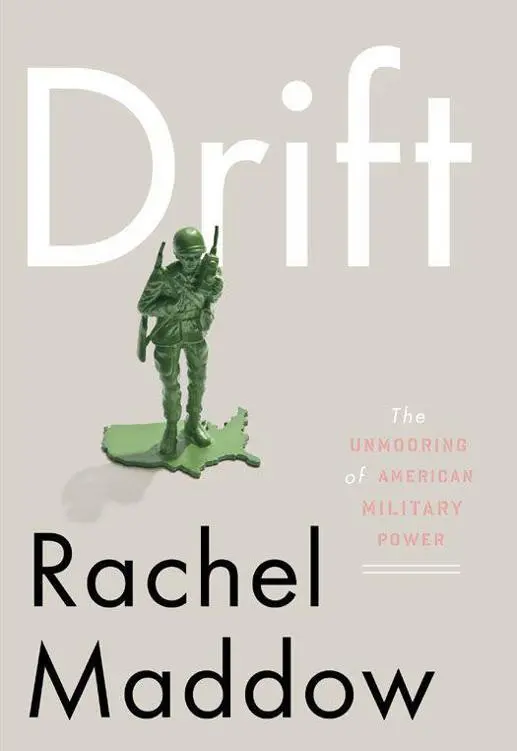
- Название:Drift
- Автор:
- Издательство:Crown Publishers
- Жанр:
- Год:2012
- Город:New York
- ISBN:978-0-307-46100-1
- Рейтинг книги:4 / 5. Голосов: 1
-
Избранное:Добавить в избранное
- Отзывы:
-
Ваша оценка:
Drift: краткое содержание, описание и аннотация
Предлагаем к чтению аннотацию, описание, краткое содержание или предисловие (зависит от того, что написал сам автор книги «Drift»). Если вы не нашли необходимую информацию о книге — напишите в комментариях, мы постараемся отыскать её.
Written with bracing wit and intelligence, Rachel Maddow’s
argues that we’ve drifted away from America’s original ideals and become a nation weirdly at peace with perpetual war, with all the financial and human costs that entails. To understand how we’ve arrived at such a dangerous place, Maddow takes us from the Vietnam War to today’s war in Afghanistan, along the way exploring the disturbing rise of executive authority, the gradual outsourcing of our war-making capabilities to private companies, the plummeting percentage of American families whose children fight our constant wars for us, and even the changing fortunes of G.I. Joe. She offers up a fresh, unsparing appraisal of Reagan’s radical presidency. Ultimately, she shows us just how much we stand to lose by allowing the priorities of the national security state to overpower our political discourse.
Sensible yet provocative, dead serious yet seriously funny,
will reinvigorate a “loud and jangly” political debate about how, when, and where to apply America’s strength and power—and who gets to make those decisions.
http://www.youtube.com/watch?v=Y9xoM7TMiTA
Drift — читать онлайн бесплатно полную книгу (весь текст) целиком
Ниже представлен текст книги, разбитый по страницам. Система сохранения места последней прочитанной страницы, позволяет с удобством читать онлайн бесплатно книгу «Drift», без необходимости каждый раз заново искать на чём Вы остановились. Поставьте закладку, и сможете в любой момент перейти на страницу, на которой закончили чтение.
Интервал:
Закладка:
Word also got around in our hemisphere that the US president was up for bargaining with any country that would indulge him on his Contra obsession. Reagan used emergency powers to get Honduras $20 million worth of military supplies from the Pentagon. El Salvador wanted trade concessions. The Guatemalan president asked the United States to double its economic assistance package to his country, and triple the military package. Panamanian president Manuel Noriega offered to assassinate the leadership of the Nicaraguan government, but in return he wanted a commitment from the White House to lift the ban on US weapons sales to Panama, and also, maybe, a little help in revitalizing his image would be nice. The whole “dictatorial strongman” thing was apparently beginning to eat at Noriega. Reagan took a pass on the Noriega deal.
President Reagan left no continent undisturbed in his quest for “Contra-butions.” When, after Reagan had left office, an independent counsel attorney presented him with a document that suggested he had asked the leader of an Asian country to ship weapons to the Contras, Reagan stammered out a remarkable truth, under oath: “I know this man of course, very well, met with him a number of times in his own country…. I don’t recall seeing this and… my policy was not to involve others in this. I mean, I wanted them involved but I didn’t want to be on the record of doing it.”
That was the way Reagan liked to work, off the record. But those Marines on his national security staff—Bud McFarlane, John Poindexter, and Oliver North—heard the president loud and clear when he tasked them to keep the Contras alive “body and soul.” According to an independent counsel’s report on the Iran-Contra affair published after more than five years of investigation, “North described how he and Secord, in order to replace the CIA in assisting the Contras, in their covert-action Enterprise created a ‘mirror image outside the government of what the CIA had done.’ [North] claimed he never made a single trip or contact ‘without the permission, express permission, of either Mr. McFarlane or Admiral Poindexter, and usually, when I could, with the concurrence of Director Casey.’”
North turned out to be one hell of an operator; he understood that the president’s appreciation for “third party” assistance to the Contras went well beyond foreign royalty and foreign governments. North managed a team of private fund-raisers and arms dealers who kept the Contras alive in the year of living without congressional funding. He’d shake the change out of the pockets of wealthy donors at fund-raisers hosted by the (newly created, not-for-profit, all-contributions-tax-deductible) National Endowment for the Preservation of Liberty, and he’d make sure the best check writers got a private audience—and a picture, of course—with the president. The president was happy to help.
With a combination of Saudi dollars and contributions from private American citizens funneled into the Enterprise’s Swiss bank accounts, North and his friend Secord kept those Contras in millions of dollars (though not as many as they raised, but more on that later) of beans, boots, Band-Aids, and bullets. By June 1985, Secord’s Enterprise was acting as the sole purchasing agent and weapons supplier of the Nicaraguan Contras. Contra leaders had no access to the money given them; North and Secord controlled it.
By spring 1986 North, Secord and partners also controlled and directed the logistics of the Contra resupply efforts (this would be known as Project Democracy) and its $4 million in assets comprising two C-123 cargo jets, two C-7 planes, and a $75,000 Maule aircraft paid for single-handedly by a wealthy Republican, Ellen Garwood, after a private meeting with the president. Ms. Ellen’s two and a half million dollars also helped pay for a maintenance base in Miami, living quarters in El Salvador for eighteen or so resupply employees, and an airstrip in Costa Rica known as “The Plantation.” This was essentially the closest North could come to the “mirror image” of the CIA’s secret support to the Contras.
But unlike the CIA, which had to depend on money from Congress, this privately funded entity had added value: the privatization of Reagan’s foreign policy initiative turned out to be just the ticket for evading all those barriers the legislature had erected. (Stupid regulations!) How could the president be obligated to report the activities of a private enterprise to Congress or anyone else? The Boland Amendment didn’t stop the administration from helping concerned citizens who just wanted to help the Contras. This quasi-privatization—with fronts like the National Endowment for the Preservation of Liberty, and for-profit companies like Secord’s Stanford Technology Trading Group International and Project Democracy’s Corporate Air Services—allowed the White House to run its Nicaragua operation unmoored from the Constitution and its fetters, free from congressional or statutory constraints, and clear of accountability. If anything went wrong, there was a firewall. Even though the Reagan administration directed the covert activity, there was a break in the formal chain of command; the orders up and down the line weren’t really traceable. So confident in the firewall of deniability was the White House that when the House Intelligence Committee got wind of the Contra resupply operation, Reagan’s NSC staff simply lied to Congress. “None of us has solicited funds, facilitated contacts for prospective potential donors, or otherwise organized or coordinated the military or paramilitary efforts of the resistance,” the national security adviser told House Intelligence Committee members. “There has not been, nor will there be, any such activities by the National Security staff.”
If accountability for military action to Congress and to the public was the foundational disincentive to war we got from the Founding Fathers, Reagan was taking a pickax to that foundation. He claimed the private right to go to war, in secret, against the express will of Congress.
The only hard part was keeping the thing funded. Overhead expenses were a bitch, of course. And then, too, private American companies like to show a profit, especially in a high-risk environment. Of the nearly $40 million that was raised toward Contra aid, only about $17 million found its way to the brave freedom fighters.
That’s why the windfall from the Iran arms-for-hostages sale was so enticing. North wanted more Iranian profits to divert to the Contras, and he made his case in crew-cut-hair-on-fire memos that made their way to Reagan. North may never have been alone in the same room with the president, but he knew his man. The way he sold the need to continue the Iranian arms deal was simple: if the United States backs off the deal now, the hostages in Lebanon are dead meat.
On January 7, 1986, at that day’s NSC meeting, the president surprised his key advisers by talking up a new idea to sweeten the pot: securing the release of twenty Hezbollah associates from Israeli prisons and shipping them along with the newest arms cache from Tel Aviv. The president could see the whole thing unfold. We arrange for Iran to get weapons and the Hezbollah guys from Israel. We sell Israel replacement weapons. Hezbollah frees our hostages. Iran pledges there will be no more kidnappings. “We sit quietly by and never reveal how we got them back,” Reagan noted.
In the middle of this presidential reverie, Secretary Weinberger once again started in on Reagan about violating the Arms Export Control Act. But Ed Meese—he had ascended to United States Attorney General by this point—offered the sort of argument that always pricked up the ears of Ronald Reagan. There was a way around the Arms Export Control Act: “The president’s inherent powers as commander in chief,” Meese said. “The president’s ability to conduct foreign policy.” Reading later descriptions of this moment brings to mind an image of the pink and jowly attorney general, his full girth tucked into circus tights, performing a series of spectacular and acrobatic trapeze feats without a net:
Читать дальшеИнтервал:
Закладка:
Похожие книги на «Drift»
Представляем Вашему вниманию похожие книги на «Drift» списком для выбора. Мы отобрали схожую по названию и смыслу литературу в надежде предоставить читателям больше вариантов отыскать новые, интересные, ещё непрочитанные произведения.








Обсуждение, отзывы о книге «Drift» и просто собственные мнения читателей. Оставьте ваши комментарии, напишите, что Вы думаете о произведении, его смысле или главных героях. Укажите что конкретно понравилось, а что нет, и почему Вы так считаете.