Rachel Maddow - Drift
Здесь есть возможность читать онлайн «Rachel Maddow - Drift» весь текст электронной книги совершенно бесплатно (целиком полную версию без сокращений). В некоторых случаях можно слушать аудио, скачать через торрент в формате fb2 и присутствует краткое содержание. Город: New York, Год выпуска: 2012, ISBN: 2012, Издательство: Crown Publishers, Жанр: Публицистика, на английском языке. Описание произведения, (предисловие) а так же отзывы посетителей доступны на портале библиотеки ЛибКат.
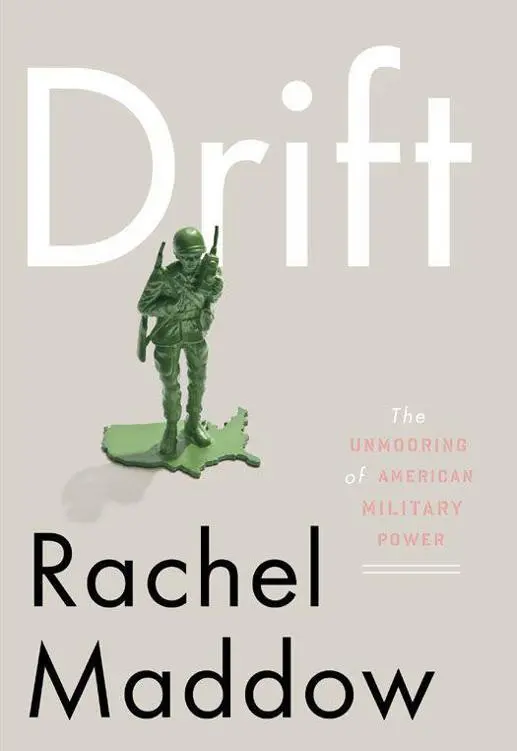
- Название:Drift
- Автор:
- Издательство:Crown Publishers
- Жанр:
- Год:2012
- Город:New York
- ISBN:978-0-307-46100-1
- Рейтинг книги:4 / 5. Голосов: 1
-
Избранное:Добавить в избранное
- Отзывы:
-
Ваша оценка:
Drift: краткое содержание, описание и аннотация
Предлагаем к чтению аннотацию, описание, краткое содержание или предисловие (зависит от того, что написал сам автор книги «Drift»). Если вы не нашли необходимую информацию о книге — напишите в комментариях, мы постараемся отыскать её.
Written with bracing wit and intelligence, Rachel Maddow’s
argues that we’ve drifted away from America’s original ideals and become a nation weirdly at peace with perpetual war, with all the financial and human costs that entails. To understand how we’ve arrived at such a dangerous place, Maddow takes us from the Vietnam War to today’s war in Afghanistan, along the way exploring the disturbing rise of executive authority, the gradual outsourcing of our war-making capabilities to private companies, the plummeting percentage of American families whose children fight our constant wars for us, and even the changing fortunes of G.I. Joe. She offers up a fresh, unsparing appraisal of Reagan’s radical presidency. Ultimately, she shows us just how much we stand to lose by allowing the priorities of the national security state to overpower our political discourse.
Sensible yet provocative, dead serious yet seriously funny,
will reinvigorate a “loud and jangly” political debate about how, when, and where to apply America’s strength and power—and who gets to make those decisions.
http://www.youtube.com/watch?v=Y9xoM7TMiTA
Drift — читать онлайн бесплатно полную книгу (весь текст) целиком
Ниже представлен текст книги, разбитый по страницам. Система сохранения места последней прочитанной страницы, позволяет с удобством читать онлайн бесплатно книгу «Drift», без необходимости каждый раз заново искать на чём Вы остановились. Поставьте закладку, и сможете в любой момент перейти на страницу, на которой закончили чтение.
Интервал:
Закладка:
MEESE: Well, Mr. Chairman, the question was directed to me as to whether the Boland Amendment applied to the NSC staff. I indicated that this was an issue on which we had not rendered an opinion in the Justice Department. I also indicated that if you look at the language it is possible to make a strong case for the fact that the Boland Amendment does not apply to the NSC staff…. If the Boland Amendment does not apply to the NSC staff then they would not be included within the prohibitions.
INOUYE: Are you telling us that the staff of the National Security Council can carry out functions that are forbidden to the CIA without evading the laws of the lands of the United States?
MEESE: If the law doesn’t apply to them then they can without violating the law, obviously. That’s a tautology. And when I say the law doesn’t apply to them, the law by its language does not include them.
INOUYE: But if an agent of the CIA carried it out, that would have been a violation of the law?
MEESE: Because the law applies to the CIA by its very terms, but the law by its terms only applies to the CIA, I believe the Defense Department, and entities of the government involved in intelligence activities. Normally, under the list that I read to you, that is not normally deemed to include the National Security Council staff.
INOUYE: Even if they carried out intelligence activities, covert activities?
MEESE: Well, it would depend again on the circumstances. It’s a hypothetical question. But by the language there I think a good case can be made that Congress in its enactment of that law did not include the National Security Council staff within the purview of the agencies that are listed in that section as involved in the prohibition.
INOUYE: Then in other words from what you’re telling me, employees of the Department of Agriculture could have done the same thing without evading the law? To carry out covert activities?
MEESE: I think that it’s entirely possible that as the—that as the law is written here where it says, ‘funds available to the Central Intelligence Agency, the Department of Defense or any other agency or entity of the United States involved in intelligence activities may be obligated and expended only as authorized in specific sections.’ Now, as I read that, as I said earlier, a strong case can be made I think that that does not apply to the Agriculture Department, that it doesn’t apply to Health and Human Services, and a number of other entities which are not involved in intelligence activities.
INOUYE: But if some agent of the Department of Agriculture involved himself with the approval of the president in some covert activity, would that law apply then?
MEESE: By its language, it does not appear to.
INOUYE: Then the Boland Amendment can be evaded very easily.
MEESE: I don’t think it would be an evasion if the law itself doesn’t apply to a particular entity. It certainly would not be an evasion.
Ta-da!
At the same time Attorney General Meese was turning in that grand performance in the Russell Senate Office Building, conjuring imagined armies of USDA inspectors and epidemiologists marching on Managua (it’s all legal), declaring the National Security Council as not being involved in intelligence activities, Meese’s Office of Legal Counsel was making the exact opposite argument. Assistant Attorney General Charles Cooper had determined that the first two arms shipments to Iran were perfectly legal because the NSC was involved, and it was “clear” that the NSC is an “intelligence agency.” Meese’s testimony and Cooper’s legal opinion were, as one might say, diabolically opposed, and this was—well, should have been anyway—embarrassing in the way they were making it up as they went. But this was all new.
Most informed and sentient onlookers would have thought back in the spring and summer of 1987 that this new Meeseian executive-branch modus operandi was about to meet the fate it deserved—a swift and sure death. Even before all the indictments and the convictions of senior administration officials, Reagan’s new way—the president can do anything so long as the president thinks it’s okay—looked like toast. In fact, Reagan looked like toast. Whatever his presidency had meant up until that point, Iran-Contra was such an embarrassment, such a toxic combination of illegality and sheer stupidity, that even the conservatives of his own party were disgusted. “He will never again be the Reagan that he was before he blew it,” said a little-known Republican congressman from Georgia by the name of Newt Gingrich. “He is not going to regain our trust and our faith easily.”
The president had been caught red-handed. Congress had exercised its legal and constitutional prerogative to restrain the executive branch from waging a war in Nicaragua. Reagan responded by breaking the law, waging the war anyway, and funding it by illegal and secret weapons deals that the president insisted weren’t happening. The secretary of defense was indicted on multiple counts, as were two national security advisers, an assistant secretary of state, the chief of Covert Ops at the CIA, and two other senior CIA officials. The president himself escaped largely by pleading exhaustive ignorance and confusion: “I’m afraid that I let myself be influenced by others’ recollections, not my own… the simple truth is, I don’t remember—period.” The Reagan presidency—the whole mythology of Reagan’s leadership—was laid bare. This was competence?
But a funny thing happened on the way to the burial of those tough-guy president-can-do-anything ideas. The lesson of the whole affair didn’t really take hold. The Tower Commission and the congressional investigating committee and the independent counsel expended their resources and energies on personalities like North and Secord and McFarlane and Poindexter, and Reagan got a pass. Which meant that in the not very much longer term, Reagan could be reimagined and reinvented by conservatives as an executive who had done no wrong: the gold standard of Republican presidents. By 2011, Newt Gingrich was trying to pave his own path to the presidency with Gingrich Productions “documentaries” like Ronald Reagan: Rendezvous with Destiny . “I knew Ronald Reagan; I began working with Ronald Reagan in 1974 when I first ran for Congress,” Gingrich was thundering from the podium at conservative conferences. “And I hate to tell this to our friends at MSNBC and elsewhere: Barack Obama is no Ronald Reagan!” (Newt’s Reagan movie kind of glossed over the whole Iran-Contra thing, when the extent of Newt Gingrich’s “working with” Ronald Reagan was throwing him under the bus, as the untrustworthy president who “blew it.”)
The Iran-Contra scandal hasn’t exactly turned into a badge of honor for those who had starring roles, but neither does it tarnish the high sheen retrospectively applied to the Reagan presidency or those who did his illegal or extraconstitutional bidding. Reagan’s successor, George H. W. Bush, pardoned most of the Iran-Contra convicts; Bush’s son George W. hired on a number of the scandal’s key players for his own administration. The Obama administration kept W’s defense secretary, Robert M. Gates, whose name is the title of chapter 16 of the Iran-Contra independent counsel report. (“The evidence established,” said the report, “that Gates was exposed to information about North’s connections to the private resupply operation that would have raised concern in the minds of most reasonable persons about the propriety of a Government officer having such an operational role.”)
But even more dangerous was the sad fact that the shameful Meese-made legal arguments about nearly unlimited executive power were not seen as the crazy talk they were, and killed off for good. One leader in Congress was instrumental in making sure this executive-power argument remained politically viable, by loudly declaiming at the time of Iran-Contra, in the midst of the scandal, that Reagan was right to do what he did. As the main author of the minority’s 145-page written dissent from the congressional investigation of Iran-Contra, Wyoming Representative Dick Cheney insisted, radically, that Iran-Contra was no crime, that Reagan was right to defy Congress, because there was nothing in Congress, nothing anywhere in America’s political structure, that could constrain a president from waging any war he wanted, however he wanted. It was an extreme view of executive power, a minority view when written, but it quickly became a blueprint for the next generation of Republican thinking about war and its limits. “The President was expected to have the primary role of conducting the foreign policy of the United States,” Cheney argued in his minority report on Iran-Contra. “Congressional actions to limit the President in this area therefore should be reviewed with a considerable degree of skepticism. If they interfere with core presidential foreign policy functions, they should be struck down. Moreover, the lesson of our constitutional history is that doubtful cases should be decided in favor of the President.”
Читать дальшеИнтервал:
Закладка:
Похожие книги на «Drift»
Представляем Вашему вниманию похожие книги на «Drift» списком для выбора. Мы отобрали схожую по названию и смыслу литературу в надежде предоставить читателям больше вариантов отыскать новые, интересные, ещё непрочитанные произведения.






Обсуждение, отзывы о книге «Drift» и просто собственные мнения читателей. Оставьте ваши комментарии, напишите, что Вы думаете о произведении, его смысле или главных героях. Укажите что конкретно понравилось, а что нет, и почему Вы так считаете.