Rachel Maddow - Drift
Здесь есть возможность читать онлайн «Rachel Maddow - Drift» весь текст электронной книги совершенно бесплатно (целиком полную версию без сокращений). В некоторых случаях можно слушать аудио, скачать через торрент в формате fb2 и присутствует краткое содержание. Город: New York, Год выпуска: 2012, ISBN: 2012, Издательство: Crown Publishers, Жанр: Публицистика, на английском языке. Описание произведения, (предисловие) а так же отзывы посетителей доступны на портале библиотеки ЛибКат.
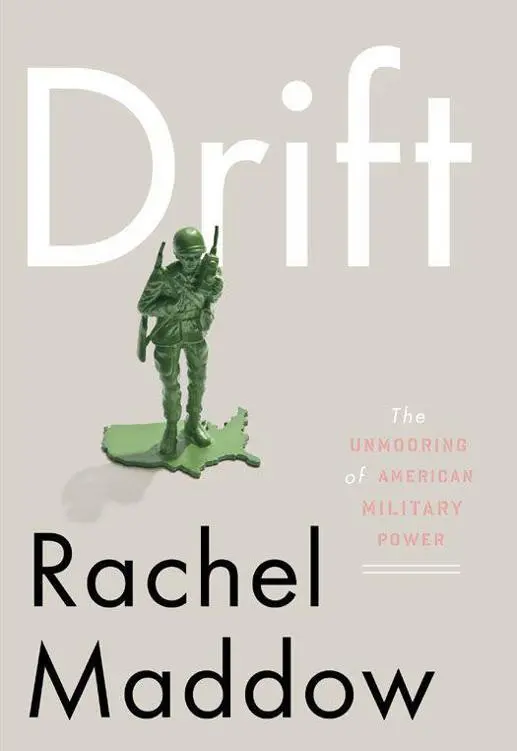
- Название:Drift
- Автор:
- Издательство:Crown Publishers
- Жанр:
- Год:2012
- Город:New York
- ISBN:978-0-307-46100-1
- Рейтинг книги:4 / 5. Голосов: 1
-
Избранное:Добавить в избранное
- Отзывы:
-
Ваша оценка:
Drift: краткое содержание, описание и аннотация
Предлагаем к чтению аннотацию, описание, краткое содержание или предисловие (зависит от того, что написал сам автор книги «Drift»). Если вы не нашли необходимую информацию о книге — напишите в комментариях, мы постараемся отыскать её.
Written with bracing wit and intelligence, Rachel Maddow’s
argues that we’ve drifted away from America’s original ideals and become a nation weirdly at peace with perpetual war, with all the financial and human costs that entails. To understand how we’ve arrived at such a dangerous place, Maddow takes us from the Vietnam War to today’s war in Afghanistan, along the way exploring the disturbing rise of executive authority, the gradual outsourcing of our war-making capabilities to private companies, the plummeting percentage of American families whose children fight our constant wars for us, and even the changing fortunes of G.I. Joe. She offers up a fresh, unsparing appraisal of Reagan’s radical presidency. Ultimately, she shows us just how much we stand to lose by allowing the priorities of the national security state to overpower our political discourse.
Sensible yet provocative, dead serious yet seriously funny,
will reinvigorate a “loud and jangly” political debate about how, when, and where to apply America’s strength and power—and who gets to make those decisions.
http://www.youtube.com/watch?v=Y9xoM7TMiTA
Drift — читать онлайн бесплатно полную книгу (весь текст) целиком
Ниже представлен текст книги, разбитый по страницам. Система сохранения места последней прочитанной страницы, позволяет с удобством читать онлайн бесплатно книгу «Drift», без необходимости каждый раз заново искать на чём Вы остановились. Поставьте закладку, и сможете в любой момент перейти на страницу, на которой закончили чтение.
Интервал:
Закладка:
This opinion was based upon an October 5, 1981, opinion of Attorney General William French Smith that if the President determined that neither the Foreign Assistance Act nor the Arms Export Control Act could be used, he could approve a transfer outside the context of these statutes if he determined that the authorities of the Economy Act and the National Security Act should be utilized in order to achieve ‘a significant intelligence objective.’ Whereas Attorney General Smith advised that reporting requirements… required that the House and Senate Intelligence Committees be informed of the President’s determination, Attorney General Meese took a more extreme view that the National Security Act implicitly authorized the President to withhold any prior or contemporaneous notice to Congress, even the limited notice to the leadership of the two houses of Congress.
Meese was spoiling for this sort of fight; he’d already hired into the Justice Department a coven of brilliant ultraconservative young lawyers—Federalist Society guys—and set them to the task of arguing the case for unleashing presidential authority. They were just then at work on a Meese-commissioned report—“Separation of Powers: Legislative-Executive Relations”—which invented something called the unitary executive theory, based on a make-believe version of the Constitution, wherein the president is given unilateral free rein in the realm of foreign policy and national security. The report made a science fiction-like case that the president was within his constitutional rights to reinterpret congressional legislation to conform more closely to his own desires, or to simply refuse to carry out laws with which he did not agree, or that, the report harrumphed, “unconstitutionally encroach on the executive branch.” In sum, anything the president doesn’t want to do he doesn’t have to do; anything he wants to do, consider it done.
This “Separation of Powers” report was still a few months away, but Meese was already living the dream at that January 1986 meeting. The nation’s chief legal officer was basically giving the back of his hand not only to all the post-Vietnam, post-Watergate fetters the legislative branch had seen fit to impose in the aftermath of a couple of runaway presidencies, but to the ones written in the Constitution, too. Meese was saying “Fuck Congress,” only in Latin. As Jane Mayer and Doyle McManus write in Landslide , their book about Reagan’s second term in office, this interpretation of the powers of the president “hadn’t been made quite so brazenly since Watergate. Following the constitutional crisis, Richard Nixon had been asked, ‘When the president does it, that means that it is not illegal, by definition?’ And he had answered, ‘Exactly, exactly. If the president approves something for national security… then the president’s decision is the one that enables those who carry it out, to carry it out without violating the law.’ Meese’s approach to the issue was essentially the same.”
Shultz was taken aback by the entire scene at the NSC meeting that day. The lack of opposition, he later said, “almost seemed unreal.”
Ten days later Reagan signed a presidential finding authorizing a new type of secret arms-for-hostages operation. On Attorney General Meese’s legal advice, it was decided the US government should sell arms directly to the Iranians and cut out the Israelis as the middleman. And as he made clear in earlier discussions of this matter, Attorney General Meese stood ready to give his Justice Department lawyers, you know, a little nudge in the right direction. (“You have to give lawyers guidance when asking them a question.”) A month later, the US government secretly shipped a thousand TOW missiles to Iran through a private party by the name of Richard Secord. One of Secord’s planes returned with the unwanted Hawks. Not a single hostage was released. And Reagan decided that the wise policy would be not to inform Congress.
Well, they got caught of course. The whole thing was so dunderheaded, how could they not? By November 1986, Reagan’s “Secret Dealings with Iran” had supplanted the 1986 midterm election results on the front page of Time magazine. Reagan played dumb for a few weeks, until the news broke that the money from the illegal arms sales had been diverted to the illegal Contra aid operation. The Reagan White House tried to get out ahead of the breaking scandal, calling for a special commission to investigate the entire affair and promising cooperation with a full-on congressional investigation. They even appointed an independent counsel to ferret out the scope and specifics of the illegalities. The president took some hard knocks. Before Christmastime that year, Time front-paged Iran-Contra twice more: “Probing the Mess,” with a grotty close-up of the downcast eyes of “White House Point Man Oliver North,” and “How Far Does It Go?” with a distant, lit-from-below White House looming like a murder-scene mansion in a horror movie.
By spring, after the Reagan-friendly Tower Commission had concluded that the administration had in fact traded arms for hostages and diverted some of the proceeds from those weapons sales to the Contras, Time had dispensed with the photographic emotional cues. They were no longer necessary to convey the seriousness of the damage to the presidency, or the ugliness of the scandal. With Reagan at the presidential lectern, and the Tower Commission report in the foreground, the cover asked simply, “Can He Recover?” The answer, in short, maybe not so much.
The answer in the magazine was longer, one derisive conclusion piled upon another. Reagan was “the befuddled and intellectually lazy figure so damningly portrayed in the Tower report… the picture of an inattentive, out-of-touch President.”
And it got worse from there:
The defects of what the commissioners euphemistically called Reagan’s “management style,” and what some former associates more bluntly term mental laziness… stands exposed as a President willfully ignorant of what his aides were doing, myopically unaware of the glaring contradictions between his public and secret policies… unable to recall when, how or even whether he had reached the key decision that started the whole arms-to-Iran affair… the President has consistently and vehemently denied that the U.S. was swapping arms for hostages, though the voluminous record assembled by the Tower commission leaves no question that that is what happened…. [I]t is far from clear whether Reagan has yet admitted that even in his own mind.
Oh, wait, there’s more.
“The President who did not understand that arms-for-hostages swaps, in the commission’s words, ‘ran directly counter to the Administration’s own policies on terrorism’ is the same Reagan who has never admitted, probably even to himself, that his tax and spending programs were bound to result in gargantuan budget deficits.”
Meese did his nimble-for-a-large-man best; he was in full protect-the-president mode. The attorney general threw the Marines—McFarlane, North, and John Poindexter—to the wolves. He got up some good evidence for a “cabal of zealots” theory arguing that they had operated without presidential knowledge. And in his July 1987 testimony before Congress, Meese did his damnedest to explain why all those activities the cabal had worked so hard to hide from Congress had not, in fact, been illegal at all; he did this by giving legislators a little legal guidance on the meaning of their own Boland Amendment. The Boland Amendment, Ed Meese explained to committee chairman Daniel Inouye in another remarkable high-wire act, didn’t apply to national security staff members in the employ of the White House.
INOUYE: As the chief law enforcement officer of the United States, are you suggesting, or is it your opinion, that once the Boland Amendment was passed setting forth certain activities that are forbidden to the CIA, the NSA and others, that the NSC could have assumed these forbidden functions without violating the law?
Читать дальшеИнтервал:
Закладка:
Похожие книги на «Drift»
Представляем Вашему вниманию похожие книги на «Drift» списком для выбора. Мы отобрали схожую по названию и смыслу литературу в надежде предоставить читателям больше вариантов отыскать новые, интересные, ещё непрочитанные произведения.









Обсуждение, отзывы о книге «Drift» и просто собственные мнения читателей. Оставьте ваши комментарии, напишите, что Вы думаете о произведении, его смысле или главных героях. Укажите что конкретно понравилось, а что нет, и почему Вы так считаете.