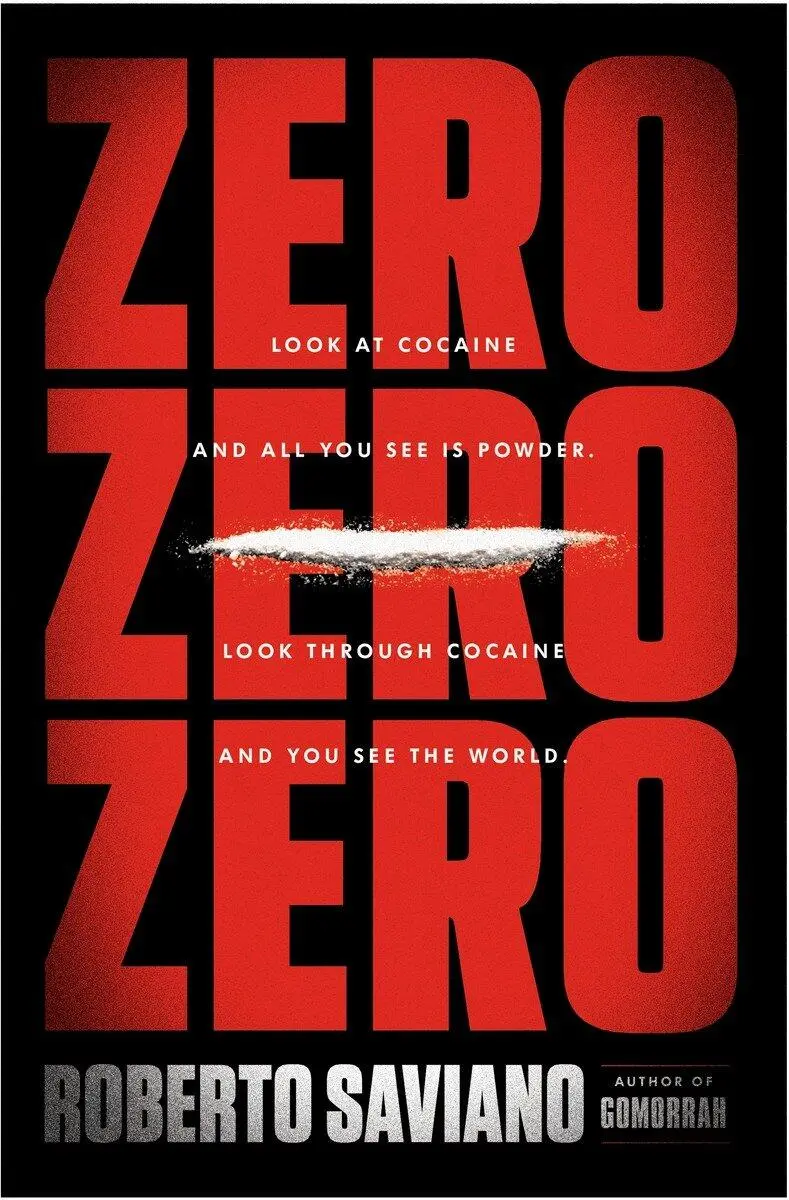
Roberto Saviano - ZeroZeroZero
Здесь есть возможность читать онлайн «Roberto Saviano - ZeroZeroZero» весь текст электронной книги совершенно бесплатно (целиком полную версию без сокращений). В некоторых случаях можно слушать аудио, скачать через торрент в формате fb2 и присутствует краткое содержание. Год выпуска: 2015, Издательство: Penguin Publishing Group, Жанр: Публицистика, Криминальный детектив, на английском языке. Описание произведения, (предисловие) а так же отзывы посетителей доступны на портале библиотеки ЛибКат.
- Название:ZeroZeroZero
- Автор:
- Издательство:Penguin Publishing Group
- Жанр:
- Год:2015
- ISBN:нет данных
- Рейтинг книги:5 / 5. Голосов: 1
-
Избранное:Добавить в избранное
- Отзывы:
-
Ваша оценка:
ZeroZeroZero: краткое содержание, описание и аннотация
Предлагаем к чтению аннотацию, описание, краткое содержание или предисловие (зависит от того, что написал сам автор книги «ZeroZeroZero»). Если вы не нашли необходимую информацию о книге — напишите в комментариях, мы постараемся отыскать её.
Saviano’s
, his explosive account of the Neapolitan mob, the Camorra, was a worldwide publishing sensation. It struck such a nerve with the Camorra that Saviano has lived with twenty-four hour police protection in the shadow of death threats for more than seven years. During this time he has become intimate with law enforcement agencies around the world. Saviano has broadened his perspective to take in the entire global corporate” entity that is the drug trade in cooperation with law enforcement officials, who have fed him information and sources and used him to guide their own thinking and tactics. Saviano has used this extraordinary access to feed his own groundbreaking reportage.
The result is a truly amazing and harrowing synthesis of intimate literary narrative and geopolitical analysis of one of the most powerful dark forces in the global economy. In
, Saviano tracks the shift in the cocaine trade’s axis of power, from Colombia to Mexico, and relates how the Latin American cartels and gangs have forged alliances, first with the Italian crime syndicates, then with the Russians, Africans, and others. On the one hand, he charts an astonishing increase in sophistication and diversification as these criminal entities diversify into many other products and markets. On the other, he reveals the threat of violence to protect and extend power and how the nature of the violence has grown steadily more appalling.
Saviano is a journalist of rare courage and a thinker of impressive intellectual depth and moral imagination, able to see the connections between far-flung phenomena and bind them into a single epic story. Most drug-war narratives feel safely removed from our own lives; Saviano offers no such comfort. As heart racing as it is heady,
is a fusion of a variety of disparate genres into a brilliant new form that can only be called
.
ZeroZeroZero — читать онлайн бесплатно полную книгу (весь текст) целиком
Ниже представлен текст книги, разбитый по страницам. Система сохранения места последней прочитанной страницы, позволяет с удобством читать онлайн бесплатно книгу «ZeroZeroZero», без необходимости каждый раз заново искать на чём Вы остановились. Поставьте закладку, и сможете в любой момент перейти на страницу, на которой закончили чтение.
Интервал:
Закладка:
Ángel Miguel suddenly raises his hand and spreads out his fingers.
“Smell. Hearing. Touch. Sight. Taste.”
The five senses, which the perfect Kaibil must develop and always keep sharp.
“Unity and strength.”
I look at Ángel Miguel. He’s no longer a Kaibil, but he still has that hollow look in his eyes. When you meet a Kaibil you come face-to-face with absence. He’s barely five feet four inches, but Ángel Miguel looks me up and down. All that talk about training and brotherhood has fed his pride, and he lords it over me and his girlfriend somehow. I have a question, and this could be the time to ask it.
“What can you tell me about the Kaibiles and narco-trafficking?”
Amnesty International began noting this phenomenon in 2003, in a report denouncing dozens of cases of military and police participation in drug-trafficking networks, as well as illegal activities such as car theft, trafficking in children for illegal adoptions, and “social cleansing” operations. In the same year, Washington included Guatemala on the list of “decertified” countries, because between 2000 and2002 the Guatemalan government seized only a fifth of the cocaine seized three years earlier.
If Ángel Miguel is annoyed, he certainly doesn’t show it. So I look to see his girlfriend’s reaction, but she too remains immobile, except for shifting her weight slightly from one high heel to the other. I’m sure she had to pass some sort of training too, before she could be with him. Finally, Ángel Miguel opens his mouth. “Unity and strength,” he repeats, and falls silent.
“Is it true that some former combatants have had successful careers in Mexican cartels?”
For several years Mexican authorities have been reporting a growing number of former Kaibil and Guatemalan soldiers being recruited by local criminal organizations. Former soldiers are a real plus for these organizations, who save time and money by enlisting young men who are already trained and experienced. A former Kaibil, who knows how to handle a weapon and operate in mountains and woods, can be very useful to the cartels. A former Kaibil knows how to survive in extremely difficult conditions and can maneuver just as well in southern Mexico as in northern Guatemala, regions with similar climates. The situation is made even more worrisome by the demobilization of the Guatemalan army, which in recent years has dropped from thirty thousand to fifteen thousand soldiers. Many soldiers were discharged and found themselves out of work. Some joined private security agencies and were sent abroad as mercenaries, to Iraq, for instance. But others ended up expanding the ranks of criminal cells.
Ángel Miguel is rubbing his thumb and index finger together, as if rolling an invisible cigarette, and there are tiny wrinkles, which I hadn’t noticed before, at the corners of his eyes. His girlfriend looks around and curls her lips nervously.
On the phone, before he agreed to meet me, Ángel Miguel had given me a list of rules that at the time I had taken for pure propaganda, but which, in his sustained silence, I now realize I hadn’t respected. A Kaibil must “earn the trust of his subordinates, direct their efforts, clarify objectives, inspire safety, create team unity, be an example of moderation at all times, keep hope alive, sacrifice himself for victory.” With two simple questions about Kaibiles past and present I had broken the spell. Our conversation was over.
6. Z
Ángel Miguel left me wanting more. He had painted a picture of his apprenticeship to violence, but he was merely playing a part: the retired combatant reminiscing about the glory days of his training. But it’s not enough. I have to see it in action, to go back to where the savagery took root and grew into an instrument of power. I have to go back to Mexico. To Osiel Cárdenas Guillén, the boss of the Gulf cartel.
Osiel is famous for never making mistakes and never forgiving those who do. But even he finally made one, and with the wrong people. In November 1999, Joe DuBois, a DEA agent, and Daniel Fuentes, an FBI agent, were in a Ford Bronco with diplomatic plates, a Gulf cartel informer sleeping in the backseat, his head pressed against the window. The informer was taking the two agents on a tour of Gulf cartel bosses’ houses and hangouts in Matamoros. He didn’t wake up even when the Ford Bronco slammed on the brakes and voices — all too familiar — were heard. “That guy’s ours, gringos!” Several vehicles surrounded the agents’ Bronco, and a dozen or so cartel members hopped out, AK-47s pointed. Osiel got out of his Jeep Cherokee, went over to the Bronco, and stuck a gun in one of the agents’ faces. So the Americans flashed their badges, revealing their identities. But Osiel didn’t give a damn who they were. It was the first time he had exposed himself like that; he knew it was risky, but he didn’t have a choice; he couldn’t let the informer talk. Time froze; the players faced off but without showing too much muscle — one wrong move and what seemed like a negotiation could quickly become a bloodbath. The FBI agent took a chance: “If you don’t let us go, the United States government will hunt you all the way to your grave.” Osiel caved. He shouted at the gringos: This is his territory, they can’t control it, and don’t ever show your faces around here again. Then he ordered his men to reverse. The FBI and DEA agents gave a sigh of relief.
It was the beginning of the end. The American authorities put a price of $2 million on Osiel’s head, and he began to get paranoid. He started seeing enemies everywhere; even his most trusted collaborators could be madrinas —godmothers, as informers are called. He needed to increase his firepower, and decided to buy himself an army. He didn’t want to be imprudent and so chose corrupt defectors from GAFE (Grupo Aeromóvil de Fuerzas Especiales or Special Forces Airmobile Group), the Mexican army’s elite corps. Ironically, GAFE’s role was to flush out criminals like him. GAFE men are tough: They’re modeled on U.S. special forces and trained by Israeli and French specialists. Among these Mexican Rambos was Lieutenant Arturo Guzmán Decena. Guzmán and Osiel had some traits in common: Both were cynical, ambitious, ruthless. Arturo, along with thirty other deserters, was put on Osiel’s payroll. So troops that had been paid to fight drug trafficking now swore loyalty to the very man who was, until recently, the enemy to take out. But the Friend Killer paid more than the Mexican government. That is how Osiel’s private army was born, and why it was baptized Los Zetas: Z was the code letter the GAFE soldiers used to communicate with one another via radio. Lieutenant Arturo Guzmán Decena became Z1.
Violence is self-absorbing; it voluntarily degrades itself in order to renew itself. In the tortured territory of Mexico, Los Zetas are like a cell that annihilates itself in order to grow stronger, more powerful, more destructive. The escalation of atrocity increased national and international pressure to get Osiel Cárdenas. On March 14, 2003, after a shoot-out in Matamoros, the Mexican army arrested him. Osiel was locked up in the La Palma maximum security prison. But being behind bars didn’t undermine his leadership; in fact, the alliance between the Gulf and Tijuana cartels was born in that prison. But although Osiel might have been able to issue orders from his cell, he couldn’t control his men, particularly Los Zetas, who were showing increasingly clear signs of wanting to be independent. Los Zetas are attracted to the most ruthless aspects of organized crime: They have absorbed the worst from the paramilitary forces, the worst from the Mafia, the worst from the drug traffickers.
From a military point of view, it’s hard to compete with Los Zetas: They have bulletproof vests and Kevlar helmets, and their arsenal includes: AR-15 assault rifles; thousands of cuernos de chivo (or goat’s horns, as they call AK-47s); MP5 submachine guns; grenade launchers; frag grenades like those used in Vietnam; surface-to-air missiles; gas masks; night-vision goggles; dynamite; and helicopters. A February 2008 army raid on the El Mezquito, one of Los Zetas’ farms near the city of Miguel Alemán, about sixty miles west of Reynosa, uncovered 89 assault rifles, 83,355 ammunition cartridges, and enough explosives to blow several buildings sky-high. Los Zetas members are highly professional; they use a modern phone-tapping system, encrypted radio signals, and Skype instead of regular telephones to elude surveillance.
Читать дальшеИнтервал:
Закладка:
Похожие книги на «ZeroZeroZero»
Представляем Вашему вниманию похожие книги на «ZeroZeroZero» списком для выбора. Мы отобрали схожую по названию и смыслу литературу в надежде предоставить читателям больше вариантов отыскать новые, интересные, ещё непрочитанные произведения.







Обсуждение, отзывы о книге «ZeroZeroZero» и просто собственные мнения читателей. Оставьте ваши комментарии, напишите, что Вы думаете о произведении, его смысле или главных героях. Укажите что конкретно понравилось, а что нет, и почему Вы так считаете.