Robert Leckie - Strong Men Armed
Здесь есть возможность читать онлайн «Robert Leckie - Strong Men Armed» весь текст электронной книги совершенно бесплатно (целиком полную версию без сокращений). В некоторых случаях можно слушать аудио, скачать через торрент в формате fb2 и присутствует краткое содержание. Город: Cambridge, Год выпуска: 2010, ISBN: 2010, Издательство: Da Capo Press, Жанр: nonf_military, на английском языке. Описание произведения, (предисловие) а так же отзывы посетителей доступны на портале библиотеки ЛибКат.
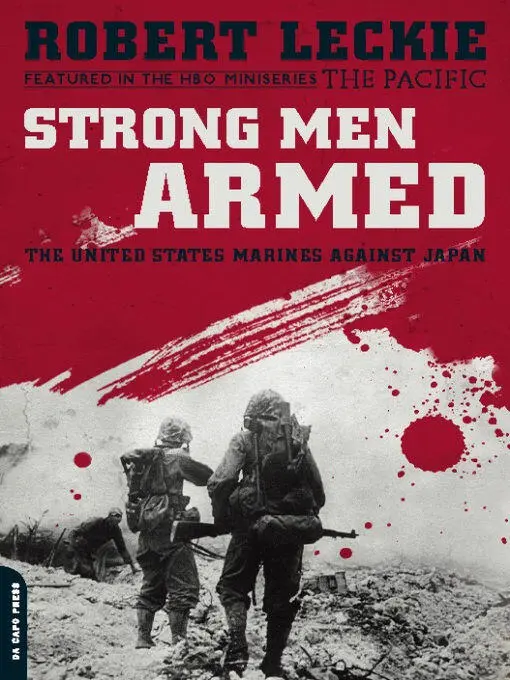
- Название:Strong Men Armed
- Автор:
- Издательство:Da Capo Press
- Жанр:
- Год:2010
- Город:Cambridge
- ISBN:978-0-786-74832-7
- Рейтинг книги:3 / 5. Голосов: 1
-
Избранное:Добавить в избранное
- Отзывы:
-
Ваша оценка:
Strong Men Armed: краткое содержание, описание и аннотация
Предлагаем к чтению аннотацию, описание, краткое содержание или предисловие (зависит от того, что написал сам автор книги «Strong Men Armed»). Если вы не нашли необходимую информацию о книге — напишите в комментариях, мы постараемся отыскать её.
Strong Men Armed — читать онлайн бесплатно полную книгу (весь текст) целиком
Ниже представлен текст книги, разбитый по страницам. Система сохранения места последней прочитанной страницы, позволяет с удобством читать онлайн бесплатно книгу «Strong Men Armed», без необходимости каждый раз заново искать на чём Вы остановились. Поставьте закладку, и сможете в любой момент перейти на страницу, на которой закончили чтение.
Интервал:
Закладка:
At night the Japanese scuttled her. By morning only a shining oil slick two miles long marked the sun-dappled seas off Savo, marking the place where great Hiei sank.
But before that morning, the Japanese Navy again came to Henderson Field. Gunichi Mikawa, who had won the Battle of the Five Sitting Ducks three months before, led six cruisers and six destroyers down to Savo again. They arrived at midnight. Standing off the island’s cone, Mikawa sent in Suzuya and Maya while his flagship Chokai and the others covered for them. The two heavies hurled 1,000 shells into the island. They would have hurled more, but six little torpedo boats crept from the creeks and coves of Tulagi Harbor and came with a roar at the big ships. They loosed a spread of torpedoes, hit cruiser Kinugasa and drove the rest away.
Gunichi Mikawa, who had passed up the chance to sink the American transports three months ago, sinking their escorts like a wolf killing the dogs and letting the sheep go, was once again departing Savo Island with that high speed which the exultant torpedo-boaters described as the act of “hauling ass.”
Then it was full morning, and in the daylight of November 14 the Wildcats and Dauntlesses and Avengers were up early to hunt out Mikawa’s force. The Japanese shelling had destroyed only two planes and damaged 16 others, and Fighter One had been manhandled swiftly into shape.
The Marine fliers found Mikawa’s ships under a cover of fleecy clouds. They put torpedoes into crippled Kinugasa, planted bombs on two more cruisers and a destroyer—and then, calling for Enterprise’s fliers to come north to finish Kinugasa and batter the others, they flew back to Guadalcanal in time to launch the slaughter of the Nagoya Division known as the Buzzard Patrol.
Commander Tadashi Yamamoto stood on the bridge of his destroyer Hoyashio as it plunged south under empty blue skies. It looked as though the convoy was going to make it undetected. There were no enemies aloft and none over the horizon. Eleven transports stuffed with about 12,000 men, plus 12 escorting destroyers, seemed destined to arrive safely off western Guadalcanal that night.
It had been so predicted. Admiral Mikawa had radioed the utter destruction of Henderson Field and reported the absence of enemy surface ships.
This was well. Even Commander Yamamoto, accustomed to his nation’s indifference to the comfort of its soldiers, felt uneasy at the sight of those troopships looking like drifting logs aswarm with ants.
It was a little after noon. There were less than six more hours to go. And then Yamamoto heard the motors.
The Americans came hurtling down from the skies, every last precious airplane which Henderson Field could put aloft. Major Joe Sailer, Major Bob Richard and the Navy’s Lieutenant A1 Coffin were among the first to strike. Thousand-pound eggs tucked beneath their Dauntless bellies fell away, described that dreadful yawning parabola—and exploded on crowded decks in leaping sheets of flame and flying steel. Two such bombs gave one of the transports its mortal wounds, six more left another troopship dead in the water, two others crippled a destroyer.
Flights now came from everywhere, from Enterprise, from Espiritu Santo, from the Fijis. They flew in, dropped their bombs, launched their torpedoes, strafed and flew away—sometimes to their own base, sometimes to Henderson for rearming. Zeros roared down from Rabaul to intercept them, but there were Marine fighters such as Captain Joe Foss and Lieutenant Colonel Joe Bauer flashing among them, shooting them down or driving them away from the diving Dauntlesses or skimming Avengers. Nor could the Zeroes tarry long. The range was now in the Americans’ favor. When they left, Marine and Navy pilots, the Army Lightning fighters lately come to Guadalcanal, swooped down at masthead level to rake decks already slippery and running red with blood.
Even the sea about those listing, settling, burning transports was incarnadine with Japanese blood. The water was dotted with thousands of bobbing heads—men blown overboard, men who had jumped to flee the fires only to feel the bullets sting and sear among them. It was merciless, it had to be merciless. Every Japanese safely ashore on Guadalcanal was another soldier a Marine must kill. Men vomited in their cockpits to see the slaughter they were spreading. They dove and saw with horror how the decks and bunks and bulkheads visible through jagged, gaping holes were glowing red with heat.
It went on until nightfall, until seven of the transports were sunk or sinking. The remaining four staggered shoreward in flames to beach themselves near Kukumbona, putting a few hundred leaderless soldiers ashore before they were destroyed by Marine fliers, the destroyer Meade and the five-inch batteries of the Marine Third Defense Battalion. Of the 12,000 men of the Nagoya Division who sailed south, something less than 5,000 survived the scourging of the Buzzard Patrol. Most of these were taken aboard the destroyers and carried north. Some reached Guadalcanal by boat. Others were scattered in ragged dispirited groups throughout the Central Solomons. And of all the supplies which General Hyakutate sent south, only five tons got ashore.
It was a stunning victory, almost absolute, but for the loss of the incomparable Joe Bauer, who was shot down and never seen again.
To Vandegrift’s Marines it seemed that they had been saved. The great enemy convoy had been destroyed at sea. They would be reinforced, they would be relieved, they would sling their rotted field packs on their shoulders, seize their rusted rines—and sail away from this horrible island forever.
But not yet.
If the virtue of the Japanese warrior was his tenacity, as it was, then the defect of that virtue was his inflexibility.
Among those admirals whom the great Admiral Yamamoto had sent to reinforce Guadalcanal or to knock out Henderson Field, none was more tenacious than Vice Admiral Nobutake Kondo. Nor more inflexible.
Kondo’s plan had called for the shelling of Henderson on three successive nights. The first night, November 12, had been a failure ending in disaster—the loss of Hiei. The second night had been better, but no success when balanced against the daylight bombing of Admiral Mikawa’s bombardment group and the calamity befalling the ships and men of the Nagoya Division.
Now it was the third night, that of November 14. Nobutake Kondo kept to his plan. He was headed for Henderson Field with battleship Kirishima, heavy cruisers Atago and Takao, two light cruisers and a flock of nine destroyers. He was loaded for bombardment, and he was not expecting a fight. Only those tiny torpedo boats which had buzzed Mikawa the night before might stand in his way, and the destroyers would make sukiyaki of these.
Even if the Americans had capital ships available, he was sure they would not dare risk them in the narrow waters of Iron Bottom Bay.
It was getting on to midnight as a trio of torpedo boats slipped out of Tulagi Harbor. They took up station at Savo’s north gate. They believed themselves to be all that was left to defend Henderson Field against the great fleet coming down. The sea was calm, the night air soft and fragrant. A first-quarter moon had set behind Cape Esperance. The pale gold gleaming beneath the violet vault of the heavens had vanished from the surface of the sea, and the lookouts peered anxiously into the dark.
They stiffened. Two great shapes came gliding toward them.
The Americans did have big ships and they were risking them in the narrow waters of Iron Bottom Bay.
Bull Halsey had sent Rear Admiral Willis Augustus Lee charging north from Noumea with the new 16-inch-gunned South Dakota and Washington. and a hastily assigned screen of four destroyers. Lee had no battle plan or radio call-signal, and he had very little information other than that the Japanese heavies were coming down.
Читать дальшеИнтервал:
Закладка:
Похожие книги на «Strong Men Armed»
Представляем Вашему вниманию похожие книги на «Strong Men Armed» списком для выбора. Мы отобрали схожую по названию и смыслу литературу в надежде предоставить читателям больше вариантов отыскать новые, интересные, ещё непрочитанные произведения.






Обсуждение, отзывы о книге «Strong Men Armed» и просто собственные мнения читателей. Оставьте ваши комментарии, напишите, что Вы думаете о произведении, его смысле или главных героях. Укажите что конкретно понравилось, а что нет, и почему Вы так считаете.