Robert Leckie - Strong Men Armed
Здесь есть возможность читать онлайн «Robert Leckie - Strong Men Armed» весь текст электронной книги совершенно бесплатно (целиком полную версию без сокращений). В некоторых случаях можно слушать аудио, скачать через торрент в формате fb2 и присутствует краткое содержание. Город: Cambridge, Год выпуска: 2010, ISBN: 2010, Издательство: Da Capo Press, Жанр: nonf_military, на английском языке. Описание произведения, (предисловие) а так же отзывы посетителей доступны на портале библиотеки ЛибКат.
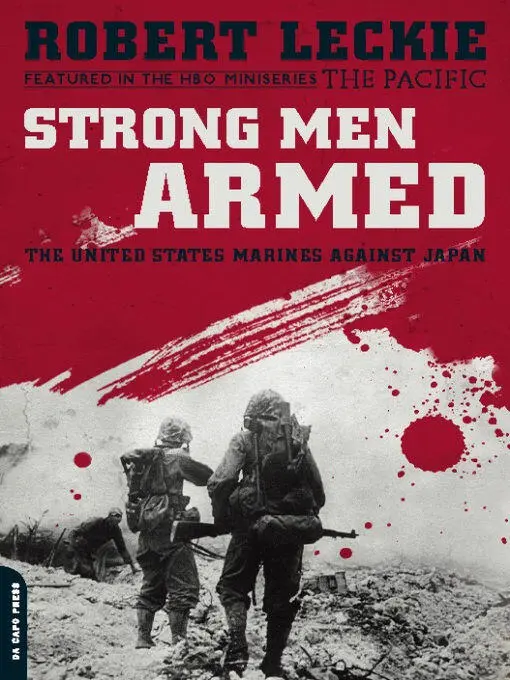
- Название:Strong Men Armed
- Автор:
- Издательство:Da Capo Press
- Жанр:
- Год:2010
- Город:Cambridge
- ISBN:978-0-786-74832-7
- Рейтинг книги:3 / 5. Голосов: 1
-
Избранное:Добавить в избранное
- Отзывы:
-
Ваша оценка:
Strong Men Armed: краткое содержание, описание и аннотация
Предлагаем к чтению аннотацию, описание, краткое содержание или предисловие (зависит от того, что написал сам автор книги «Strong Men Armed»). Если вы не нашли необходимую информацию о книге — напишите в комментариях, мы постараемся отыскать её.
Strong Men Armed — читать онлайн бесплатно полную книгу (весь текст) целиком
Ниже представлен текст книги, разбитый по страницам. Система сохранения места последней прочитанной страницы, позволяет с удобством читать онлайн бесплатно книгу «Strong Men Armed», без необходимости каждый раз заново искать на чём Вы остановились. Поставьте закладку, и сможете в любой момент перейти на страницу, на которой закончили чтение.
Интервал:
Закладка:
“Sergeant,” Vandegrift called, “the Admiral would like to speak to you.”
Butch Morgan came out of his tent-galley. He drew a tat-toed forearm across his glistening handlebar mustache and grimy stubble of beard. He carefully wiped his hands on his T-shirt.
“Sergeant,” Admiral Halsey said grandly, “I want to compliment you on your cooking. Especially the apple pie. It was terrific!”
Sergeant Morgan shifted his feet sheepishly while that awful thing called a blush colored his wrinkled, weather-leathered face. He looked at his general in agony, and then he burst out:
“Oh, bullshit, Admiral—you don’t have to say that!”
The admiral and the general exchanged glances, and the sergeant was mercifully dismissed. The next day Bull Halsey flew back to Noumea, heartened to hear that Archie Vandegrift still thought he could hold, convinced that men fed by such cooks could never be defeated.
One day later, November 10, those men of Alexander Vandegrift had pulled the string on the Japanese to the east. They killed 350 of them, against their own losses of 40 dead, 120 wounded. They captured 15 tons of rice, 55 boats and much of the enemy’s artillery. But most of the 230th escaped, pouring through a gap blasted in the inland line held by the 2nd Battalion, 164th. They fled westward toward Hyakutate’s reorganizing remnants, moving over the trail which the Kawaguchi Brigade had cut around the Marine perimeter in September. Following them like a scourge came Carlson’s Raiders.
Another private war had begun. With only an occasional air-drop of ammunition and rice, disdainful of help or the barest report which might acknowledge the fact of the larger war raging seaward, Carlson’s Raiders began to whittle the retreating 230th Regiment.
They struck the Japanese column twelve times, falling savagely on the flanks and rear, vanishing almost as suddenly as they had appeared—employing that simple guerrilla tactic which Carlson had learned from the Chinese. The Raider main body marched in a line parallel to the retreat of the Japanese main body, sometimes on the right side, sometimes on the left. Directly behind the Japanese came Raider patrols. Each time the patrols ran into large numbers of Japanese they opened fire. Whereupon the enemy would begin to rush reinforcements to his rear. As he did, Carlson’s main body struck from the flank with concentrated firepower.
Carlson’s Raiders killed 500 men of the 230th Regiment with this tactic, and when they returned to the Marine lines 30 days after they had set out from Aola Bay, with only 17 of their comrades fallen, they found that “Gung Ho!” was no longer a cry of derision among their brother Marines. They also found that their private war had run concurrently with the general war they had left—for the tide of battle on Guadalcanal had at last turned.
And it turned at sea.
17
“Commence firing!” Rear Admiral Daniel Callaghan shouted. “Give’em hell, boys!”
Callaghan’s little stopgap fleet drove ahead; his ships plunged straight into the flaming guns of the mighty Japanese fleet which had come south to pulverize Henderson Field. Guns roaring, sterns down, keels carving hard white wakes in the glittering obsidian waters of Iron Bottom Bay, they rushed on to destruction—to the fiercest surface battle of the war.
Callaghan’s fleet had come north to escort the Army’s 182nd Infantry Regiment to Guadalcanal. There were his own flagship, the cruiser San Francisco, the other cruisers Atlanta— with Rear Admiral Norman Scott aboard her —Portland, Helena and Juneau; and the destroyers Laffey, Cushing, Sterrett, O’Bannon, Aaron Ward, Barton, Monssen and Fletcher. They covered the 182nd’s landing November 11, and when 32 Japanese torpedo bombers and fighters came winging over The Slot the afternoon of November 12, their antiaircraft guns joined Henderson’s fighters in knocking all but one of them from the skies.
In the afternoon succeeding that fifteen-minute flurry came word of the Japanese bombardment fleet sweeping down from the Shortlands: the battleships Hiei and Kirishima, the cruiser Nagara, and 14 of those big Nipponese destroyers.
To stop them Admiral Turner had only Uncle Dan Callaghan and his five cruisers and eight destroyers. He ordered Callaghan to attack.
Admiral Kondo had to be held off for at least one night, for mighty Enterprise had been repaired and was tearing north with a load of warplanes to hunt out the Japanese transports bringing the rest of the Nagoya Division to Guadalcanal. The planes would need to land at Henderson Field. Therefore Henderson must not be bombarded.
Turner’s decision was made after the twilight in which Callaghan’s ships stood out to sea. They returned at midnight. At a quarter of two in the morning of November 13 Callaghan stood on San Francisco’s bridge and shouted his rallying cry and the battle was joined.
It was as though the world were being remade. It was cataclysm ripping matter apart like paper. Searchlights slashed the star-shell-showered night. Gunflashes flitted like bolts of summer lightning. The wakes of speeding ships were crisscrossed by the thin foaming lines of racing torpedoes, blotted out by the flaming geysers of their collision. And above the smoking roar of battle, Admiral Callaghan was crying over the Talk Between Ships:
“We want the big ones, boys, we want the big ones!”
Little Laffey took on a big one. She ran in under great Hiei’s mighty 14-inch turrets and peppered her bridge. She was so close that Hiei’s pagoda silhouette seemed to sway above her. Hiei thundered and Laffey lurched and began to burn. San Francisco was dueling Hiei, hurling salvo after salvo into her superstructure. Hiei thundered again. A full salvo of 14-inchers tore into San Francisco’s bridge, killing Callaghan and every other man there. San Francisco’s gun turrets began firing on local control, and her salvos were rocking crippled Atlanta. Admiral Norman Scott was dead; the commander who had won the Battle of Cape Esperance had fallen from our own fire. Silhouettes plunging in and out of smoke were difficult to determine. American fired on American, Japanese on Japanese—and every ship but Fletcher was hit. Barton blew up. Monssen sank. So did Cushing, Laffey—and the cruisers Juneau and Atlanta.
But the Japanese were running. Every one of them had been staggered. Destroyer Yudachi was going down. So would Akatsuki. Admiral Kondo’s ships were streaking north, and limping behind them, rudderless, her hull rent with jagged holes from the twin torpedoes of little Sterrett, her superstructure a mass of wreckage from 85 shell hits, came great Hiei.
After her came the fighters and bombers from Henderson Field. Though Callaghan and Scott and many of their men had died, though the Americans had lost six ships, Henderson had not been scratched. The battle which Fleet Admiral King called “the fiercest naval battle ever fought” had served its purpose, the preservation of the airborne Marine fighters and bombers that were now coming to kill Hiei. They slashed down on the eight Zeros sent south to cover her and shot them down. Major Joe Sailer planted a bomb on Hiei’s remaining antiaircraft turrets and knocked them out. Captain George Dooley’s quartet of Avengers sent another torpedo flashing into the great ship’s hull. Seven Dauntlesses fell upon her with thousand-pounders. Nine Avengers from Enterprise joined the assault, and full five more attacks were made on Hiei that day. Still the great sea monster wallowed in the swells, glowing cherry red, sailing an aimless circle, now making for Guadalcanal, now drifting north again—refusing to go under.
Читать дальшеИнтервал:
Закладка:
Похожие книги на «Strong Men Armed»
Представляем Вашему вниманию похожие книги на «Strong Men Armed» списком для выбора. Мы отобрали схожую по названию и смыслу литературу в надежде предоставить читателям больше вариантов отыскать новые, интересные, ещё непрочитанные произведения.






Обсуждение, отзывы о книге «Strong Men Armed» и просто собственные мнения читателей. Оставьте ваши комментарии, напишите, что Вы думаете о произведении, его смысле или главных героях. Укажите что конкретно понравилось, а что нет, и почему Вы так считаете.