Robert Leckie - Strong Men Armed
Здесь есть возможность читать онлайн «Robert Leckie - Strong Men Armed» весь текст электронной книги совершенно бесплатно (целиком полную версию без сокращений). В некоторых случаях можно слушать аудио, скачать через торрент в формате fb2 и присутствует краткое содержание. Город: Cambridge, Год выпуска: 2010, ISBN: 2010, Издательство: Da Capo Press, Жанр: nonf_military, на английском языке. Описание произведения, (предисловие) а так же отзывы посетителей доступны на портале библиотеки ЛибКат.
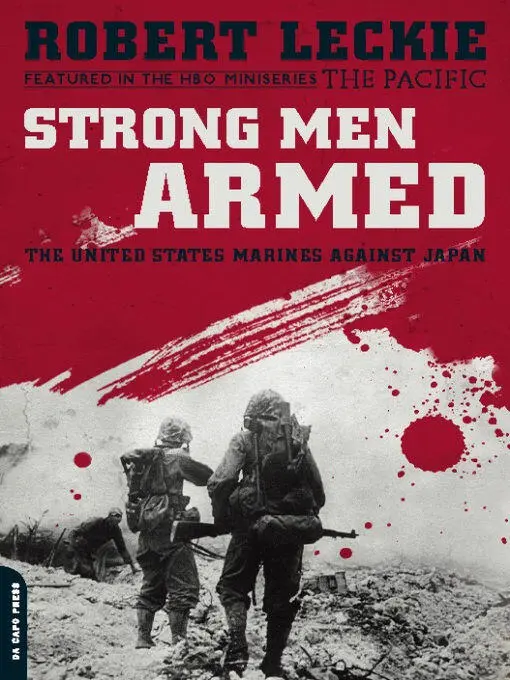
- Название:Strong Men Armed
- Автор:
- Издательство:Da Capo Press
- Жанр:
- Год:2010
- Город:Cambridge
- ISBN:978-0-786-74832-7
- Рейтинг книги:3 / 5. Голосов: 1
-
Избранное:Добавить в избранное
- Отзывы:
-
Ваша оценка:
Strong Men Armed: краткое содержание, описание и аннотация
Предлагаем к чтению аннотацию, описание, краткое содержание или предисловие (зависит от того, что написал сам автор книги «Strong Men Armed»). Если вы не нашли необходимую информацию о книге — напишите в комментариях, мы постараемся отыскать её.
Strong Men Armed — читать онлайн бесплатно полную книгу (весь текст) целиком
Ниже представлен текст книги, разбитый по страницам. Система сохранения места последней прочитанной страницы, позволяет с удобством читать онлайн бесплатно книгу «Strong Men Armed», без необходимости каждый раз заново искать на чём Вы остановились. Поставьте закладку, и сможете в любой момент перейти на страницу, на которой закончили чтение.
Интервал:
Закладка:
So these men faced the month of November, forgetting the outside world, forgetting even that they were Americans—mindful only that they were Marines and trying always for those flashes of rough comedy which could nourish their spirit.
Sometimes men stood on the hills and shouted insults at an unseen or nonexistent enemy in the darkened jungle. They called Emperor Hirohito “a bucktoothed bastard.” They dwelt at loving length on the purity of his lineage. They yelled unprintables at Premier Tojo while ascribing to him every vice in the book of human depravity. And there came an astonishing night when a thin reedy voice shrilled up at them in outraged retaliation:
“F—— Babe Ruth!”
So went November on Guadalcanal, the month which General Vandegrift began with another offensive west and a counterinvasion move east.
On November 1 a force of roughly 5,000 Marines moved across the Matanikau. Vandegrift was again hoping to prevent an enemy build-up to the west, as well as to destroy the disorganized survivors of the October battles. He hoped also to raise morale with a successful offensive and to knock out Pistol Pete, now firing again, and all other enemy artillery to the west. The western force moved cautiously at first, striking along the coast toward Kukumbona.
On the same day another force of Marines was trucked to the Tenaru preparatory to crossing the river next day. Admiral Halsey had already notified Vandegrift that Koli Point, about a dozen miles east of the Tenaru, was probably going to be the next enemy landing place. Halsey was also worried about the security of Aola Bay, 18 miles east of Koli Point, where he hoped to build another airstrip and where engineers and the newly arrived Second Raider Battalion were to land on November 3. An enemy unit at Koli Point could cut communications between the perimeter and the Aola Bay force. So Vandegrift was sending troops east to prevent a Koli Point landing.
The eastern force was the same Second Battalion, Seventh Marines, which had stopped Oka. It was led by Lieutenant Colonel Herman Henry Hanneken, the “King of the Banana Wars” who had fought as a sergeant in Haiti, meeting the Caco leader, King Charlemagne, in personal combat and killing him.
The next morning, November 2, Hanneken’s battalion crossed the Tenaru and began a forced march to Koli Point. They reached it before dusk, crossed the Nalimbiu River which cuts through it, and then also crossed the Metapona River another few miles east. They set up a coastal defensive perimeter on the east bank of the Metapona. And then, in the fading light of day, they saw three Japanese ships slip into the lee of the coast another mile east and begin unloading troops. Hanneken watched helplessly. Rain had put his radios out of commission, and he had strung communications wire no farther east then the Nalimbiu.
In three hours, the 230th Infantry Regiment, vanguard of the 38th or Nagoya Division, came ashore with supplies and guns—and the cruiser, destroyer and transport which had brought them sailed away.
Next morning, Hanneken decided to attack. His mortars opened up. The Japanese replied with an artillery barrage and themselves began attacking. They came down the beach in superior force and Hanneken withdrew. He got back behind the Metapona, set up, and was attacked again.
A destroyer had put a Japanese landing party ashore in front of Hanneken’s Marines.
At about the same time west of the Matanikau, the Fifth Marines closed in on a few hundred Japanese caught in a trap around Point Cruz and destroyed them with bayonets. Next day the Fifth was to sweep on to Kukumbona.
But they would not. That night they were under orders to return to the perimeter next day, for Lieutenant Colonel Hanneken’s radios had at last begun to function and the beleaguered commander had asked for reinforcements. Vandegrift was calling off his western offensive again, and planning a trap for the Japanese 230th Infantry.
The Marine general ordered the First Battalion, Seventh, east by boat to reinforce Hanneken, who was even then successfully forcing his way west of the Nalimbiu River. The unit which landed in front of him was not large enough to contain him. Hanneken set up a beachhead 400 yards wide and 300 yards inland and at midnight the reinforcing battalion arrived and joined his defense line.
Next Vandegrift ordered his air to strike everything the Japanese had in the east, especially with an eye toward protecting the Aola Bay airfield-construction force which had also landed November 3.
Finally, he sent the 164th Infantry Regiment on a march southeast. This was begun November 4, even as Hanneken’s force attacked eastward again and recrossed the Nalimbiu. When the 164th was far enough southeast, or behind the Japanese, it would wheel and face north to the sea. Hanneken, meanwhile, would turn the enemy inland. Thus, the soldiers of the 164th Infantry would become the anvil on which the hammer blows of the Seventh Marines would shatter the enemy.
As a final touch, to cut off and annihilate any Japanese who might burst out of the trap, Vandegrift was going to place another force still farther south. He had just the outfit to do it.
Carlson’s Raiders.
They specialized in private wars, these men of Carlson’s. They had made the hit-and-run raid on Makin Island on August 25, and though they had been wildly acclaimed in the States, their score of roughly 100 enemy dead had failed to impress the dogged, sardonic defenders of Guadalcanal. For the “Gung Ho Boys” of Evans Carlson were not popular with brother Marines. They regarded themselves as an elite of an elite, they had volunteered for the Raiders’ special mission of staging commando-style raids, they had all answered “Yes” to their commander’s unique question, “Could you cut a Jap’s throat without flinching?”—and because of this, because of Makin, because they could march and fight on an unchanging ration of rice, tea and bacon, they thought themselves tougher than the ordinary Marine.
But the “ordinary” Marine, if such exists, could not agree. They now knew to the last cruel degree of adversity the difference between the unromantic foot-slogger who hits-and-holds and the dashing beach-leaper who hits-and-runs. Even the Raiders’ motto of “Gung Ho”—the Chinese phrase for “Work Together” which Carlson had learned during his prewar service with the Chinese Eighth Route Army—was not likely to thrill or awe these ordinary Marines. It was more likely to call forth sarcasm. If the Marine Corps’ own slogan of “Semper Fidelis” was often interpreted to mean “I got mine, how’d you make out?” the Raiders’ flamboyant “Gung Ho!” could receive the sneering twist, “Which way’s the photographers?”
Carlson’s Raiders were now at Aola Bay. On November 5 they moved west toward the Japanese who had attacked Hanneken. They sloshed up the trails following that tall, lean, long-nosed, passionate man who had given them their individuality and their battle cry, unaware, as he was unaware, that “Gung Ho!” now must prove itself beneath the eyes of the most critical audience they knew—the ordinary Marines of Guadalcanal.
On November 8, while Vandegrift’s eastward forces were still maneuvering to spring their trap, Vice Admiral Halsey came to Guadalcanal.
He came in without fanfare. He put on Marine dungarees and boondockers and rode in a jeep around the perimeter. His staff officers begged him to stand up, to wave, to do anything that would let the men know that Bull Halsey was there. He refused.
It would be “too damn theatrical,” he said, it would be an affront to the weary men who had held this island for three months.
At noon Halsey went to Vandegrift’s headquarters for lunch.
It was a surprisingly good meal. There was even apple pie. Admiral Halsey was so impressed that he wished to compliment Vandegrift’s cook.
Читать дальшеИнтервал:
Закладка:
Похожие книги на «Strong Men Armed»
Представляем Вашему вниманию похожие книги на «Strong Men Armed» списком для выбора. Мы отобрали схожую по названию и смыслу литературу в надежде предоставить читателям больше вариантов отыскать новые, интересные, ещё непрочитанные произведения.










Обсуждение, отзывы о книге «Strong Men Armed» и просто собственные мнения читателей. Оставьте ваши комментарии, напишите, что Вы думаете о произведении, его смысле или главных героях. Укажите что конкретно понравилось, а что нет, и почему Вы так считаете.