Robert Leckie - Strong Men Armed
Здесь есть возможность читать онлайн «Robert Leckie - Strong Men Armed» весь текст электронной книги совершенно бесплатно (целиком полную версию без сокращений). В некоторых случаях можно слушать аудио, скачать через торрент в формате fb2 и присутствует краткое содержание. Город: Cambridge, Год выпуска: 2010, ISBN: 2010, Издательство: Da Capo Press, Жанр: nonf_military, на английском языке. Описание произведения, (предисловие) а так же отзывы посетителей доступны на портале библиотеки ЛибКат.
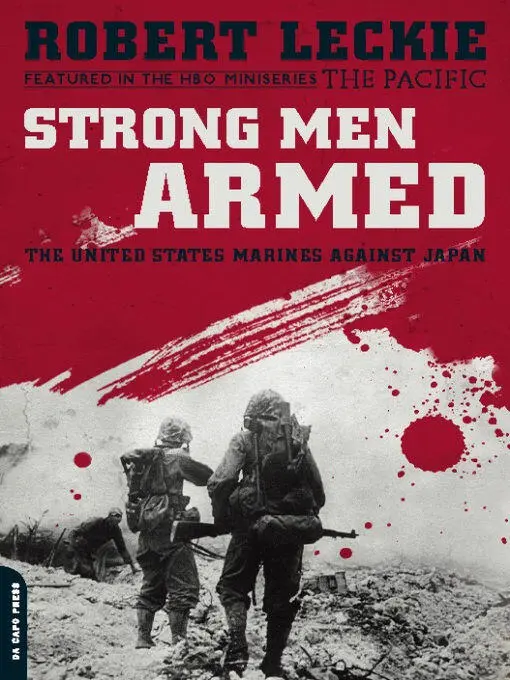
- Название:Strong Men Armed
- Автор:
- Издательство:Da Capo Press
- Жанр:
- Год:2010
- Город:Cambridge
- ISBN:978-0-786-74832-7
- Рейтинг книги:3 / 5. Голосов: 1
-
Избранное:Добавить в избранное
- Отзывы:
-
Ваша оценка:
Strong Men Armed: краткое содержание, описание и аннотация
Предлагаем к чтению аннотацию, описание, краткое содержание или предисловие (зависит от того, что написал сам автор книги «Strong Men Armed»). Если вы не нашли необходимую информацию о книге — напишите в комментариях, мы постараемся отыскать её.
Strong Men Armed — читать онлайн бесплатно полную книгу (весь текст) целиком
Ниже представлен текст книги, разбитый по страницам. Система сохранения места последней прочитанной страницы, позволяет с удобством читать онлайн бесплатно книгу «Strong Men Armed», без необходимости каждый раз заново искать на чём Вы остановились. Поставьте закладку, и сможете в любой момент перейти на страницу, на которой закончили чтение.
Интервал:
Закладка:
15
On October 26, while land fighting sputtered out on Guadalcanal, the naval battle which Admiral Yamamoto expected was fought in waters roughly 300 miles to the east.
Yamamoto, who had always sought a major engagement with the American fleet, hurled his forces into the fight as eagerly as Bull Halsey, who sent Rear Admiral Thomas Kincaid into action with the signal: “Attack! Repeat—Attackl”
But the air-sea engagement known as the Battle of the Santa Cruz Islands fell short of a clear-cut decision. The Americans lost the carrier Hornet and a destroyer to submarine attack, and 76 American planes went down. The unsinkable Enterprise was again hit. The Japanese suffered severe damage to two carriers and a heavy cruiser and lost 100 aircraft. Minor damage was about even.
Santa Cruz was a disappointment to both sides, but neither side allowed the stand-off to weaken its resolve to fight on for Guadalcanal.
Already, in the final days of October, while the surviving ships of both nations steamed north to Truk and south to Noumea, the Americans were sending more ships to the South Pacific area and Marine and Army units were under orders for movement to the island.
Up in Rabaul, Lieutenant General Hyakutate was taking the last shot from his locker. He was calling on the 17th Army’s reserve division, the 38th. Hyakutate had already fed in the Ichiki Detachment, the Kawaguchi Brigade, the Sendai Division, and a handful of lesser units. Now he would send roughly 15,000 troops down The Slot, the bulk of that 38th or Nagoya Division commanded by Lieutenant General Tadayoshi Sano.
On Guadalcanal itself in the final days of October, the broken remnants of the Sendai Division, together with the survivors of all those other units which had come to the island since early August, were streaming westward through the jungle. They were disorganized, starving, wounded and sick. Some 5,000 Japanese died beneath Marine guns in those attacks which began on October 21, and which, after Maruyama’s main thrust was shattered on October 24-26, erupted sporadically in small local actions or jungle skirmishes until the month ended.
Among these dead was Colonel Furumiya. He and his staff officer had not been able to find their way back to the jungle south of the American lines. They had not eaten for days. They had barely enough strength to tear the 29th’s colors into bits and grind them into the mud with their feet. They had not burned the flag because the smoke might give them away. Then Colonel Furumiya wrote a letter which the staff officer was to deliver to Maruyama, although it would actually be taken from the officer’s dead body by the Marines who killed him. Furumiya wrote:
…I do not know what excuse to give…
I am sorry I have lost many troops uselessly and for this result which has come unexpectedly. We must not overlook firepower. When there is firepower the troops become active and full of spirit. But when firepower ceases they become inactive. Spirit exists eternally.
I feel sleepy because of exhaustion for several days.
I am going to return my borrowed life today with short interest.
Colonel Furumiya straightened. He placed a pistol to his head. He bowed in the direction of Tokyo and the Emperor, and the staff officer pulled the trigger.

Chesty Puller was also writing a letter, composing it mentally while he lay on a hospital cot with seven pieces of shrapnel in his legs.
Puller had been helping wiremen repair communications wire in a patrol to the east of the Tenaru when an enemy shell burst among them, wounding Puller. A Navy corpsman quickly gave him aid and began to write out an evacuation tag.
Chesty tore it from the corpsman’s hand and flung it at him. “Go label a bottle with that goddam tag!” he roared.
But Puller had been forced to accept hospital treatment. Now he lay on his cot, thinking. He had had a close call with the corpsman. He could have been evacuated and sent Stateside, out of the war. Automatically, the words of a request to Headquarters began forming in his mind: “… therefore I respectfully request… duty overseas with a combat unit… for the duration of the war…”
He would write it as soon as he returned to his men, with all but one of the shrapnel pieces pried from his legs, which would be at the end of that dreadful black month of November.
16
It was in November that the Marines of Major General Alexander Vandegrift came close to losing their minds.
A bitter aching fatigue had come upon them. They had met the enemy on the beaches, in caves, atop the hills, down in the jungle swamps—and they had defeated him. They had been battered by every weapon in the arsenal of modern war. They had been blown from their holes or been buried in them. They had not slept. They had been ravaged by malaria, weakened by dysentery, nagged by tropical ulcers and jungle rot, scorched by the sun or drenched by the rain. They had met each ordeal with the hope of victory, and had survived only to prepare for greater trial. They had come to Guadalcanal lean and muscular young men, and now there was not one of them who had not lost twenty pounds, and there were some who had lost fifty. They had come here with high unquenchable spirit, but now that blaze of ardor was flickering low and there was a darkness gathering within them and their minds were retreating into it.
All the world was circumscribed by their perimeter. Guadalcanal had become Thermopylae multiplied by ninety days. There might be ninety more, for all they knew, for there seemed no way out, around or through. This was that “feeling of expendability” of which so much has been written, but which, like a toothache, can never be understood but only felt. It was a long shuddering sigh of weariness with which men rehearsed in their minds what had gone before, wondering dully, not that it had been sustained, but in what new hideous shape it would reappear. It was a sense of utter loneliness made poignant by their longing for encouragement from home, which never seemed to be forthcoming, by their hope of help, which was always being shattered. It seemed to these men that their country had set them down in the midst of the enemy and left them there to go it alone. They could not understand—had no wish to understand—that high strategy which might assign a flood of men and munitions to another theater of war, a trickle to their own. They reasoned only as they fought: that a man in trouble should get help, and here they were alone.
So they turned in upon themselves. They developed that vacant, thousand-yard stare—lusterless unblinking eyes gazing out of sunken, red-rimmed sockets. They drew in upon themselves in little squad groups, speaking constantly in low voices to each other, rarely to men of other units. They avoided those top NCO’s and officers who might put them on working parties unloading ships. They were not shirking duty, they were saving strength—for the daily patrols, for the ordeal of the night watch with its terrors of the imagination, terrors fancied but real. Some of these men had not the strength to go to the galley to eat, for galleys usually lay in the lowlands behind the lines. Weakened men might get down to the galley, but they could not get back up. Their friends brought them food, just as men brought food to buddies sickened by malaria but not sick enough to occupy a precious cot in the regimental sick bays. Men with temperatures a few points above 100 were not regarded as bona fide malaria cases. There had been only 239 of these in September, there had been 1,941 of them in October—and before November ended there would be 3,200 more.
Читать дальшеИнтервал:
Закладка:
Похожие книги на «Strong Men Armed»
Представляем Вашему вниманию похожие книги на «Strong Men Armed» списком для выбора. Мы отобрали схожую по названию и смыслу литературу в надежде предоставить читателям больше вариантов отыскать новые, интересные, ещё непрочитанные произведения.











Обсуждение, отзывы о книге «Strong Men Armed» и просто собственные мнения читателей. Оставьте ваши комментарии, напишите, что Вы думаете о произведении, его смысле или главных героях. Укажите что конкретно понравилось, а что нет, и почему Вы так считаете.