Robert Leckie - Strong Men Armed
Здесь есть возможность читать онлайн «Robert Leckie - Strong Men Armed» весь текст электронной книги совершенно бесплатно (целиком полную версию без сокращений). В некоторых случаях можно слушать аудио, скачать через торрент в формате fb2 и присутствует краткое содержание. Город: Cambridge, Год выпуска: 2010, ISBN: 2010, Издательство: Da Capo Press, Жанр: nonf_military, на английском языке. Описание произведения, (предисловие) а так же отзывы посетителей доступны на портале библиотеки ЛибКат.
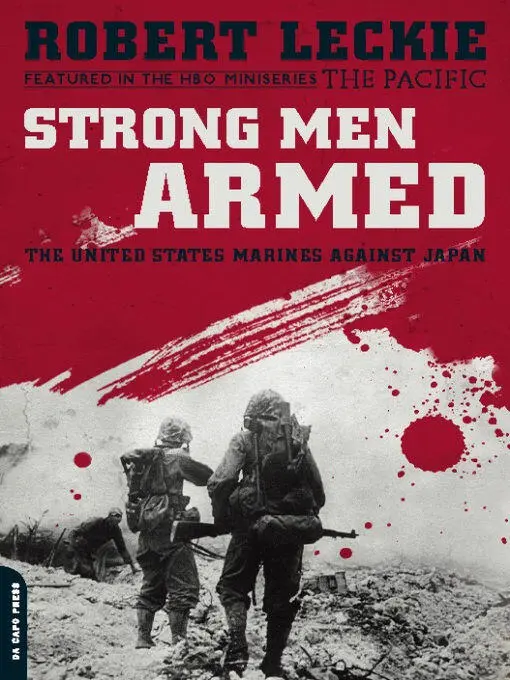
- Название:Strong Men Armed
- Автор:
- Издательство:Da Capo Press
- Жанр:
- Год:2010
- Город:Cambridge
- ISBN:978-0-786-74832-7
- Рейтинг книги:3 / 5. Голосов: 1
-
Избранное:Добавить в избранное
- Отзывы:
-
Ваша оценка:
Strong Men Armed: краткое содержание, описание и аннотация
Предлагаем к чтению аннотацию, описание, краткое содержание или предисловие (зависит от того, что написал сам автор книги «Strong Men Armed»). Если вы не нашли необходимую информацию о книге — напишите в комментариях, мы постараемся отыскать её.
Strong Men Armed — читать онлайн бесплатно полную книгу (весь текст) целиком
Ниже представлен текст книги, разбитый по страницам. Система сохранения места последней прочитанной страницы, позволяет с удобством читать онлайн бесплатно книгу «Strong Men Armed», без необходимости каждый раз заново искать на чём Вы остановились. Поставьте закладку, и сможете в любой момент перейти на страницу, на которой закончили чтение.
Интервал:
Закладка:
Dugout Sunday’s services began at ten in the morning, which was when Akatsuki, Ikazuchi and Shiratsuyo showed up. They steamed into the Bay with all guns going and pounded Marine coastal installations. They sank the tugboat Seminole and made wreckage of other little harbor craft. They looked hungrily about for other victims, and then, to their great surprise, geysers of water rose around them.
Gunners of the Third Marine Defense Battalion were blasting at the Japanese destroyers with five-inch rifles. They were scoring hits. Soon black clouds were boiling off the destroyers’ sterns. Sending up a screen of smoke, Akatsuki, Ikazuchi and Shiratsuyo streaked for home.
The airplanes arrived at half-past two.
The Japanese pilots attacked thinking the airfield had been knocked out. If they had come in the morning their belief would have been correct, in effect, for the rains of the preceding night had made a mire of both runways. But General Geiger put his repair crews to work while placing a call for help with American air bases in the south, and the Seabees and engineers, aided by a hot, drying sun, had the runways operable by midafternoon. Then there began that daylong jolting rhythm of flying, fighting, landing, refueling, rearming —and flying again.
Captain Joe Foss and Lieutenant Jack Conger were among those Marine fighter pilots who struck ferociously at the first Japanese flight of 16 heavy bombers, plus escorting Zeros. Foss had been on Guadalcanal only 16 days and he was already a legend. He had shot down 11 enemy planes—had flamed four bombers on October 23 alone—and now on Dugout Sunday, riding his cockpit with a dead cigar stub clenched in his teeth, he was climbing aloft to duplicate that feat. In the first scramble Foss and three others took on six Zeros. Foss got two of the three knocked down. But his Wildcat was so riddled by bullets he had to go down for another one, bringing his pilots down with him to refuel. They went back up to close with nine of the dozens of Zeros leading a fresh formation of bombers over the field. Foss shot down two more, and dove for home again, just one plane shy of a kill for every day he had spent on the island.
Lieutenant Jack Conger fought until he ran out of ammunition. He had escorted a crippled comrade back to Henderson, fighting off Zeros all the way. He shot one down, but now, as he turned and screamed up toward an enemy fighter, the pressure of his thumb on the gun button brought no response from his wing guns. Still he flew upward at the Zero. He brought his whirling propeller blades under its tail. The Zero turned frantically, and broke in two.
Conger’s plane was also staggered. It was going over, falling. Conger couldn’t bring it out. That huge obliquely-sliding mirror which was the surface of Iron Bottom Bay seemed to flip up toward him. Conger strained at his escape hatch. He couldn’t get out, he thought he would never get out, and that monster mirror was about to slap him. With a great wrench, Conger was free. He was barely 150 feet above the water when his parachute billowed, jerking him. He could see his plane plummet down among the coconuts, then he was into the mirror, jolted and jarred as though it possessed the very density and opaqueness of glass.
Conger surfaced, treading water. He slashed at the smothering shroud of his parachute. He glanced up to see another Zero falling in flames. He gaped in astonishment as its pilot floated down to water not 20 feet away from him.
Now there was a rescue boat speeding toward Conger. It came alongside, its exhaust putt-putting hollowly in the swells. Conger was hauled aboard. The boat slewed around and made for the Japanese pilot. Conger called to him, made surrender motions. The flier dived under. He came up beside the boat, kicked with both feet against its hull, and tried to swim away. The boat pursued. Conger grabbed a boathook and caught the flier by his jacket. The man struggled. Conger leaned forward. They contemplated each other, warbirds of East and West, the one rescuing, the other refusing—and the Japanese pulled out a Mauser pistol, pressed it against Conger’s face and pulled the trigger.
Click!
Conger sprawled backward. I’m dead! he thought. But he was not, nor was the Japanese pilot, who, failing to return death for life, had placed the pistol to his own head and produced another click. Conger seized a water can and slammed it down on the flier’s head. Limp and unconscious, the Japanese was hauled into the boat.
In all, 26 Japanese planes fell to Marine fighters and antiaircraft gunners. Marine bombers went up too, and from the hilarious shouts of their returning pilots, even the imprisoned little flier might have guessed that they had caught the Japanese ships behind Florida and left a cruiser sinking.
And yet, the flier’s confusion could never match the consternation of that naval liaison officer then composing a fourth report for Admiral Yamamoto. The Army’s night attack had failed. There had been “difficulty in handling the force in the complicated terrain,” he reported, but General Hyakutate was going to try again that night. The Army was ready.
The Army had better be ready, the Navy thundered. There was a naval battle making up northeast of the Solomons and the Army must have possession of the airfield before it began.
Down the chain of command went Hyakutate’s frustration. Colonel Oka had better attack tonight. Maruyama’s Sendai had better keep faith with its motto: “Remember that Death is lighter than a feather, but that Duty is heavier than a mountain.”
But heavier than duty was that mountain of despair weighing upon the men of the Sendai this night of October 25. They munched their meager ration, stunned, dispirited and wet—for the jungle continues to drip long after the sun comes out. Their officers were not sure of their position; Matsumoto’s map had caused them to blunder into the Marines the preceding night. The men were still mindful of that hideous firepower which had nearly made zemmetsu of the 29th Regiment. What had happened to the 29th? Was it true that they had lost their colors? Where was Colonel Furumiya?
He was trapped behind the enemy lines.
The 7th Company which had carried the 29th’s colors through the Marine wire had been annihilated. Only Colonel Furumiya and a staff officer had survived. Throughout the night they had blundered through the dark, hoping to rejoin their regiment. They had become lost. With day, they had gone into hiding, for the colors were wound around the waist of Colonel Furumiya. Loss of the regiment’s colors to the enemy meant that the 29th would be struck from the lists in disgrace. Rather than risk exposing them to capture, Colonel Furumiya decided to lie low and await Maruyama’s inevitable night attack.
The inevitability of an attack that night of October 25 was also evident to Sergeant Paige’s platoon of machine-gunners, men with names like Leiphart, Stat, Pettyjohn, Gaston, Lock, McNabb, Swanek, Reilly, Totman, Kelly, Jonjeck, Grant, Payne, Hinson.
They had found their can of peaches in the jungle and had opened it with a bayonet—Guadalcanal’s all-purpose instrument—and eaten. Then they dug in, certain of an attack from the fact of the myriad winking lights they had seen in the jungle. They knew these were not fireflies but the colored flashlights which the enemy used for signaling.

Lieutenant Colonel Chesty Puller was also ready, though the fury of Dugout Sunday had not given his men much time to improve their positions; there had been time to resupply the 81-millimeter mortars, those unlovely stovepipe killers of which their gunners sang:
Читать дальшеИнтервал:
Закладка:
Похожие книги на «Strong Men Armed»
Представляем Вашему вниманию похожие книги на «Strong Men Armed» списком для выбора. Мы отобрали схожую по названию и смыслу литературу в надежде предоставить читателям больше вариантов отыскать новые, интересные, ещё непрочитанные произведения.










Обсуждение, отзывы о книге «Strong Men Armed» и просто собственные мнения читателей. Оставьте ваши комментарии, напишите, что Вы думаете о произведении, его смысле или главных героях. Укажите что конкретно понравилось, а что нет, и почему Вы так считаете.