Robert Leckie - Strong Men Armed
Здесь есть возможность читать онлайн «Robert Leckie - Strong Men Armed» весь текст электронной книги совершенно бесплатно (целиком полную версию без сокращений). В некоторых случаях можно слушать аудио, скачать через торрент в формате fb2 и присутствует краткое содержание. Город: Cambridge, Год выпуска: 2010, ISBN: 2010, Издательство: Da Capo Press, Жанр: nonf_military, на английском языке. Описание произведения, (предисловие) а так же отзывы посетителей доступны на портале библиотеки ЛибКат.
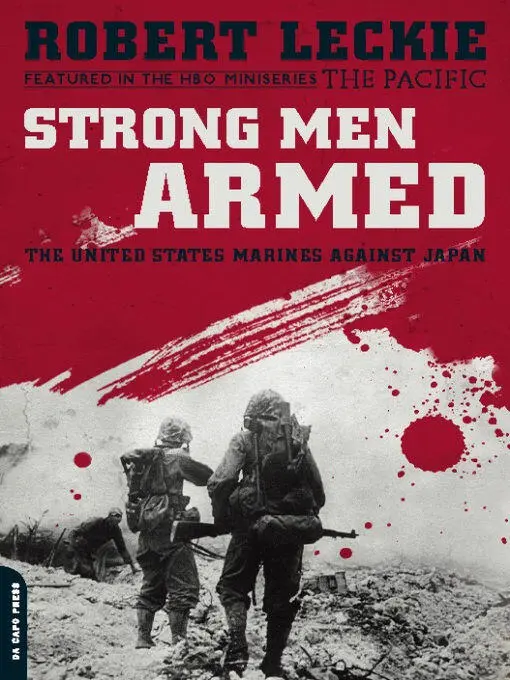
- Название:Strong Men Armed
- Автор:
- Издательство:Da Capo Press
- Жанр:
- Год:2010
- Город:Cambridge
- ISBN:978-0-786-74832-7
- Рейтинг книги:3 / 5. Голосов: 1
-
Избранное:Добавить в избранное
- Отзывы:
-
Ваша оценка:
Strong Men Armed: краткое содержание, описание и аннотация
Предлагаем к чтению аннотацию, описание, краткое содержание или предисловие (зависит от того, что написал сам автор книги «Strong Men Armed»). Если вы не нашли необходимую информацию о книге — напишите в комментариях, мы постараемся отыскать её.
Strong Men Armed — читать онлайн бесплатно полную книгу (весь текст) целиком
Ниже представлен текст книги, разбитый по страницам. Система сохранения места последней прочитанной страницы, позволяет с удобством читать онлайн бесплатно книгу «Strong Men Armed», без необходимости каждый раз заново искать на чём Вы остановились. Поставьте закладку, и сможете в любой момент перейти на страницу, на которой закончили чтение.
Интервал:
Закладка:
Only one of Nakaguma’s 10 medium tanks succeeded in crossing to the east or Marine bank. It held the tank company leader, Captain Maeda. It raced over the sandbar, rolled over the barbed wire, crushed a pillbox and swung right to come clanking down on a foxhole held by Private Joe Champagne.
Champagne ducked. He fumbled for his grenade. The tank’s underbelly blotted out the night. Champagne reached up, slipped the grenade into the tank’s treads. He huddled down again.
Wham!
Captain Maeda’s tank sloughed around out of control. A Marine half-track rolled out on the sandbar. Its 75-millimeter rifle flashed. Maeda’s tank lurched. The half-track fired again.
A sheet of flame gushed from Maeda’s tank. The half-track had hit the ammunition locker and the tank was blown 20 yards into the sea, where it was finished off.
Now, one by one, Marine half-tracks rolled down to the sandbar and destroyed the remaining tanks.
The attack which had begun with dark was over by ten o’clock in the night. Morning revealed a hideous spectacle on that sandbar. Nothing moved among jagged coconut stumps, twisted blackened tanks, whole tops of trees lying in broken-headed ruin among the heaps of dead—nothing moved but the bloated crocodiles swimming lazily downstream.
14
The day after the 4th Regiment met zemmetsu or annihilation on the Matanikau, Colonel Akinosuke Oka explained his own unit’s failure to attack with this report:
“The Regiment endeavored to accomplish the objective of diverting the enemy, but they seemed to be planning a firm defense of this region.”
It was not true, there was no defense on the left of the Marines opposite Nippon Bridge, and Lieutenant General Hyakutate could not accept Oka’s alibi. The colonel had again played the part of Ferdinand the Bull. But by late afternoon of October 24 the general was at last able to goad Oka into getting across the river and moving down toward that exposed left.
Oka did and moved too far.
Men of the Third Battalion, Seventh Marines, on top of the ridge where the Marine left was refused spotted Japanese soldiers moving across a lower ridge to their left. They reported it to headquarters.
General Vandegrift acted quickly. The Second Battalion, Seventh Marines, was even then moving out of reserve to relieve the Third Battalion, First, which had fought at the rivermouth the night before. Vandegrift turned this battalion south and sent it up to the undefended high ground lying about 1,000 yards east of the refused left flank.
The Marines of the reserve began moving south just as the sun began to fade from the sky to their right.
The dying sun of October 24 was on the left of Lieutenant General Maruyama’s main body as it at last moved north on its march to battle. Maruyama’s men had made their left turn, had quit the tortuous ravines, and were coming in undetected on the Marines who held the hills between them and Henderson Field. They could hear their own bombs exploding within the Marine perimeter a few miles in front of them. Maruyama was pleased that radio contact was being renewed with Hyakutate and that the naval liaison officer present at the Kukumbona headquarters would be able to relay news of the airfield’s capture to Admiral Yamamoto, thus sending the Combined Fleet into action.
General Maruyama was confident of victory. Like Colonel Oka, he believed that he was moving on a weak point in the enemy lines. He trusted in the map provided by Matsumoto. There was no reason not to. How could Maruyama know that the map taken from the dead Marine was an American copy of a map taken from a dead Japanese early in August? How could he suspect that the American lettering on it marked positions held by the Japanese prior to the Marine landing?
Maruyama, like Oka, was not moving against a gap. He was approaching the low-lying jungle to the east of Bloody Ridge, a point held by the battalion commanded by Chesty Puller.
The sun was down.
It was dusk of Saturday night, October 24.
A young Marine on patrol outside Puller’s line in the southern hills stopped dreaming of the delights of Saturday night back home and hurried to catch up with comrades who had left him behind. He paused. Behind him, just silhouetted on a low ridge, he could see a Japanese officer studying the line through field glasses. The officer disappeared. The Marine rushed on to report to his patrol leader.
Japanese south of the airfield?
Vandegrift was uneasy. He had just strengthened the Matanikau left with all he could spare from his reserve. What would he do if Puller got hit hard back there?
Probably, he thought, he would have to use the soldiers. There was a battalion of the 164th in bivouac behind the Tenaru.
The men of the U.S. 164th Infantry Regiment were sulking. They were sick and tired of being an orphan outfit, being pushed around. They had been squeezed out of their own division—the 41st—when the old National Guard “square” divisions were made “triangular,” that is, cut from four to three infantry regiments. They had been tossed into another orphan outfit with the bastard name of Americal Division—not even a number!—and been pushed around the Pacific. They had landed in dismal Noumea, which was bad enough, being an oversized hatrack for Navy brass, but which was also worse with those snooty French colonials frosting the doughfoots and the fact that if there was so much as a single native girl to go skylarking with she’d surely be found doing some shave-tail’s laundry.
Then they were detached again and handed over to the Marines!
They had been bombed and shelled and shot at and put on the Tenaru and then been made to suffer the indignity of having fresh-faced kids five and six years their junior tell them they should have been on Guadalcanal “when it was really rough.” Kids that couldn’t grow beards, and they’d come around with their notched rifles and try to swap souvenir battle flags for the candy the 164th still possessed or for wrist-watches that had not yet rusted in the jungle. Japanese “battle flags”1 Even the men of the 164th knew that the Marines made them by pounding red match tips onto the center of white handkerchiefs.
The men of the 164th were sore, nor did they feel any better when they heard the rumor that they had been alerted to stand by for action in a battle expected that night.
At seven o’clock on that night of October 24, Platoon Sergeant Mitchell Paige crawled forward to the nose of the ridge position which was then being occupied to nail down the Matanikau left flank. Paige’s men had reached their position in darkness. Now the sergeant was feeling around him with his hands, searching for a good position for the guns. He felt the ridge fall away sharply to either side.
“Here,” he whispered to the men of his machine-gun platoon. “Put the guns here.”
They set them up, moving stealthily, careful not to stumble in the mud, careful to slip the gun pintles into tripod sockets without a telltale clink of metal.
“Chow time,” Paige whispered. “Where’s the chow?”
They had one can of Spam and also a can of peaches “borrowed” from a rear-echelon galley on their march south to the ridge. The man carrying the peaches mumbled that he had dropped the can and it had rolled down the ridge into the jungle. There were fierce coarse things hissed in the dark and it was well for the loser of the peaches that the night veiled his face. Paige opened the Spam, tore the soft meat in pieces and pressed them into outstretched hands. The men ate.
They took up watches on their guns. It began to rain. Suddenly, after midnight, from far to their left, they heard the sound of battle.
At half-past midnight Sunday morning, October 25, the rain was coming down in a torrent, and a torrent of Japanese soldiers was washing against the line held by Chesty Puller’s Marines.
Читать дальшеИнтервал:
Закладка:
Похожие книги на «Strong Men Armed»
Представляем Вашему вниманию похожие книги на «Strong Men Armed» списком для выбора. Мы отобрали схожую по названию и смыслу литературу в надежде предоставить читателям больше вариантов отыскать новые, интересные, ещё непрочитанные произведения.








Обсуждение, отзывы о книге «Strong Men Armed» и просто собственные мнения читателей. Оставьте ваши комментарии, напишите, что Вы думаете о произведении, его смысле или главных героях. Укажите что конкретно понравилось, а что нет, и почему Вы так считаете.