Robert Leckie - Strong Men Armed
Здесь есть возможность читать онлайн «Robert Leckie - Strong Men Armed» весь текст электронной книги совершенно бесплатно (целиком полную версию без сокращений). В некоторых случаях можно слушать аудио, скачать через торрент в формате fb2 и присутствует краткое содержание. Город: Cambridge, Год выпуска: 2010, ISBN: 2010, Издательство: Da Capo Press, Жанр: nonf_military, на английском языке. Описание произведения, (предисловие) а так же отзывы посетителей доступны на портале библиотеки ЛибКат.
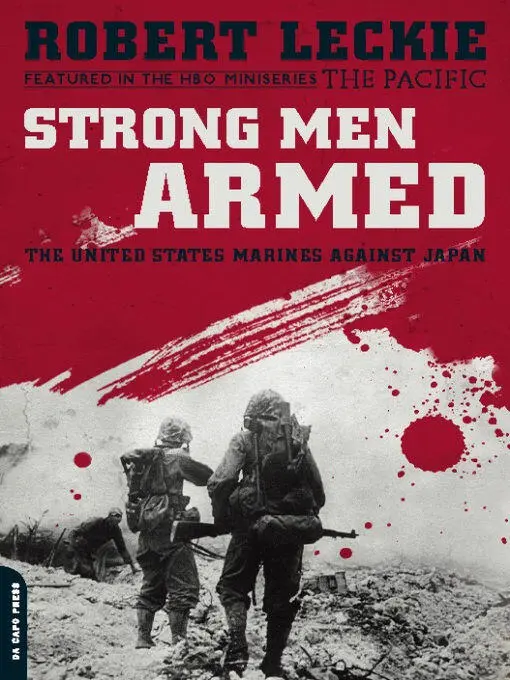
- Название:Strong Men Armed
- Автор:
- Издательство:Da Capo Press
- Жанр:
- Год:2010
- Город:Cambridge
- ISBN:978-0-786-74832-7
- Рейтинг книги:3 / 5. Голосов: 1
-
Избранное:Добавить в избранное
- Отзывы:
-
Ваша оценка:
Strong Men Armed: краткое содержание, описание и аннотация
Предлагаем к чтению аннотацию, описание, краткое содержание или предисловие (зависит от того, что написал сам автор книги «Strong Men Armed»). Если вы не нашли необходимую информацию о книге — напишите в комментариях, мы постараемся отыскать её.
Strong Men Armed — читать онлайн бесплатно полную книгу (весь текст) целиком
Ниже представлен текст книги, разбитый по страницам. Система сохранения места последней прочитанной страницы, позволяет с удобством читать онлайн бесплатно книгу «Strong Men Armed», без необходимости каждый раз заново искать на чём Вы остановились. Поставьте закладку, и сможете в любой момент перейти на страницу, на которой закончили чтение.
Интервал:
Закладка:
General Maruyama not only counted on surprise but also hoped to pierce the enemy line without a fight. The Sendai intelligence officer, a Lieutenant Colonel Matsumoto, having failed to obtain intelligence of the enemy by torturing a captured Marine, had beheaded the American in the honorable way and turned to searching enemy bodies. He had found an American operations map which showed many gaps in the enemy’s southern line. The map had been reproduced for the Sendai’s officers.
Lieutenant General Hyakutate was pleased. He agreed, also, that the American, Vandegrift, should surrender his sword at the rivermouth.
Maruyama bowed and strode off to join his main body.
The following day, October 18, far to the southeast in New Caledonia, a stocky American admiral with a bulldog face led a force of carriers into the harbor of Noumea. The great ships dropped anchor. A whaleboat drew alongside the admiral’s flagship. A naval officer came aboard and handed the admiral a manila envelope. Inside it was another marked SECRET. The admiral ripped it open. It was from Admiral Chester Nimitz, the commander-in-chief of the Pacific. It said: “You will take command of the South Pacific Area and South Pacific forces immediately.”
“Jesus Christ and General Jackson!” the admiral swore. “This is the hottest potato they ever handed me!”
William Frederick Halsey was taking over—old Bull Halsey of the craggy bristling jaw, the creed of attack and the undying hatred of the enemy. The Marines on Guadalcanal now knew they had a fighting sailor behind them.
The day after Halsey took command in the South Pacific, Secretary of the Navy Frank Knox held a press conference in Washington to discuss the perilous situation on Guadalcanal. There was a direct question: Could the Marines hold?
“I certainly hope so,” the secretary replied. “I expect so. I don’t want to make any predictions, but every man out there, ashore or afloat, will give a good account of himself.”
Those Marines on Guadalcanal who had been jubilant to hear that Old Bull was taking over received the secretary’s shy little pep talk with the wonderful bad grace which would always sustain them.
“Didja hear about Knox? It was on the ‘Frisco radio. He says he don’t know, but we’re sure gonna give a good account of ourselves.”
“Yeah, I heard—ain’t he a tiger?”
The Maruyama Road had run into unexpected roadblocks. Captain Oda’s engineers had slashed easily through the foothills of the Lunga Mountains, but then, three days and about 20 miles out, they had blundered into a maze of steep cliffs and a clutter of jungle-tangled ravines and gorges. General Maruyama chafed at the delay, but there was nothing he could do. A patrol might have moved along the Maruyama Road, but not almost a division of troops loaded down with burdens of 50 pounds each. Each man carried an artillery shell in addition to his own equipment. They had to cut footholds in the cliffs, haul the guns up by ropes. Rain fell constantly. Advance troops churned the underfooting into a mush which slowed the steps of following soldiers. Maruyama had to call repeated halts to close the gaps. His men were weakening, for Maruyama, having lost much food, had been forced to put them on one-third rations.
By evening of October 20 the Sendai was still far short of its intended position to the south. General Maruyama signaled his superiors by portable radio. Would the Navy hold off its sweep until October 26? The photographs made by the naval fliers had been imperfect. There were difficulties of terrain. Also, had he remembered to point out to General Hyakutate that General Vandegrift’s surrender offer must be accepted at once, that he must come from his headquarters alone but for an interpreter?
Alexander Vandegrift was not at his headquarters that evening. He was in Noumea, conferring aboard the U.S.S. Argonne with Bull Halsey, Major General Millard F. Harmon, the Army’s South Pacific commander, and Major General Alexander M. Patch, who would one day relieve Vandegrift. Even the commandant of the Marine Corps, Lieutenant General Thomas Holcomb, was present at this dramatic shipboard conference.
Vandegrift told his story. The facts marched forth as gaunt and unpolished as his Marines. Halsey asked:
“Are we going to evacuate or hold?”
“I can hold,” Vandegrift said. “But I’ve got to have more active support than I’ve been getting.”
Rear Admiral Richmond Kelly Turner was stung. He commanded the Amphibious Forces Pacific, and Kelly Turner could not accept that Marine rebuke without reply. He spoke quickly in the Navy’s defense. There were getting to be fewer transports and cargo ships, fewer warships to protect them. There were no sheltering bases at Guadalcanal, and the Solomons’ landlocked waters were too narrow for maneuver. There were enemy submarines.
Halsey heard him out. But he had made up his mind.
“All right,” he told Vandegrift. “Go on back. I’ll promise you everything I’ve got.”
Even as Vandegrift flew back to Guadalcanal, Lieutenant General Hyakutate had decided to press the attack on the Matanikau. His irritation had not been mollified by Maruyama’s nice touch about the surrender. The Navy had grown churlish. Kondo and Nagumo were badgering him: would soldiers never learn that ships sail on oil? The Combined Fleet could not remain much longer at sea. Hyakutate had better get on with it.
He did. On the afternoon of October 21, he ordered Pistol Pete to begin pounding the Third Battalion, First Marines, atop the ridges overlooking the sandbar at the rivermouth. With night, the tanks would roll.
But that afternoon Pistol Pete found himself in a fight with the five-inch rifles of the Third Marine Defense Battalion. Two of the Japanese 150’s were silenced, and the others were forced to change position.
When Colonel Nakaguma’s 4th Regiment came at the Marines that night with their tanks and their gobbling cries of death, the big howitzers joined the lighter ones to destroy the lead tank and send the remaining ten rumbling back into the jungle with the 4th’s infantrymen swarming after them.
The Japanese repulse was so swift, the flare-up so brief, that General Vandegrift considered the entire engagement a patrol action.
It had not been, of course, it had only been Colonel Oka again. Not ten minutes after the tanks had rolled, Lieutenant General Hyakutate had learned that Oka was twenty-four hours behind schedule. He not only had not gotten into position east of the river upstream, he hadn’t gotten over the river.
Hyakutate quickly called off the attack.
Next day the commander of the 17th Army arrived at the Matanikau front in a rage of command. He signaled Oka and told him that he had better get across the Matanikau and be prepared to attack the exposed left flank of the Marine line by the night of October 23. Men who malingered were to be dealt with ruthlessly.
The assault was going to be made the night of the twenty-third no matter what, and with any luck, it might just happen that Maruyama—from whom nothing had been heard since October 20—would strike at the same time.
But General Maruyama had not yet reached his point of attack on that black night of October 23, and Colonel Oka was still dragging his feet. Only Colonel Nakaguma attacked, and it would have been better for the Japanese cause if he had not. For Nakaguma was another of those Japanese officers who pressed home attacks that were no better than massed deathswarmings. They could not fight and run away, these commanders. They would not fight another day. They would look on death before defeat.
The 4th Regiment rushed into the massed fire of 10 batteries of Marine artillery, into the murderous interlocking fire of machine guns, rifles and automatic weapons. They were like moths, seeking to obliterate the light with their exploding bodies. They matched flesh against steel and were torn apart.
Читать дальшеИнтервал:
Закладка:
Похожие книги на «Strong Men Armed»
Представляем Вашему вниманию похожие книги на «Strong Men Armed» списком для выбора. Мы отобрали схожую по названию и смыслу литературу в надежде предоставить читателям больше вариантов отыскать новые, интересные, ещё непрочитанные произведения.










Обсуждение, отзывы о книге «Strong Men Armed» и просто собственные мнения читателей. Оставьте ваши комментарии, напишите, что Вы думаете о произведении, его смысле или главных героях. Укажите что конкретно понравилось, а что нет, и почему Вы так считаете.