Robert Leckie - Strong Men Armed
Здесь есть возможность читать онлайн «Robert Leckie - Strong Men Armed» весь текст электронной книги совершенно бесплатно (целиком полную версию без сокращений). В некоторых случаях можно слушать аудио, скачать через торрент в формате fb2 и присутствует краткое содержание. Город: Cambridge, Год выпуска: 2010, ISBN: 2010, Издательство: Da Capo Press, Жанр: nonf_military, на английском языке. Описание произведения, (предисловие) а так же отзывы посетителей доступны на портале библиотеки ЛибКат.
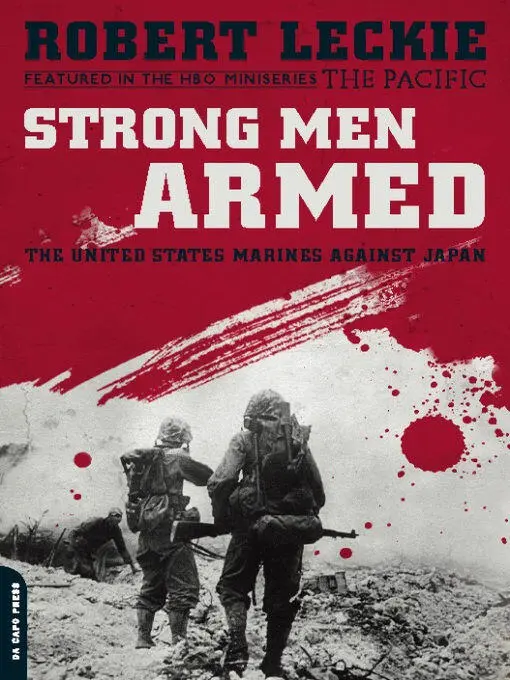
- Название:Strong Men Armed
- Автор:
- Издательство:Da Capo Press
- Жанр:
- Год:2010
- Город:Cambridge
- ISBN:978-0-786-74832-7
- Рейтинг книги:3 / 5. Голосов: 1
-
Избранное:Добавить в избранное
- Отзывы:
-
Ваша оценка:
Strong Men Armed: краткое содержание, описание и аннотация
Предлагаем к чтению аннотацию, описание, краткое содержание или предисловие (зависит от того, что написал сам автор книги «Strong Men Armed»). Если вы не нашли необходимую информацию о книге — напишите в комментариях, мы постараемся отыскать её.
Strong Men Armed — читать онлайн бесплатно полную книгу (весь текст) целиком
Ниже представлен текст книги, разбитый по страницам. Система сохранения места последней прочитанной страницы, позволяет с удобством читать онлайн бесплатно книгу «Strong Men Armed», без необходимости каждый раз заново искать на чём Вы остановились. Поставьте закладку, и сможете в любой момент перейти на страницу, на которой закончили чтение.
Интервал:
Закладка:
All this was done in the few days following the victory gained across the Matanikau October 7-9, done while that big invasion force of which the coastwatchers had sent warning was sailing down The Slot.
The Japanese ships were bringing Pistol Pete to Guadalcanal.
This was the collective nickname which the Marines were to bestow on those 150-millimeter howitzers with which General Maruyama hoped to chew up the runway at Henderson Field, as well as to batter the American lines.
On October 10 four of these big guns went aboard a seaplane tender at Rabaul.
Next day they sailed south in that task force which included destroyer-transports bringing more of the Sendai Division to Guadalcanal, cargo ships, a protecting screen of destroyers and a division of cruisers to shell Henderson Field while guns, men and supplies were being put ashore.
Waiting for them off Cape Esperance was Rear Admiral Norman Scott with four cruisers and five destroyers of his own.
Again the island of Guadalcanal was quivering like a live thing. Once more the night glowed with the glare of burning ships while concussions rolled unimpeded over blackly gleaming water. Marines ashore were throwing aside ponchos and blankets and rushing for their holes in frantic, jostling groups. And Alexander Vandegrift was entering his headquarters tent to sit in battle vigil beneath the light of a single blue electric bulb.
The Battle of Cape Esperance had begun.
Pistol Pete and the bombardment force coming down had collided with Rear Admiral Norman Scott’s cruisers and destroyers coming up. And Scott “crossed the T.” He swung wide of western Guadalcanal to cover the Savo Island water gate and at midnight his ships were standing broadside to the Japanese, all their guns swiveled and trained starboard upon the perpendicular of an enemy column “now visible to the naked eye.
Heavy Salt Lake City hurled ten swift salvos into cruiser Furutaka, broke her in two, sank her. Heavy San Francisco, the lights Boise and Helena, and the five destroyers, shot off shell after shell into the others. Big Aoba, Rear Admiral Aritomo Goto’s flagship, took 40 hits. She staggered out of the battle, Goto dying on his bridge, half of the crew dead. The big destroyer Fubuki went down. Destroyer-transports hit bottom. In the morning, planes from Henderson boiled out to finish big destroyers Natsugumo and Murakamo. By then the American destroyer Duncan was also gone—shot at by both sides—and Boise had two gun turrets burned out. But before morning Alexander Vandegrift’s vigil had ended in jubilation. Colonel Thomas had rushed into his tent to tell him that Norman Scott had squared accounts for the Battle of the Five Sitting Ducks. Iron Bottom Bay was no longer a Japanese lagoon. The Navy would be coming back, and there would be reinforcements.
But a dozen miles west to Kukumbona, General Maruyama gave orders for the emplacement of four big guns with their tractors. If many ships and men had not survived the crossing of the T—Pistol Pete had.
We asked all the Doggies to come to Tulagi
But General MacArthur said “No.”
When asked for his reason—
“It isn’t the season.
”Besides you have no U.S.O.!”
There was a refrain, beginning with the uncomplimentary and unjust sobriquet “Dugout Doug.” The Marines knew that General Douglas MacArthur was a brave man, but this did not deter them from singing their derision of the Army Dogfaces who had still not arrived on Guadalcanal. The Marines had given up hope—not of victory, but of help-and had turned to mocking the Doggies.
So they were astonished, almost resentful, to find on the morning of October 13 that the Doggies had actually come to Tulagi. The Army’s 164th Infantry Regiment had arrived from Noumea, just in time for a fiery baptism which not even the Marines had experienced.
For the thirteenth was also the day on which Australian coastwatchers in Bougainville were fleeing Japanese patrols and keeping radio silence. There were no advance warnings of the three Japanese aerial formations that struck so savagely at the island. At noon, 24 twin-engined bombers and escorting Zeros flew over Henderson Field before the Marine Wildcats could climb to intercepting stations. They let loose a rain of bombs and incendiary bullets that set stores of aviation gasoline blazing. Two hours later 15 more bombers pounced, multiplying destruction. Captain Joe Foss shot down one of the escorting Zeroes—his first—took a bullet in the oil pump of his engine and came rocketing down from 22,000 feet to a dead-stick landing while a trio of Zeros rode his tail. But the rest of the attackers escaped. And then the third Japanese formation struck, bombing the coconut groves where the 164th was bivouacked.
The Doggies had been blooded.
It was dusk and Sergeant Butch Morgan was preparing the evening meal for General Vandegrift. He was frying meat on a Japanese safe that had been upended and made into a griddle.
Pistol Pete spoke.
His first shell screamed over Division Headquarters and struck the airfield with a crash. Sergeant Morgan grabbed his helmet and raced for his air-raid hole. Another shell screeched overhead. Sergeant Morgan held his helmet down tight and ducked.
Crrrrrash!
Alexander Vandegrift looked up in surprise. He glanced thoughtfully overhead.
“That wasn’t a bomb,” he called. “That’s artillery.”
Sergeant Butch Morgan was embarrassed. He glanced about him, shamefaced, hoping that no boot had seen his flight—for Sergeant Morgan was an Old Salt who had fought in France and knew something of artillery.
“Aw, hell,” he muttered, taking off his helmet. “I mean, only artillery…”
If it was “only artillery” it was the first with enough authority to reach the airfield. And now Pistol Pete was pumping them out, ripping up the big strip with a thoroughness that would make night flight impossible, shifting to hammer the perimeter, swinging to Kukum to blow up naval stores—and finally falling among the men of the 164th with such rending red terror that a sergeant crawled about begging his men to shoot him.
And then the same terror came upon all the island.
Red flares shot up from the jungle, Pistol Pete roared and roared, enemy aircraft circled overhead—drifting in and out of the crisscrossing searchlight beams that sought them, eluding the flak and dropping bombs—and men stumbled into foxholes, climbed out of them, ran back to them, bracing in expectation of they knew not what.
At half-past one in the morning Louie the Louse planted a green flare over the airfield and the Night of the Battleships began.
Mighty Haruna and Kongo had steamed down from Rabaul. Cruisers and destroyers came with them, some to join the airfield bombardment, others to protect seven transports loaded with General Maruyama’s remaining troops.
They slid into the bay, screened by cruiser Isuzu and eight destroyers. They awaited the flares of the ground troops, the patrol plane’s green light. Then: “Commence firing!”
Star shells rose, horrible and bright, scarlet with the fat red beauty of Hell, exploding like giant ferris wheels to shower the night with streamers of light. And then, the 14-inchers of the battleships, the eight-inchers of Isuzu, the five-inchers of the destroyers…
Pah-boom, pah-boom. Pah-boom, pah-boom, pah
Men in their holes could hear the soft hollow thumping of the salvos to seaward, see the flashes shimmering outside the gun ports, and then the great airy boxcars rumbling overhead, wailing and straining— hwoo-hwooee —seeming to lose breath directly overhead, to pause, whisper, and go on. Then the triple tearing crash of the detonating shells and the bucking and rearing of the very ground beneath them.
Читать дальшеИнтервал:
Закладка:
Похожие книги на «Strong Men Armed»
Представляем Вашему вниманию похожие книги на «Strong Men Armed» списком для выбора. Мы отобрали схожую по названию и смыслу литературу в надежде предоставить читателям больше вариантов отыскать новые, интересные, ещё непрочитанные произведения.






Обсуждение, отзывы о книге «Strong Men Armed» и просто собственные мнения читателей. Оставьте ваши комментарии, напишите, что Вы думаете о произведении, его смысле или главных героях. Укажите что конкретно понравилось, а что нет, и почему Вы так считаете.