Robert Leckie - Strong Men Armed
Здесь есть возможность читать онлайн «Robert Leckie - Strong Men Armed» весь текст электронной книги совершенно бесплатно (целиком полную версию без сокращений). В некоторых случаях можно слушать аудио, скачать через торрент в формате fb2 и присутствует краткое содержание. Город: Cambridge, Год выпуска: 2010, ISBN: 2010, Издательство: Da Capo Press, Жанр: nonf_military, на английском языке. Описание произведения, (предисловие) а так же отзывы посетителей доступны на портале библиотеки ЛибКат.
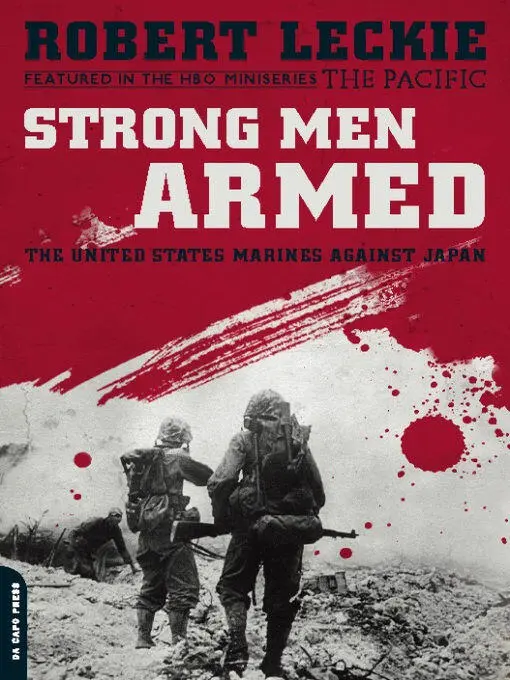
- Название:Strong Men Armed
- Автор:
- Издательство:Da Capo Press
- Жанр:
- Год:2010
- Город:Cambridge
- ISBN:978-0-786-74832-7
- Рейтинг книги:3 / 5. Голосов: 1
-
Избранное:Добавить в избранное
- Отзывы:
-
Ваша оценка:
Strong Men Armed: краткое содержание, описание и аннотация
Предлагаем к чтению аннотацию, описание, краткое содержание или предисловие (зависит от того, что написал сам автор книги «Strong Men Armed»). Если вы не нашли необходимую информацию о книге — напишите в комментариях, мы постараемся отыскать её.
Strong Men Armed — читать онлайн бесплатно полную книгу (весь текст) целиком
Ниже представлен текст книги, разбитый по страницам. Система сохранения места последней прочитанной страницы, позволяет с удобством читать онлайн бесплатно книгу «Strong Men Armed», без необходимости каждый раз заново искать на чём Вы остановились. Поставьте закладку, и сможете в любой момент перейти на страницу, на которой закончили чтение.
Интервал:
Закладка:
Back at his headquarters, Vandegrift was under the impression that the Raiders had crossed the river and were now engaging the enemy on the west bank. He thought his planned strike at the Japanese right flank was taking place. So he sent the companies under Major Rogers on an amphibious thrust at the Japanese left. They were to go west to the Kukumbona vicinity by boat that same day. They were to land there and cut off the “defeated” enemy’s retreat.
The Marines under Major Rogers shoved off just as the first of three waves of Zeros and bombers swept overhead. Destroyer Ballard which was to deliver supporting fire was forced to flee. Still the Marines went west, but when they came ashore they were far short of Kukumbona. They were at Point Cruz, a small peninsula just west of the Matanikau and just north or behind the Japanese left.
The Marines went in without radio, without naval gunfire, and before they had gone 500yards they were blasted by Japanese mortars and Major Rogers was killed. An enemy column came from the Matanikau’s west bank and struck them. The Marines took refuge on the top of a ridge, and the Japanese moved in between them and the sea and began pounding them with mortars.
Now Vandegrift had three battalions in trouble and the last one was out of contact.
H-E-L-P
Lieutenant Dale Leslie could not be sure. He was flying his Dauntless west of the Matanikau, on station for the aerial support planned against the Japanese there, and this could be another enemy trick. Leslie peered over the side of his plane. There it was—H-E-L-P—spelled out with something white, maybe T-shirts.
Leslie passed the word to the Fifth Marines, with whom he was in radio contact. The Fifth contacted Vandegrift and a rescue by sea was set in motion.
Ballard went west along the coast again. She stood off Point Cruz. Her officers saw a Marine leap up on a ridge about 500 yards inland. He was waving his arms, making semaphore signals.
The waving Marine was Sergeant Robert Raysbrook, standing erect amid Japanese bullets. His signals told Ballard’s officers that the Japanese stood between the Marine ridge and the beach. Ballard’s five-inchers boomed, striking the Japanese, cutting a swath of safety for the Marines. One of the batteries of Marine artillery which was to support the attack at the rivermouth raised sights and battered the nose of Point Cruz, which jutted into the water east of the besieged ridge and which could hold enemy gunners.
The Marines came down the ridge, taking heavy enemy fire. The Japanese rushed to close. Sergeant Tony Malinowski turned to cover his company’s withdrawal. He took on the onrushing Japanese with his BAR. He was never seen again.
But his comrades got down the hill. Now they were at the beach. The Japanese set up an interlocking fire of machine guns. They swept the beach. Casualties mounted. The Marines threw up a defensive perimeter while a Coast Guardsman named Donald Munro led the first wave of boats through the surf. They got in, though Munro was killed—winning a posthumous Medal of Honor. But the second wave hesitated.
Lieutenant Leshe nosed his Dauntless down again. He came in with a roar, flying low, shepherding the faltering boats shoreward, spraying bullets as he banked to climb for the return swoop. The Marines got out, with all of their 23 wounded, but not all of their 24 dead.
It was a daring rescue compounded of ingenuity and courage, and it served to take some of the sting out of the Marines’ defeat at the Matanikau.
Defeat it was, for Vandegrift shortly afterward called all his forces back from the river. He had lost 60 dead and 100 wounded and his repulse had been the result of bad intelligence and piecemeal commitment of forces, tactics that had heretofore characterized only Japanese operations.
But Cactus Air Force was still master of the aerial enemy. By the end of September General Geiger’s flyers had 171 Japanese kills to their credit. There were 19 little red balls painted on Major Smith’s Wildcat and “Smitty” had won the Medal of Honor. So had Major Bob Galer, who shot down 13 enemy planes, who might have destroyed more if he had not been knocked down three times himself. Captain Marion Carl’s string had been run up to 16, after the interruption of a jungle crash.
So the second month on Guadalcanal ended with the Marines on the ground bruised but still capable of more battle and with those in the skies steadily whittling enemy air power.
And then it was October.
11
October was the month of the dreadful rains, the month of decision, of change, of unending battle between men and ships and airplanes—the month of the Night of the Battleships, of Dugout Sunday, of Pistol Pete—the month when Americans on Guadalcanal were still hanging on while other Americans in Washington were backing off.
By day the Marines strengthened their lines, sent out patrols, rushed in supplies and troops or flew from the airfield to break up those aerial attacks which the enemy launched by day to clear the way for his movement at night. At night the Marines lay still in their holes, peering into the rain-swept darkness, knowing that destroyers were disgorging troops to the west, or that great dark shapes were gliding into the bay and that at any moment the silence might be shattered by the thundering of guns and the yelling of a new attack.
On each of those early October nights, the Tokyo Express brought an average of 900 troops to the island. On the night of October 4, they landed Lieutenant General Masao Maruyama.
Maruyama was a disciplinarian. He was a proud man, with haughty chin and an aristocratic nose beneath which ran a thin line of mustache as supercilious as a raised eyebrow. He was easily irritated, and he was displeased with what he found on Guadalcanal. Colonel Akinosuke Oka should not have allowed the American Marines to get away so cheaply on September 27. More, he should not have permitted the Ichiki and Kawaguchi survivors he commanded to mingle with the men of the Sendai’s fresh 4th Regiment and spread their tales of horror among them.
The 4th had arrived first from Rabaul. It had come ashore on Guadalcanal and reached Kukumbona, Maruyama’s headquarters, with its men full of vigor and splendidly equipped. Apart from his weapon, each man was supplied two pairs of trousers, two shirts, gloves, camouflage helmet-cover and split-toed shoes. His pack bulged, not with uncooked rice, but with canned fish or beef, canned vegetables—even a ration of hard candy. None of the “Old Whisky” looted from the Philippines had yet come down to Guadalcanal for the troops, but there would certainly be beer for them later and saki for the officers.
But Oka had allowed these excellent men to mingle with the scarecrows bequeathed him by General Kawaguchi. Those who were not prostrate with malaria or malnutrition had been telling horrible stories of Guadalcanal to the men of the 4th.
On October 5, General Maruyama received a letter written by a soldier of the 4th and intercepted by his commanding officer. It said:
The news I hear worries me. It seems as if we have suffered considerable damage and casualties. They might be exaggerated, but it is pitiful. Far away from our home country a fearful battle is raging. What these soldiers say is something of the supernatural and cannot be believed as human stories.
Lieutenant General Masao Maruyama issued a general order, which said:
From now on, the occupying of Guadalcanal Island is under the observation of the whole world. Do not expect to return, not even one man, if the occupation is not successful. Everyone must remember the honor of the Emperor, fear no enemy, yield to no material matters, show the strong points as of steel or of rocks, and advance valiantly and ferociously. Hit the enemy opponents so hard they will not be able to get up again.
Читать дальшеИнтервал:
Закладка:
Похожие книги на «Strong Men Armed»
Представляем Вашему вниманию похожие книги на «Strong Men Armed» списком для выбора. Мы отобрали схожую по названию и смыслу литературу в надежде предоставить читателям больше вариантов отыскать новые, интересные, ещё непрочитанные произведения.







Обсуждение, отзывы о книге «Strong Men Armed» и просто собственные мнения читателей. Оставьте ваши комментарии, напишите, что Вы думаете о произведении, его смысле или главных героях. Укажите что конкретно понравилось, а что нет, и почему Вы так считаете.