Robert Leckie - Strong Men Armed
Здесь есть возможность читать онлайн «Robert Leckie - Strong Men Armed» весь текст электронной книги совершенно бесплатно (целиком полную версию без сокращений). В некоторых случаях можно слушать аудио, скачать через торрент в формате fb2 и присутствует краткое содержание. Город: Cambridge, Год выпуска: 2010, ISBN: 2010, Издательство: Da Capo Press, Жанр: nonf_military, на английском языке. Описание произведения, (предисловие) а так же отзывы посетителей доступны на портале библиотеки ЛибКат.
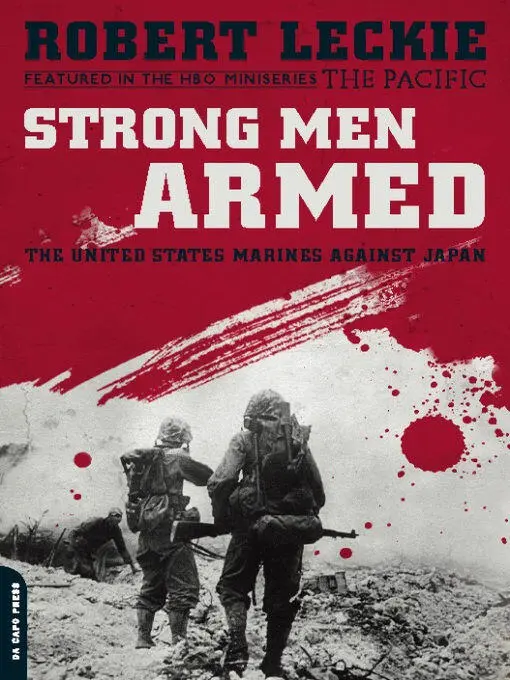
- Название:Strong Men Armed
- Автор:
- Издательство:Da Capo Press
- Жанр:
- Год:2010
- Город:Cambridge
- ISBN:978-0-786-74832-7
- Рейтинг книги:3 / 5. Голосов: 1
-
Избранное:Добавить в избранное
- Отзывы:
-
Ваша оценка:
Strong Men Armed: краткое содержание, описание и аннотация
Предлагаем к чтению аннотацию, описание, краткое содержание или предисловие (зависит от того, что написал сам автор книги «Strong Men Armed»). Если вы не нашли необходимую информацию о книге — напишите в комментариях, мы постараемся отыскать её.
Strong Men Armed — читать онлайн бесплатно полную книгу (весь текст) целиком
Ниже представлен текст книги, разбитый по страницам. Система сохранения места последней прочитанной страницы, позволяет с удобством читать онлайн бесплатно книгу «Strong Men Armed», без необходимости каждый раз заново искать на чём Вы остановились. Поставьте закладку, и сможете в любой момент перейти на страницу, на которой закончили чтение.
Интервал:
Закладка:
Then, while awaiting the arrival of his other troops—the 16th and 29th Regiments, his heavy artillery and a few thousand men of a Naval Landing Force Brigade—General Maruyama went to work planning an advance across the Matanikau. He, too, had seized the importance of the east bank. He would need it to gain room for the jumping-off of his main attack. He ordered Colonel Juro Nakaguma to take the 4th across the river in the early-morning dark of October 7.
Then Maruyama began searching his maps for that point most suitable to receive the surrender of the American General Vandegrift.
Although the detail of a surrender point escaped him, Alexander Vandegrift also studied maps of the Matanikau that afternoon of October 5.
He still believed that he could not allow the Japanese west of the river to build their forces unmolested. His earlier setback had only impressed upon him the need of using a force large enough to destroy the enemy. He decided to use five full battalions led by Red Mike Edson, now commander of the Fifth, and Colonel Wild Bill Whaling of the special Scout-Snipers group.
They would attack on October 7.
On October 6 the Japanese 4th Regiment’s approach march from Kukumbona to the Matanikau was broken up by Marine aircraft. The men took cover. At night Colonel Nakaguma ordered them forward to the west bank of the river. They dug in. They would cross in the early morning. Meanwhile, Nakaguma sent three of his companies downstream to the rivermouth. They crossed there.
On October 7 Colonel Edson’s force reached the east bank of the Matanikau mouth. The Third Battalion, Fifth, joined battle with Nakaguma’s three companies which had crossed to the east bank. The Marines pressed the Japanese back, slowly containing them. Edson asked for reinforcements. Vandegrift sent the Raiders into their last battle. Commanded by Major Silent Lou Walt of the Fifth Marines, the Raiders helped push the enemy into a pocket. During the night the Japanese attempted to break out. They were destroyed.
Upriver on October 7 Colonel Whaling’s men were unable to cross until nightfall, at which time they turned right to face the sea themselves on the west bank, the Edson forces on the east bank.
On October 8 it rained. Water poured from skies so dark that the jungle became a murk of gloom. Both sides were mired in a slop of mud.
On October 9 the coastwatchers up north sent word of a great invasion force making up in Rabaul. Vandegrift was forced to shave his ambitions. Even though Whaling’s men had begun to make good progress seaward that day and Edson was across the Matanikau, Vandegrift decided that he would not strike at Kukumbona but be content with battering the enemy in the Point Cruz-Matanikau Village area before withdrawing to the east bank of the river and fortifying it.
It was then that the First Battalion, Seventh, was ordered out on reconnaissance again.
Lewis Burwell Puller was the battalion commander’s full name, but he was simply “Chesty” to his men. This was the famous Chesty Puller who had already blooded his battalion in the Matanikau defeat and who had chafed at the order to withdraw. He was a man of only five feet six inches in height, but with an enormous rib cage stuck on a pair of matchstick legs—the barrel chest crowned by a great commanding head with strong outthrust jaw. At forty-four Puller was only a “light” colonel, for in him there was none of the guile that slips up the ladder of promotion. Chesty had become notorious among brother officers for insisting that regimental staffs were too large and the distance between command posts and front lines was too long. When he came to Guadalcanal leading the First Battalion, Seventh, he was already legendary for battles which had won him two Navy Crosses and for a salty tongue which had won him the affection of his men. Asked why Nicaragua patrols were slow, he had snapped: “Because of the officer’s bed roll!” Shown his first flame-thrower, he had growled: “Where do you fit the bayonet on it?” Flunked out of Pensacola flying school on the unique report, “Glides too flat, skids on turns, climbs too fast,” he had merely been relieved that he might return to the riflemen where “all the fightin’s on foot.”
And now he was on foot again during the afternoon of October 9, leading his battalion over a series of grassy ridges west of the Matanikau near the coast. Atop a high ridge Puller saw that a ravine below him was swarming with Japanese. At the same moment he received orders to scout the coastal road toward Kukumbona and to avoid combat. He asked and obtained permission to stay where he was for he had found a whole battalion under his guns.
The ravine became a slaughter-pen.
Marine mortar shells fell with dreadful accuracy. Death swept suddenly and invisibly among those Japanese, devastating them. They swarmed blindly up the hill against Puller’s men. They were raked with small arms. They fled back down into the ravine, rolling down the slope, sprinting in terror through that hell of mortar fire and up the side of an opposing ridge, only to re-emerge on the crest in full view of Puller’s Marines. They were riddled.
Again they fled down into the ravine, again they tried to come up through Puller’s men again, were halted, turned, and sent through the reverse gantlet once more—and now the carnage was multiplied by the aerial bombs and artillery shells which Chesty Puller had called down into the ravine.
There were few Japanese who survived.
Seven hundred fell in that awful trap, and Lieutenant General Masao Maruyama’s attempt to seize the east bank of the Matanikau met with disaster. For there were roughly 200 more casualties inflicted on the 4th Regiment as the converging Whaling and Edson forces drove briskly into Point Cruz-Matanikau Village. The 4th was shattered and now Nakaguma’s men had terrifying tales of their own to spread among comrades sailing south to the place they would call Death Island.
Marines withdrawing east from the river, bringing back their 65 dead and 125 wounded, heard the welcome roar of massed motors overhead. Major Leonard (Duke) Davis was leading Squadron 121 to the Cactus Shivaree.
Riding the cockpit of one of those 20 Wildcats was a cigar-smoking, blunt-featured, high-spirited Marine captain by the name of Joseph Jacob Foss.
12
It was clear that the Matanikau had eclipsed the Tenaru in importance. The Japanese no longer landed on eastern Guadalcanal but came ashore in the west. It was vital that the Marines’ western boundary be extended to the east bank of the Matanikau River to stop the inevitable thrust from the west.
Because he had not enough men to hold all the river line, Vandegrift decided to defend the two main crossings—at the mouth of the river and at the upriver crossing which the Marines called Nippon Bridge from the Japanese characters ippon-bashi, meaning “one-tree bridge.” This was about 2,000 yards inland, just below the fork in the stream.
The river block became a shallow horseshoe. Fortifications at the mouth “refused” the right flank, that is, exposed it in a backward curve to the beach behind it. Then the line ran slightly more than 2,000 yards along the river past Nippon Bridge to refuse the left flank, which was drawn back across a ridge and down into the jungle and allowed to dangle there.
Vandegrift knew it was possible to cross the river at other points farther inland than Nippon Bridge. But he was making shift with what he had. He could spare two battalions. The Third Battalion, Seventh, went in line on the left and the Third Battalion, First, on the right. They could be reinforced and supplied along the coastal road connecting them with the original perimeter still held intact a few miles back east. Artillery was placed in support.
Читать дальшеИнтервал:
Закладка:
Похожие книги на «Strong Men Armed»
Представляем Вашему вниманию похожие книги на «Strong Men Armed» списком для выбора. Мы отобрали схожую по названию и смыслу литературу в надежде предоставить читателям больше вариантов отыскать новые, интересные, ещё непрочитанные произведения.











Обсуждение, отзывы о книге «Strong Men Armed» и просто собственные мнения читателей. Оставьте ваши комментарии, напишите, что Вы думаете о произведении, его смысле или главных героях. Укажите что конкретно понравилось, а что нет, и почему Вы так считаете.