Robert Leckie - Strong Men Armed
Здесь есть возможность читать онлайн «Robert Leckie - Strong Men Armed» весь текст электронной книги совершенно бесплатно (целиком полную версию без сокращений). В некоторых случаях можно слушать аудио, скачать через торрент в формате fb2 и присутствует краткое содержание. Город: Cambridge, Год выпуска: 2010, ISBN: 2010, Издательство: Da Capo Press, Жанр: nonf_military, на английском языке. Описание произведения, (предисловие) а так же отзывы посетителей доступны на портале библиотеки ЛибКат.
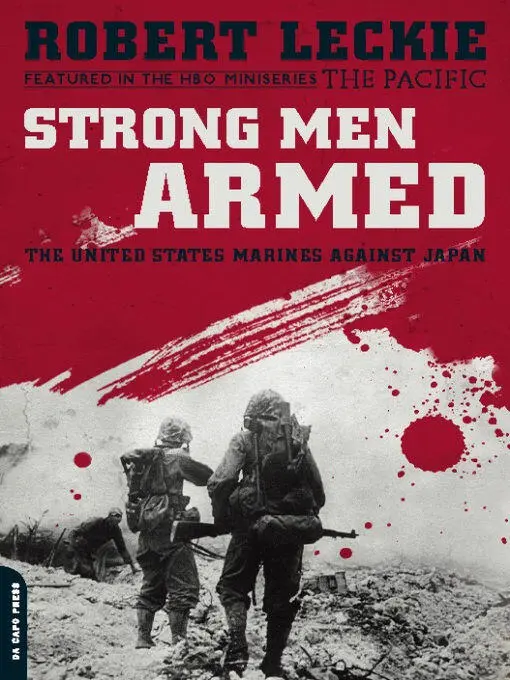
- Название:Strong Men Armed
- Автор:
- Издательство:Da Capo Press
- Жанр:
- Год:2010
- Город:Cambridge
- ISBN:978-0-786-74832-7
- Рейтинг книги:3 / 5. Голосов: 1
-
Избранное:Добавить в избранное
- Отзывы:
-
Ваша оценка:
Strong Men Armed: краткое содержание, описание и аннотация
Предлагаем к чтению аннотацию, описание, краткое содержание или предисловие (зависит от того, что написал сам автор книги «Strong Men Armed»). Если вы не нашли необходимую информацию о книге — напишите в комментариях, мы постараемся отыскать её.
Strong Men Armed — читать онлайн бесплатно полную книгу (весь текст) целиком
Ниже представлен текст книги, разбитый по страницам. Система сохранения места последней прочитанной страницы, позволяет с удобством читать онлайн бесплатно книгу «Strong Men Armed», без необходимости каждый раз заново искать на чём Вы остановились. Поставьте закладку, и сможете в любой момент перейти на страницу, на которой закончили чтение.
Интервал:
Закладка:
Admiral Lee was hungering for intelligence as his ships swept west of Savo, turned north, swung east and put the hulking island off to the right, unaware that he had also put two little torpedo boats to his left. Admiral Lee signaled Guadalcanal, using the code word, “Cactus.” Back came the exasperating reply:
“We do not recognize you.”
Admiral Lee decided to play it by ear. Archie Vandegrift was his personal friend. He would remember Lee’s Annapolis nickname.
“Cactus, this is Lee. Tell your big boss Ching Lee is here and wants the latest information.”
Silence.
And then, over the Talk Between Ships from the softly chatting torpedo boat skippers, came this:
“There go two big ones, but I don’t know whose they are.”
Unrecognized to his right, suspected to his left, Admiral Lee quickly called Guadalcanal.
“Cactus, refer your big boss about Ching Lee. Chinese, catchee? Call off your boys!”
Guadalcanal replied: “The Boss has no additional information,” and Admiral Lee took his battleships into the Bay. He about-faced and sailed west again. It was close to midnight when he addressed the startled PT-boat skippers:
“This is Ching Lee. Get out of my way. I’m coming through!”
The little boats scurried aside and the battleships went through.
At sixteen minutes past one in the morning, Lee’s radar screens were covered with approaching pips and there was a babble of Japanese voices on the radio-telephone.
It went hard at first for the Americans. Preston, Benham and Walke took the full brunt of shoals of Japanese torpedos and were sunk. South Dakota was pinioned like a big bug on the cold white shafts of enemy searchlights and was shuddering under the impact of their shells. But Lee’s flagship Washington had tracked mighty Kirishima and her terrible sixteen-inchers were tearing her apart. Kirishima was a mass of flames topside, and would soon join her sister Hiei on the bottom of the sea. And now South Dakota was helping Washington batter the heavy cruisers Atago and Takao. Her great guns flashed and smoked above the litter of dead and wreckage topside. The Japanese heavies dragged themselves out of the fight. They would not see action again for many, many months. The destroyers and lights fled after them.
It was quiet on the Bay.
Ching Lee sailed back to Noumea with triumphant Washington, with valiant South Dakota, with lucky little Gwin.
Never again would Japanese battleships come out to fight until they sailed to their fiery Götterdämmerung in the narrow seas of Surigao Strait two years hence. The three-day Naval Battle of Guadalcanal was over.
The Marines had held, and now they were truly saved.
18
It was December 9 and command of Guadalcanal was passing from the Marines to the Army.
Major General Vandegrift had again put together an offensive to the west and had finally seized the high ground he wished to hold. The Army would direct the clean-up of the island.
The last weeks of November and early days of December were relatively quiet, though the enemy continued to sneak in a few thousand troops by barge. On November 30 Japan sent down the last supplies by sea, and won the Battle of Tassafaronga when the torpedoes of eight of her destroyers drove off the American force trying to intercept them.
Aerial battles sputtered sporadically, there were infrequent bombings, but Henderson Field was gradually shaping up as the great forward bastion of American air power in the Pacific. From the 31 Marine aircraft with which Cactus Air Force was launched on August 20, Henderson’s strength had slowly risen through September, had sunk to that disastrous low of 14 after the Night of the Battleships, and was now climbing toward 150.
Troop strength had increased concurrently. Vandegrift now commanded his own First Marine Division as well as all but one infantry regiment of the Second Marine Division and the Army’s Americal Division. With these went supporting troops and specialists.
As Major General Alexander Vandegrift handed over command to Major General Alexander Patch on this day of December 9, the men who had done so much to make the Rising Sun stand still—the men of Vandegrift’s First Marine Division —were coming down from the hills.
Some of these Marines had spent as many as 122 consecutive days on the lines without relief. They gaped in astonishment at the mountains of food heaped within supply dumps behind their perimeter, for they had only dreamed of this while their sodden bellies growled with rice and Argentine corned beef. They saw big trucks raising clouds of dust along the coastal road, great four-engined bombers roaring off the airfield, ships of all sizes in the Bay. They saw the new cemetery, serried ranks of white crosses broken here and again with stars of David. They were astounded to hear that there was an open-air movie near the airfield, and most of them refused to go—for they wanted nothing of a luxury that belittled their own hard memories of this island.
Then they marched down to the beach to take ship. The Fifth Regiment left first on December 9, the First Marines by December 22, the Seventh Marines before January.
But they could not really march. They stumbled. They were ragged, bearded, sick, emaciated. They had not the strength to climb the cargo nets. Sailors had to pull them over the gunwales, fish them out of the water where they had fallen—doing it gladly and with open tears. They were sticks of men and their sunken eyes stared wonderingly at that island they were leaving, where General Vandegrift, Manila John Basilone, Red Mike Edson, Mitchell Paige and the fallen Major Bailey had won Medals of Honor; where 621 of the Division’s men died, where 1,517 more were wounded and another 5,600 had been stricken with malaria. It seemed such a small cost to balance against the 30,000 soldiers Japan lost at Guadalcanal. But who would count that other cost, that toll of suffering and sacrifice told in shrunken necks and knobby joints and stark rib cages and faces made of bone and parchment flesh?
They couldn’t tell. They could only go below to the Marine’s reward of a hot meal and a clean bunk, while the great ships shuddered and made for the open sea.
Behind them, General Patch’s soldiers and Marines were already moving against General Hyakutate’s remnant, men now scourged beyond belief by malaria and beriberi, men who were now clinging, as the Marines had clung, to the hope of reinforcement. It had been often promised in propaganda leaflets tucked inside those pitiful few sacks of rice or cases of bullets air-dropped to them from the skies:
“The enemy is collapsing before your eyes.”
“We are convinced of help from Heaven and Divine Grace. Respect yourself and by no means run away from the encampment.”
“We, too, will stick to it.”
But they did not. Though there had been bitter conferences between the Army High Command and the War Ministry, though staff officers came to blows in the quarrel over whether Guadalcanal should be reinforced or evacuated, it was the War Ministry’s resolve to evacuate that carried.
Once again swift destroyers swept down The Slot. On three February nights 20 destroyers skillfully took off Haruyoshi Hyakutate and most of the 13,000 men remaining in his 17th Army. On the afternoon of February 9, 1943, at a village west of the Tenamba River, a patrol of soldiers from the 132nd Infantry joined with another patrol from the 161st Infantry. They had reached the island’s west coast and found no enemy.
Guadalcanal was secured.
But not until October 27, 1947, did the last of those most tenacious Japanese soldiers surrender. He came out of his cave, his hair long and matted, his uniform in tatters, a broken Australian bayonet stuck in his belt, a shovel in one hand, a water bottle in the other. His feet were bound in rags and wire, and as he approached a member of the British constabulary, he bowed deeply from the waist.
Читать дальшеИнтервал:
Закладка:
Похожие книги на «Strong Men Armed»
Представляем Вашему вниманию похожие книги на «Strong Men Armed» списком для выбора. Мы отобрали схожую по названию и смыслу литературу в надежде предоставить читателям больше вариантов отыскать новые, интересные, ещё непрочитанные произведения.











Обсуждение, отзывы о книге «Strong Men Armed» и просто собственные мнения читателей. Оставьте ваши комментарии, напишите, что Вы думаете о произведении, его смысле или главных героях. Укажите что конкретно понравилось, а что нет, и почему Вы так считаете.