Robert Leckie - Strong Men Armed
Здесь есть возможность читать онлайн «Robert Leckie - Strong Men Armed» весь текст электронной книги совершенно бесплатно (целиком полную версию без сокращений). В некоторых случаях можно слушать аудио, скачать через торрент в формате fb2 и присутствует краткое содержание. Город: Cambridge, Год выпуска: 2010, ISBN: 2010, Издательство: Da Capo Press, Жанр: nonf_military, на английском языке. Описание произведения, (предисловие) а так же отзывы посетителей доступны на портале библиотеки ЛибКат.
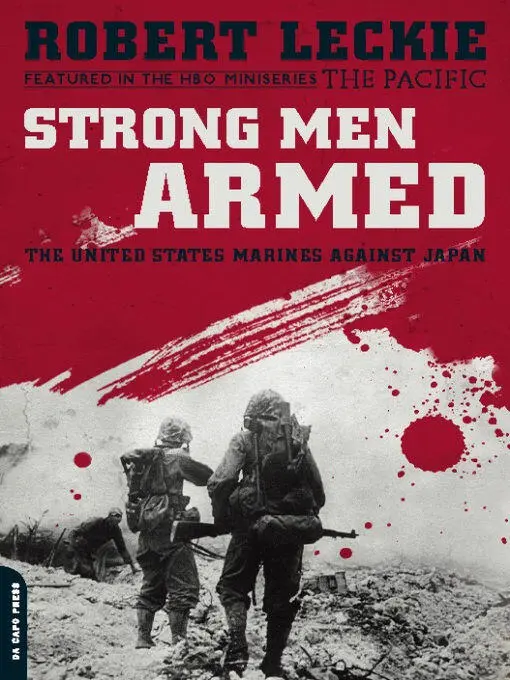
- Название:Strong Men Armed
- Автор:
- Издательство:Da Capo Press
- Жанр:
- Год:2010
- Город:Cambridge
- ISBN:978-0-786-74832-7
- Рейтинг книги:3 / 5. Голосов: 1
-
Избранное:Добавить в избранное
- Отзывы:
-
Ваша оценка:
Strong Men Armed: краткое содержание, описание и аннотация
Предлагаем к чтению аннотацию, описание, краткое содержание или предисловие (зависит от того, что написал сам автор книги «Strong Men Armed»). Если вы не нашли необходимую информацию о книге — напишите в комментариях, мы постараемся отыскать её.
Strong Men Armed — читать онлайн бесплатно полную книгу (весь текст) целиком
Ниже представлен текст книги, разбитый по страницам. Система сохранения места последней прочитанной страницы, позволяет с удобством читать онлайн бесплатно книгу «Strong Men Armed», без необходимости каждый раз заново искать на чём Вы остановились. Поставьте закладку, и сможете в любой момент перейти на страницу, на которой закончили чтение.
Интервал:
Закладка:
He inquired about the war and about the Americans, those ferocious Marines whom Tokyo Rose always called “the butchers of Guadalcanal.” He was told that they had sailed away nearly five years ago.
And gone charging on to westward.
II. All Their Blood
Song for a Pilot
Who plows the sky, said a wise man,
Shows himself a fool;
But he went out to plow it—
Taught in a different school.
Who sows the wind, says Scripture,
Must reap and reap again;
But he went out to sow the wind—
And reaped the bitter grain.
He took his death like charity,
Like nothing understood;
He freshened all the oldest words
With all his blood.
1
Once a jolly swagman camped by a billabong
Under the shade of a coolibah tree.
And he sang as he watched and waited till his billy boiled,
“You’ll come a waltzin’ Matilda with me.”
It was a great tune to march to, a rollicking one to bellow at top voice while rolling merrily home through the quiet broad streets of Melbourne—that spacious airy Australian city where the First Marine Division had begun to recuperate from Guadalcanal.
The Marines arrived in Melbourne in early January, 1943, and were at once clasped to the hearts of its people. They were looked upon as the saviors of Australia, for they had preserved the country’s lifeline to America. They were treated as saviors, in spite of their being men of another nation as well as mere human beings inclined to take advantage of the savior status. But there seemed to be nothing that these Marines could do to outrage their hosts, and gradually, after the Marines’ inevitably exuberant response to the delights of civilization became contained, there developed between host city and guest army a friendship so warm and understanding as to be unique.
Australian soldiers or “Diggers” who might have been miffed, at first, to find the pubs closing early a few times weekly because the Yankee Marines had again drunk the town dry, also found that they were perpetually welcome at the wet canteens or “slop-chutes” of the Marine camps. Complaints that the Americans’ voracious appetite for steak-and-eggs was making beef hard to come by were tempered by the realization that the Yanks were generous with their coveted cigarettes and that they frequently arrived at Australian homes bringing a pound of precious butter. Soon the Aussies were saying “okay” for “good-o” and their movie theaters played “The Marines’ Hymn” as often as “God Save the King,” while over in the Marine camps—where the band often played “Waltzin’ Matilda” on ceremonial parade—the Yanks called their friends “cobber” and spoke of riding a “tram” to keep a date with some “shiela.” Before the division departed Melbourne there was many a Yankee ring on an Australian finger, and during the nine months of that truly remarkable rest the Marines thought less and less of the alternating hell of fear and fire which they had left behind them, remembering it only when a comrade looked up from a Melbourne newspaper account of the war in North Africa or New Guinea and exclaimed:
“I wonder what it’s like back on the ‘Canal?”
Back on the ‘Canal in that early January of 1943 the war had lost its spectacular quality. Over at Tulagi there was a sign which, in letters two feet high, proclaimed Bull Halsey’s battle creed: KILL JAPS, KILL JAPS, KILL MORE JAPS. But most of the killing would have to be done farther north, for Hyakutate’s men had already pulled back preparatory to their evacuation and Japanese naval strength no longer ventured south.
The coastwatchers who occupied the lonely high peaks of Guadalcanal were being called in. Among them was the erstwhile planter K. D. Hay, a veteran of World War One and easily the fattest man in the South Pacific. Yet he had hung on to his station at the mountain mining camp known as Gold Ridge. But now, in January, he was coming down, bringing with him the aged nun who was the sole survivor of a Japanese mission massacre and whom Hay had cared for. Melanesian bearers brought the nun down. Hay made his own panting descent. By the time he had reached the coastal road he was near collapse. He sent word to the Americans requesting a jeep. He explained that he was “knocked up,” innocently unaware that the Australian slang for being exhausted was also American slang for being pregnant.
A puzzled U. S. Army officer drove up the road. He saw Hay. He saw his belly. He clapped his hand to his forehead and swore:
“My God, it’s true!”
In mid-January Japanese aerial attacks on Henderson Field began to increase, giving Captain Joe Foss his chance to break Captain Eddie Rickenbacker’s record.
Foss was back on Guadalcanal. He had recovered from the malaria which had stricken him November 24, the day after he had shot down his twenty-third plane. He had been evacuated to Sydney, but now he was back with Squadron 121 with only a few weeks to go on his tour of duty. And all the talk was whether or not Joe would equal the 26 kills which had made Rickenbacker the American ace-of-aces in World War One.
On January 15 Captain Joe Foss became the ace-of-aces in the new war. On that day he tore into a formation of Zeros and shot down three of them. Foss’s score stayed at 26, while his squadron went on to record 164 kills against 20 of its own pilots lost. At the end of January Joe Foss’s tour of duty was over.
He went home to receive the Medal of Honor, the path of his homegoing convoy crossing that of those carriers and convoys coming out with a new weapon and a new outfit for the Marines’ war against Japan: the peerless Corsair fighter and the Third Marine Division.
The first of the Corsairs arrived at Guadalcanal on February 12. They came to Henderson Field with a bad reputation, for many Navy pilots swore they were “full of bugs” and at least one carrier commander refused to permit them aboard his ship. But the Marines made the Corsair their own, forgetting the stubborn Wildcat which had won the air battle of Guadalcanal in their jubilation at the range and staying power of this gull-winged, paddle-bladed killer. The big Corsairs could fly faster than anything Japan had, could climb nearly 3,000 feet a second, and range twice as far as the Wildcats. If they were difficult aboard ship they were not so ashore—and the Marine fliers would be landlocked for most of the rest of the war.
The Third Marine Division which entered the Pacific Theater almost simultaneously with the Corsair was not only new but also novel. It was a weld of raw recruit and battle-blooded. veteran. It made manifest the fact that the rewards of the Solomons offensive were not all strategic. Unlike Guam, Wake or the Philippines, Guadalcanal had ended in a victory that produced thousands of veteran warriors to drill and lead America’s cadres. Even the lowest ranks of the Third Division included men who had fought the Japanese on Guadalcanal. Having recovered from the wounds or malaria which had brought them home, they had been assigned to the Third. Many of the new division’s officers and top NCO’s were also veterans. They had been promoted and detached from the First to command in the Third.
Never again would a Marine division go into battle as green as the First had been at Guadalcanal. Every outfit would have its heavy quota of officers and men who knew the difference between the myth of the superman of the jungle and the fact of the tenacious enemy who fought so much with his heart, so little with his head. They could tell the boots and Ninety-Day Wonders of the Third that though the enemy was indeed “a tricky little bastard,” his tactics were so tied to trickery that he sometimes confused his means for his ends.
Читать дальшеИнтервал:
Закладка:
Похожие книги на «Strong Men Armed»
Представляем Вашему вниманию похожие книги на «Strong Men Armed» списком для выбора. Мы отобрали схожую по названию и смыслу литературу в надежде предоставить читателям больше вариантов отыскать новые, интересные, ещё непрочитанные произведения.









Обсуждение, отзывы о книге «Strong Men Armed» и просто собственные мнения читателей. Оставьте ваши комментарии, напишите, что Вы думаете о произведении, его смысле или главных героях. Укажите что конкретно понравилось, а что нет, и почему Вы так считаете.