Robert Leckie - Strong Men Armed
Здесь есть возможность читать онлайн «Robert Leckie - Strong Men Armed» весь текст электронной книги совершенно бесплатно (целиком полную версию без сокращений). В некоторых случаях можно слушать аудио, скачать через торрент в формате fb2 и присутствует краткое содержание. Город: Cambridge, Год выпуска: 2010, ISBN: 2010, Издательство: Da Capo Press, Жанр: nonf_military, на английском языке. Описание произведения, (предисловие) а так же отзывы посетителей доступны на портале библиотеки ЛибКат.
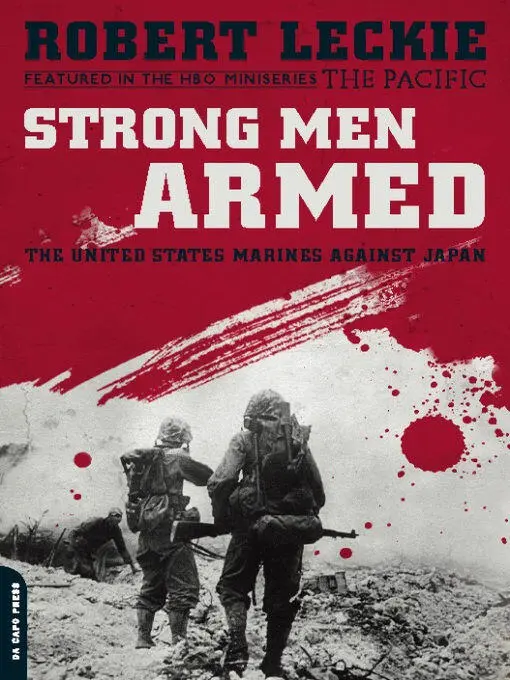
- Название:Strong Men Armed
- Автор:
- Издательство:Da Capo Press
- Жанр:
- Год:2010
- Город:Cambridge
- ISBN:978-0-786-74832-7
- Рейтинг книги:3 / 5. Голосов: 1
-
Избранное:Добавить в избранное
- Отзывы:
-
Ваша оценка:
Strong Men Armed: краткое содержание, описание и аннотация
Предлагаем к чтению аннотацию, описание, краткое содержание или предисловие (зависит от того, что написал сам автор книги «Strong Men Armed»). Если вы не нашли необходимую информацию о книге — напишите в комментариях, мы постараемся отыскать её.
Strong Men Armed — читать онлайн бесплатно полную книгу (весь текст) целиком
Ниже представлен текст книги, разбитый по страницам. Система сохранения места последней прочитанной страницы, позволяет с удобством читать онлайн бесплатно книгу «Strong Men Armed», без необходимости каждый раз заново искать на чём Вы остановились. Поставьте закладку, и сможете в любой момент перейти на страницу, на которой закончили чтение.
Интервал:
Закладка:
“Well, I’ll be damned,” he said after the grin had faded from his face. “Yes, sir! I’ll bring them right over!”
General Erskine’s attempt had also failed, and now it was up to the Fifth Division to clean out the rocky, Japanese-infested gorge lying south of Kitano Point. Here were the remnants of Colonel Ikeda’s 145th Infantry, here were blockhouses commanding all the entrances, and here was General Kuribayashi himself.
It was the most grinding work of the grimmest battle in Marine history. One blockhouse withstood endless shelling as well as demolition attempts with 40-pound shaped charges. The Marines cleaned out the surrounding positions and bypassed it, leaving it to the tank-dozers to seal off its air vents and cave it in with five 1,600-pound dynamite charges.
Then the tank-dozers caught up with the riflemen moving through the gorge. One of them began shoving out a path for the Sherman tanks to follow. Suddenly a single Japanese soldier scrambled out of a cave and ran at the tank-dozer with a satchel charge.
The driver swung his tank sharply to face the charging Japanese. He raised his blade high in the air. It paused there. Then it dropped to cut the assailant in two.
To the astonishment of the men in the waiting Sherman tanks, the tank-dozer’s turret came open. The driver popped out. He ran back to the tanks, while bullets whined and clanged off rock and steel. He hammered on the side of one of them, until someone answered him through a fire port.
“Did you see what that Nip bastard tried to do to me?” he called. “That does it, brother—I’ve had it!”
He turned and walked out of the gorge.
But the next day he was back again, sealing off caves, clearing roads for the killer-tanks as the attack in the gorge ground forward. That was on March 21. That night General Kuribayashi was still alive, for he got off a message to Major Horie on Chichi Jima.
“We have not eaten nor drunk for five days. But our fighting spirit is still running high. We are going to fight bravely to the last.”
Three days later, Major Horie’s radio crackled again.
“All officers and men of Chichi Jima—goodbye.”
Silence.
The following night on Iwo Jima some 300 figures arose from caves, from the ruins of pillboxes and blockhouses in that last northwest pocket. Many of them carried swords, for there were numerous officers among them. Most of them carried explosives. They slipped down to the western beaches and they fell on men of the Army Air Corps’ VII Fighter Command based there.
They had come upon those Americans least trained to fight on foot in the dark, and they took a fearful toll. Then they raced on to the bivouac of the Fifth Marine Pioneer Battalion, and here they were brought up short against a hastily organized defense line, and were struck to the ground by a counterattack led by Lieutenant Harry Martin. The counterstroke broke them, though Lieutenant Martin himself did not live to receive his Medal of Honor.
In the daylight of March 26 there were 223 Japanese bodies counted on the western beaches, 196 of them in the Fifth Pioneers’ area. The Marines looked eagerly for the body of Tadamichi Kuribayashi, for they had heard it was he who had led this last lash of the Japanese tail on Iwo Jima. Like Senda’s, it was never found.
But there were the bodies of more than 5,000 Marines to be buried in grim testimony to the skill and tenacity with which Tadamichi Kuribayashi and 21,000 Japanese warriors had defended the Emperor’s front gate. In all, 5,885 United States Marines were killed on Iwo, or in the air above or sea around it. There were also 17,272 Marines wounded, 46 Marines missing and surely dead, 2,648 Marines felled by combat fatigue —as well as 738 dead and wounded Navy doctors and corpsmen.
The Fifth Division had more Medal of Honor men to bury. Platoon Sergeant Joseph Julian lost his life charging pillboxes, Pfc. James LaBelle and Private George Phillips had thrown themselves on grenades to save their comrades, Lieutenant Jack Lummus had died leading his men, Corpsmen Jack Williams and John Willis had perished protecting wounded Marines. They were all buried in the shadow of the volcano their division had captured. In the hospitals far from Iwo Jima Private Franklin Sigler and Corpsman George Wahlen recuperated from wounds suffered while helping stricken comrades. They too would receive Medals of Honor. So the fledgling Fifth was blooded now with 8,563 casualties in its first and only fight—and the Fifth buried its dead at the base of Mount Suribachi while taps blew sad and solitary over the drifted ash dunes.
Higher up the island the Third and Fourth Divisions buried their dead in adjoining cemeteries. Already the men had carved memorials out of Iwo’s sandstone and decorated the graves of their friends with carved crosses and Marine emblems. Some had made inscriptions:
And then this single stark cry of anguish:
Marines came to the cemeteries from their bivouacs to stand or kneel in prayerful farewell before they took ship to sail away from this dark ugly curse of an island. Major General Erskine spoke to them, commemorating all the fallen.
“Only the accumulated praise of time will pay proper tribute to our valiant dead. Long after those who lament their immediate loss are themselves dead, these men will be mourned by the Nation.
“They are the Nation’s loss!
“There is talk of great history, of the greatest fight in our history, of unheard-of sacrifice and unheard-of courage. These phrases are correct, but they are prematurely employed.
“Victory was never in doubt. Its cost was.
“The enemy could have displaced every cubic inch of volcanic ash on this fortress with concrete pillboxes and blockhouses, which he nearly did, and still victory would not have been in doubt.
“What was in doubt, in all our minds, was whether there would be any of us left to dedicate our cemetery at the end, or whether the last Marine would die knocking out the last Japanese gun and gunner.
“Let the world count our crosses!
“Let them count them over and over. Then when they understand the significance of the fighting for Iwo Jima, let them wonder how few there are. We understand and we wonder—we who are separated from our dead by a few feet of earth; from death by inches and fractions of an inch.
“The cost to us in quality, one who did not fight side by side with those who fell can never understand.”
There would be more crosses for the world to count, more stars, more plain headboards for those nonbelievers who also fell—and the cost to the nation in quality would increase.
On March 26, the day the fighting at Iwo Jima was declared ended, an Army division landed at a place called Kerama Retto.
Okinawa, the last battle, had begun.
9
No one expected Okinawa to be the last battle.
To both sides the inevitable fight for this chief and largest island of the Ryukyu chain was to be but prelude to the titanic struggle on Japan itself. To America it meant seizure of the last steppingstone to Nippon. To Japan it was to be the anvil on which the hammer blows of a Divine Wind would destroy the American fleet.
This was still the chief object of Japanese military policy-this destruction of American sea power. It was sea power which had brought the Americans through the island barriers, had landed them at Iwo within the very Prefecture of Tokyo, was now bringing them to within less than 400 miles of Kyushu in southern Japan. Only sea power could bring about the invasion of Japan, something which had not happened in the three thousand years of Nippon’s recorded history, something which had been attempted only once before.
Читать дальшеИнтервал:
Закладка:
Похожие книги на «Strong Men Armed»
Представляем Вашему вниманию похожие книги на «Strong Men Armed» списком для выбора. Мы отобрали схожую по названию и смыслу литературу в надежде предоставить читателям больше вариантов отыскать новые, интересные, ещё непрочитанные произведения.










Обсуждение, отзывы о книге «Strong Men Armed» и просто собственные мнения читателей. Оставьте ваши комментарии, напишите, что Вы думаете о произведении, его смысле или главных героях. Укажите что конкретно понравилось, а что нет, и почему Вы так считаете.