Robert Leckie - Strong Men Armed
Здесь есть возможность читать онлайн «Robert Leckie - Strong Men Armed» весь текст электронной книги совершенно бесплатно (целиком полную версию без сокращений). В некоторых случаях можно слушать аудио, скачать через торрент в формате fb2 и присутствует краткое содержание. Город: Cambridge, Год выпуска: 2010, ISBN: 2010, Издательство: Da Capo Press, Жанр: nonf_military, на английском языке. Описание произведения, (предисловие) а так же отзывы посетителей доступны на портале библиотеки ЛибКат.
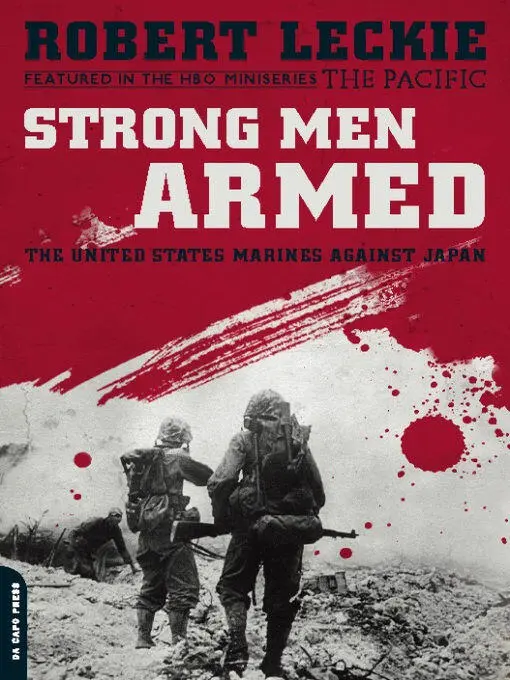
- Название:Strong Men Armed
- Автор:
- Издательство:Da Capo Press
- Жанр:
- Год:2010
- Город:Cambridge
- ISBN:978-0-786-74832-7
- Рейтинг книги:3 / 5. Голосов: 1
-
Избранное:Добавить в избранное
- Отзывы:
-
Ваша оценка:
Strong Men Armed: краткое содержание, описание и аннотация
Предлагаем к чтению аннотацию, описание, краткое содержание или предисловие (зависит от того, что написал сам автор книги «Strong Men Armed»). Если вы не нашли необходимую информацию о книге — напишите в комментариях, мы постараемся отыскать её.
Strong Men Armed — читать онлайн бесплатно полную книгу (весь текст) целиком
Ниже представлен текст книги, разбитый по страницам. Система сохранения места последней прочитанной страницы, позволяет с удобством читать онлайн бесплатно книгу «Strong Men Armed», без необходимости каждый раз заново искать на чём Вы остановились. Поставьте закладку, и сможете в любой момент перейти на страницу, на которой закончили чтение.
Интервал:
Закладка:
There was indeed little to love about the Great Loo Choo, as Okinawa was called when Chinese influence was great enough to give the entire chain its original name of the Loo Choos or “bubbles floating on water.” Japanese military power and Japanese difficulty in pronouncing the letter L changed it to Ryukyus in 1875, but even the Divine Emperor could do nothing about those floating bubbles. Neither Eritrea nor the Belgian Congo is more humid than Okinawa, and the Great Loo Choo’s skies are capable of pouring out 11 inches of rainfall in a single day. Its people, of mixed Chinese, Malayan and Ainu blood, are among the most docile in the world.
The Okinawans have no history of war. They neither make nor carry arms, a fact which filled Napoleon with enraged incredulity in the early nineteenth century, and which, in the mid-twentieth, led the Japanese to regard the Okinawans as an inferior race. Apart from those schoolteachers trained in Japan, Okinawans were disdained as good for nothing but farming their tiny plots of sweet potatoes, sugar cane or rice. So spurned, they resented their masters and clung doggedly to their Chinese culture.
“The houses and customs here resemble those of China,” a Japanese private wrote in his diary. “They remind one of a Chinese town.”
Christ, Allah and Buddha had been to Okinawa with venturesome European and Malay sailors, with Chinese culture—but the people still practiced a primitive animism while worshipping the bones of their ancestors. These were placed in urns kept within lyre-shaped tombs sprinkled over plains and low hillsides. Many tombs within the Naha-Shuri-Yonabaru line had also been fitted with machine guns and cannon, and strengthened by those diggers and drillers of Ushijima’s unwilling Boeitai.
Conscription of the Boeitai had unwittingly led to one of the chief complaints among Ushijima’s soldiers: the lack of fresh vegetables. There hadn’t been enough adult males around to produce the normal vegetable crop that fall and winter, and Tokyo was shipping in bullets, not beans.
“I cannot bear having just a cup of rice for a meal with no side dishes at all,” a soldier wrote. “Our health will be ruined.”
The lament was raised frequently elsewhere, and Ushijima took account of it by urging his men to “display a more firm and resolute spirit, hold to the belief of positive victory, and always remember the spirit of martyrdom and of dying for the good of the country.”
By way of consolation, the general issued each man a pint and a half of sweet-potato brandy, proclaimed a temporary amnesty for drunkards and promised another issue on April 13, when the Emperor Hirohito would become forty-four years old. That had been in January, just before General Ushijima dispatched General Cho to Tokyo on a flying visit.
Cho came back in late January. He reported that Ushijima’s defense plans dovetailed with Imperial Headquarters strategy and that he had been able to dispel some doubts about the decision not to defend the Hagushi Beaches. Cho was also elated by a secret report on the kamikaze which he had seen. The attacks of 26 of Admiral Ugaki’s six-plane units had brought about instantaneous sinking of one American battleship, six carriers and 34 cruisers. Even the clearheaded Cho had been blown overboard by the Divine Wind. He got out an inspirational message for the 32nd Army’s top commanders. It said:
“The brave ruddy-faced warriors with white silken scarves tied about their heads, at peace in their favorite planes, dash out spiritedly to the attack. The skies are slowly brightening.”
But the skies were rather darkening with the airplanes of the American Fast Carrier Forces which began striking the Great Loo Choo late that month. After the raid of January 22, a Japanese superior private wrote in his diary:
While some of the planes fly overhead and strafe, the big bastards fly over the airfield and drop bombs. The ferocity of the bombing is terrific. It really makes me furious. It is past three o’clock and the raid is still on. At six the last two planes brought the raid to a close. What the hell kind of bastards are they? Bomb from six to six!
They were “hard-nosed bastards,” these Americans, and there were more and bigger ones coming—both at the Ryukyus and Japan, both by air and by sea. Naha was being pounded to rubble and the wolf packs of the American submarine service were littering the floor of the China Sea with sunken cargo vessels and drowned soldiers.
“The enemy,” wrote another private, “is brazenly planning to destroy completely every last ship, cut our supply lines and attack us.”
The “enemy” was also hurling neutralizing thunderbolts at the homeland. Giant B-29’s had begun to strike Tokyo, Nagoya, Osaka and Kobe in 300-plane raids. On March 9 the Superforts came down to 6,000 feet over Tokyo to loose the dreadful fire-bombs which burned up a quarter of a million houses, made a million persons homeless and killed 83,793 others. Neither Hiroshima nor Nagasaki would equal the carnage of this most lethal air raid in history.
Throughout February and March, while the Marines were conquering Iwo Jima, land- and carrier-based air struck again and again at the Great Loo Choo. Superforts began to rage all over the Ryukyus. Okinawa was effectively cut off from Kyushu in the north, Formosa in the south. On March 1, while the Fast Carrier Forces were returning to Ulithi from their third strike at Japan, there were so many planes strafing, bombing and rocketing Okinawa that pilots had to get in line for a crack at a target. Lieutenant General Mitsuru Ushijima was impressed.
“You cannot regard the enemy as on a par with you,” he told his men. “You must realize that material power usually overcomes spiritual power in the present war. The enemy is clearly our superior in machines. Do not depend on your spirits overcoming this enemy. Devise combat method based on mathematical precision—then think about displaying your spiritual power.”
Ushijima’s order was perhaps the most honest issued by a Japanese commander throughout the war. It was Bushido revised, turned upside down, but the revision had been made too late.
10
There were 1,300 ships and perhaps another 300 left behind in the anchorages. Some of the ships were new, some came from the West Coast and were sailing 7,200 miles to battle, putting in at island battlegrounds whose names they bore, staging up through the latest battlegrounds at Ulithi, Leyte and Saipan. They roved boldly about that Pacific Ocean which was now an American lake, for Manila had fallen on February 24 and only the mighty battleship Yamato had survived the holocaust of Leyte Gulf. There were British vessels present, a fast carrier force of 22 warships, for in Europe the gate had been left open at Remagen, American troops were over the Rhine, and the old queen of the waves was sending help to the new lord of the seas.
Fleet Admiral Nimitz was still in over-all command in Hawaii as he had been when the Japanese were stopped at Midway, when the long charge began at Guadalcanal. Admiral Spruance commanded the Fifth Fleet, and there was the saltiest salt still giving orders to the expeditionary force. Vice Admiral Richmond Kelly Turner had brought the Marines to Guadalcanal and now, nearly three years later, still roaming his flagship bridge in an old bathrobe, still a profane perfectionist with beetling brow and abrasive tongue, a matchless planner who would also not scruple to tell the coxswain how to beach his boat, Kelly Turner was bringing the Tenth Army to Okinawa.
A newcomer to the Central Pacific led the ground troops: Lieutenant General Simon Bolivar Buckner, Jr., “the old man of the mountain,” the son of the famous Confederate general of that name and rank, himself a product of the strictest Army training, a big man, ruddy-faced, white-haired, strong for the physical conditioning of troops. He had served four years in Alaska and the Aleutians and had built up the Alaskan defenses. He had hoped to lead the invasion of Japan through the North Pacific, but the thrust from the Aleutians was never made. It was coming from the center, and Simon Bolivar Buckner was called down to lead it—commanding that Tenth Army which was in fact only a new number for seven veteran divisions which had made the assault possible.
Читать дальшеИнтервал:
Закладка:
Похожие книги на «Strong Men Armed»
Представляем Вашему вниманию похожие книги на «Strong Men Armed» списком для выбора. Мы отобрали схожую по названию и смыслу литературу в надежде предоставить читателям больше вариантов отыскать новые, интересные, ещё непрочитанные произведения.






Обсуждение, отзывы о книге «Strong Men Armed» и просто собственные мнения читателей. Оставьте ваши комментарии, напишите, что Вы думаете о произведении, его смысле или главных героях. Укажите что конкретно понравилось, а что нет, и почему Вы так считаете.