Robert Leckie - Strong Men Armed
Здесь есть возможность читать онлайн «Robert Leckie - Strong Men Armed» весь текст электронной книги совершенно бесплатно (целиком полную версию без сокращений). В некоторых случаях можно слушать аудио, скачать через торрент в формате fb2 и присутствует краткое содержание. Город: Cambridge, Год выпуска: 2010, ISBN: 2010, Издательство: Da Capo Press, Жанр: nonf_military, на английском языке. Описание произведения, (предисловие) а так же отзывы посетителей доступны на портале библиотеки ЛибКат.
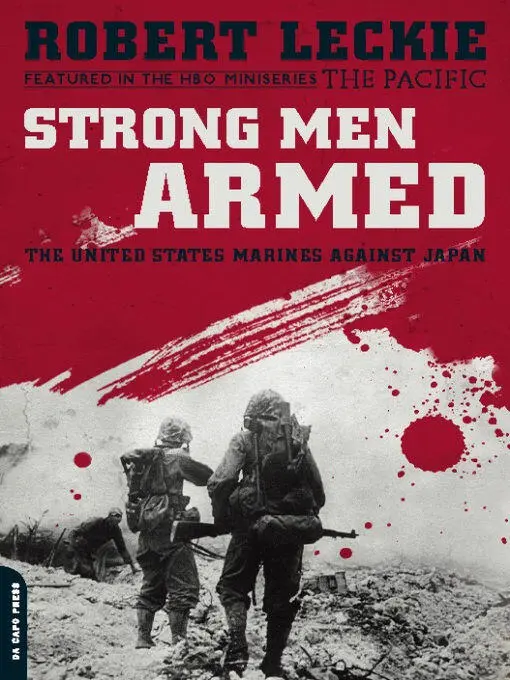
- Название:Strong Men Armed
- Автор:
- Издательство:Da Capo Press
- Жанр:
- Год:2010
- Город:Cambridge
- ISBN:978-0-786-74832-7
- Рейтинг книги:3 / 5. Голосов: 1
-
Избранное:Добавить в избранное
- Отзывы:
-
Ваша оценка:
Strong Men Armed: краткое содержание, описание и аннотация
Предлагаем к чтению аннотацию, описание, краткое содержание или предисловие (зависит от того, что написал сам автор книги «Strong Men Armed»). Если вы не нашли необходимую информацию о книге — напишите в комментариях, мы постараемся отыскать её.
Strong Men Armed — читать онлайн бесплатно полную книгу (весь текст) целиком
Ниже представлен текст книги, разбитый по страницам. Система сохранения места последней прочитанной страницы, позволяет с удобством читать онлайн бесплатно книгу «Strong Men Armed», без необходимости каждый раз заново искать на чём Вы остановились. Поставьте закладку, и сможете в любой момент перейти на страницу, на которой закончили чтение.
Интервал:
Закладка:
The left-flank battalion came upon the enemy asleep in their emplacements, and wiped them out. Jubilantly, the Marines reported they had taken Hill 362-C. But they had not. In the darkness they had mistaken Hill 331 for their objective, and now it was daylight and those two battalions in the center and right had been spotted and pinned down.
They fought back throughout that day. The men in the center were hit so savagely that companies were reduced to barely more than squad strength. By nightfall Lieutenant Wilcie O’Bannon commanded less than 10 men—all that was left of F Company. He held them together on a mound 300 yards within the Japanese strong-point, while directing mortar fire by radio. But the Japanese opened with countermortars and O’Bannon’s radio fell silent. Lieutenant Colonel Robert Cushman ordered tanks to the rescue. Thirty-six hours after the dawn attack began, the tanks ground over the rubble to the mound where O’Bannon and four other men lay fighting. They straddled them to drag them inside the escape hatches. And Company E under Captain Maynard Schmidt fared just slightly better in the same sector. They had seven men left.
On the right, there were also companies cut off among the jumble of rocks and crags, out in front of pillboxes passed during the darkness. Here Lieutenant John Leims risked death three times to save his men—once crawling 400 yards through enemy fire to lay communications wire from his cut-off company to the battalion command post, and then, after skillfully pulling his company back out of the trap, twice more crawling up to the abandoned ridge to rescue wounded Marines—and for this he received the Medal of Honor.
Such desperate heroics throughout that tragic March 7 made it appear that the night attack had ended in disaster.
But it had not. Other companies had been fed into the fighting on the center and the right, and here it was found that the Marines had penetrated the outer works of a formidable bastion which would be known as Cushman’s Pocket and would fall only after eight evil days of fighting. On the north, the men who had taken Hill 331 fought doggedly on to take their original objective—Hill 362-C—which rose directly in front of them. They took it, but only because their surprise assault had taken Hill 331. It was there that the Japanese had concentrated their fortifications.
By nightfall, all the highest ground on the Motoyama Plateau was in Marine hands—and from it the end was in sight.
There were other proofs that the Japanese had begun to crack: They had begun to commit suicide. Over on the left flank a hundred enemy soldiers holed up inside a ridge blew themselves up—as well as a company of Marines who had occupied the ridge.
The night of the next day came the battle’s only banzai, another sign of Japanese desperation. A thousand Japanese tried to break the Fourth Division’s lines on the right flank. They tried to infiltrate to gain Airfield Number One, where they would blow up equipment with the charges wound around their waists. But they were blown up themselves. The Marines killed 784 of these human bombs. It was the only break of the Iwo Jima campaign—784 Japanese who could have exacted a fearful price within their caves and pillboxes had come out to be killed easily.
The following day, March 9, a patrol of the Third Division reached the northern end of Iwo Jima. They clambered down the rocky cliffs to the sea. They filled a canteen with sea water and sent it back to Major General Schmidt, inscribed: “For inspection, not consumption.”
Iwo Jima had been traversed in eighteen days.
That night Tadamichi Kuribayashi sent his first melancholy message to Tokyo.
“All surviving fighting units have sustained heavy losses. I am very sorry that I have let the enemy occupy one part of Japanese territory, but I am taking comfort in giving him heavy damages.”
He was indeed doing that. Even though resistance was subsiding, there were still many Japanese holed up in individual pockets. In the eastern bulge, where the Fourth Division had been gathering momentum since the banzai, there were numerous hold-out pockets. One of them was believed to be the headquarters of Major General Sadasui Senda, commander of the 2nd Mixed Brigade which had opposed the Fourth. To him Major General Clifton Cates addressed a surrender appeal broadcast from loudspeakers. He said:
“You have fought a gallant and heroic fight, but you must realize the Island of Iwo Jima has been lost to you. You can gain nothing by further resistance, nor is there any reason to die when you can honorably surrender and live to render valuable service to your country in the future. I promise and guarantee you and the members of your staff the best of treatment. I respectfully request you accept my terms of honorable surrender. I again appeal to you in the name of humanity—surrender without delay.”
But Senda did not surrender. Nor was his body found when, by March 16, there was nothing but corpses opposing the Marines in the eastern bulge. The Fourth Marine Division had conquered again—but it had suffered casualties of 9,098 men, of whom 1,806 had been killed. That was half the division’s strength. In fourteen months’ time, this splendid division had fought three major battles and had suffered casualties almost equal to its strength—17,722 dead and wounded Marines. In three more days the battered Fourth would sail for Hawaii, never to enter battle again.
But the brother Third and Fifth Divisions still had fighting to do in the west sector commanded by Colonel Masuo Ikeda. On March 16 General Erskine made his own surrender appeal. It was addressed to Colonel Ikeda and typed in English on one side of a paper, written in Japanese on the other. It said:
Our forces now have complete control and freedom of movement on the island of Iwo Jima except in the small area now held by the valiant Japanese troops just south of Kitano Point. The fearlessness and indomitable fighting spirit which has been displayed by the Japanese troops on Iwo Jima warrants the admiration of all fighting men. You have handled your troops in a superb manner but we have no desire to completely annihilate brave troops who have been forced into a hopeless position. Accordingly, I suggest that you cease resistance at once and march, with your command, through my lines to a place of safety where you and all your officers and men will be humanely treated in accordance with the rules of war.
General Erskine entrusted the message to two captured enemy soldiers. He gave one of them a walkie-talkie radio and instructed him to tell his countrymen that he had taken it from enemy Marines after a harrowing fight. On the message, Smith said that the Japanese soldiers had been taken captive while lying unconscious in their foxholes. The two men set out to pass a day and a night divided between lying to their countrymen and dodging the shell-bursts of both armies. One of them actually reached the cave occupied by Colonel Ikeda and got a sergeant friend to take the note in to him. But then, the resourceful prisoner got cold feet. He slipped away. He rejoined his companion and spent the next day spotting targets for the Marine artillery.
The two Japanese returned to the Marine lines the night of March 17, but to those of the Fifth Division. To their great indignation they were seized and treated as common prisoners. An American officer asked them in Japanese how they got the walkie-talkie.
“An American general gave it to me,” the boldest of them replied, adding stiffly: “I demand to be taken to my commanding officer.”
The interpreter grinned.
“Oh, yeah? Who’s he?”
The Japanese soldier stiffened and rapped it out rat-a-tat-tat.
“Major General Graves Erskine,” he said, and the interpreter was just startled enough to call the Third Division’s command post.
Читать дальшеИнтервал:
Закладка:
Похожие книги на «Strong Men Armed»
Представляем Вашему вниманию похожие книги на «Strong Men Armed» списком для выбора. Мы отобрали схожую по названию и смыслу литературу в надежде предоставить читателям больше вариантов отыскать новые, интересные, ещё непрочитанные произведения.











Обсуждение, отзывы о книге «Strong Men Armed» и просто собственные мнения читателей. Оставьте ваши комментарии, напишите, что Вы думаете о произведении, его смысле или главных героях. Укажите что конкретно понравилось, а что нет, и почему Вы так считаете.