Robert Leckie - Strong Men Armed
Здесь есть возможность читать онлайн «Robert Leckie - Strong Men Armed» весь текст электронной книги совершенно бесплатно (целиком полную версию без сокращений). В некоторых случаях можно слушать аудио, скачать через торрент в формате fb2 и присутствует краткое содержание. Город: Cambridge, Год выпуска: 2010, ISBN: 2010, Издательство: Da Capo Press, Жанр: nonf_military, на английском языке. Описание произведения, (предисловие) а так же отзывы посетителей доступны на портале библиотеки ЛибКат.
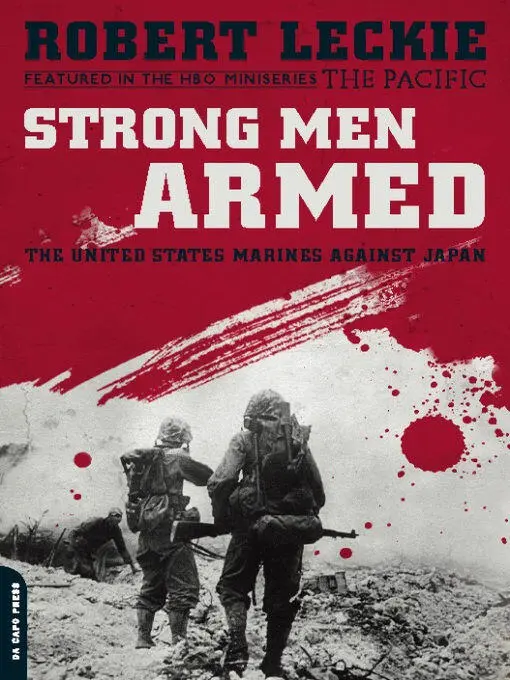
- Название:Strong Men Armed
- Автор:
- Издательство:Da Capo Press
- Жанр:
- Год:2010
- Город:Cambridge
- ISBN:978-0-786-74832-7
- Рейтинг книги:3 / 5. Голосов: 1
-
Избранное:Добавить в избранное
- Отзывы:
-
Ваша оценка:
Strong Men Armed: краткое содержание, описание и аннотация
Предлагаем к чтению аннотацию, описание, краткое содержание или предисловие (зависит от того, что написал сам автор книги «Strong Men Armed»). Если вы не нашли необходимую информацию о книге — напишите в комментариях, мы постараемся отыскать её.
Strong Men Armed — читать онлайн бесплатно полную книгу (весь текст) целиком
Ниже представлен текст книги, разбитый по страницам. Система сохранения места последней прочитанной страницы, позволяет с удобством читать онлайн бесплатно книгу «Strong Men Armed», без необходимости каждый раз заново искать на чём Вы остановились. Поставьте закладку, и сможете в любой момент перейти на страницу, на которой закончили чтение.
Интервал:
Закладка:
Gradually, the battering of the Marine attacks began to break Japanese resistance. Four days after the battle began, there was a shift of regiments. The Twenty-fourth relieved the Twenty-third in front of The Hill, while still-fresh units of the Twenty-third went down to the Amphitheater and Turkey Knob. One position after another on The Hill was hammered into powder. Caves were sealed, observation posts blown up. At Turkey Knob a 75-millimeter howitzer was hauled to the front to deliver point-blank fire into a blockhouse. Men with demolitions crawled up to it to blast holes in its walls. A flame-throwing tank rolled up a path cut by tank-dozers to pour hissing streams of flame through the holes. Turkey Knob fell. So, too, did the Amphitheater by the sixth day of fighting.
On the seventh, E Company of the Twenty-fourth Marines all but disappeared. But its remnants, having survived a half-dozen company commanders, joined the remnants of F Company and a platoon remaining from a company of another battalion and went up The Hill under Captain Walter Ridlon. They stayed there.
The Meatgrinder was utterly broken on March 3, though it had cost the Fourth Marine Division thousands of casualties. The division’s losses were now 6,591 men killed and wounded, and its fighting capacity was down 30 per cent.
In the center, the Third Division slashed through the First Belt with a series of slanting attacks, finally breasting it, overrunning the half-completed Airfield Number Three and coming up short against Kuribayashi’s Secondary Line.
On the left, Hill 362 still resisted the Fifth Division. If this western height was only 20 feet lower than its bigger brother in The Meatgrinder, it was only that much less costly. Marines burned the Japanese out of their caves by rolling gasoline drums inside and shooting them aflame, by hanging over cliff ledges to lower explosives on ropes—which the Japanese often cut—and by bringing up rocket trucks to loose showers of missiles on the infested hillside.
Three of the men who helped raise flags over Suribachi died on Hill 362. Lieutenant Colonel Chandler Johnson, the commander who had ordered Old Glory flung to the winds on the volcano’s summit, also was killed there.
The Pineapple Kid died, too. Corporal Geddings volunteered to help evacuate wounded. He gave his helmet to a stricken Marine. Ten minutes later a shell fragment struck him in his now-exposed neck and killed him. Four more Medals of Honor were won on Hill 362: by Sergeant William Harrell holding off a squad of Japanese infiltrators; by Gunnery Sergeant William Walsh, Corporal Charles Berry and Pfc. William Caddy throwing themselves on grenades and dying to save their friends.
Hill 362 fell on March 1, after holding out to the last man. The final defender killed himself. He came out of a cave and tapped his grenade on his helmet to arm it. The Marines who saw him ducked back, thinking he meant to throw it. There was a silence and the Marines raised their heads above the rocks again.
The Japanese soldier was crouched with the grenade to his ear, as though listening. It had not exploded.
He tapped it again and listened. No sound.
He tapped it a third time and listened. It went off.
None of the Marines thought it grimly comic. None thought it sad. They merely turned to glance at those western beaches which the fall of Hill 362 now made secure and wondered if the skipper would be able to get hot chow up to them.
7
It was March 4 and General Kuribayashi was signaling Tokyo for help. He had already told Imperial Headquarters: “I am not afraid of the fighting power of only three American Marine divisions, if there are no bombardments from aircraft and warships.” Now he was calling for his own aircraft, his own warships. “Send me these things, and I will hold this island,” he said. “Without them I cannot hold.”
He would not get them, although Japan had tried. On February 21 the kamikazes had made a major attack on the American warships surrounding the island. Suicide planes came in at dusk and sank the escort carrier Bismarck Sea, badly damaged big Saratoga and sent her limping home to Pearl Harbor, and damaged the escort carrier Lunga Point, plus a cargo ship and an LST.
None of the planes of this Second Mitate Special Attack Force ever returned to base.
That was all the help that Kuribayashi got from a homeland beginning to reel beneath the intensified raids of the American B-29’s. The night before Kuribayashi’s last appeal Japan had been raided again, and on that very morning of March 4 one of the returning Superforts was frantically trying to contact Iwo Jima. At last Sergeant James Cox heard a voice crackling over his radio.
“This is Iwo. What is your trouble?”
“Iwo, this is Nine Baker Able. We are running low on gasoline. Can you give us a bearing to Iwo?”
“Course 167 for 28 miles. Do you prefer to ditch offshore or try to land on the strip?”
“We prefer to land.”
Sergeant Cox switched off his radio. He watched the tiny cinder draw closer to the big bomber’s nose. He looked over the side as Lieutenant Raymond Malo circled the smoking, flashing little island in two wide circles—the narrow runway sliding out of his field of vision each time. The third time Lieutenant Malo hit the runway squarely. The big silvery bomber rolled 3,000 feet before it came to a halt.
Lieutenant Malo and Sergeant Cox grinned to hear the cheering of the Marines outside the plane.
The first B-29 had landed on Iwo Jima. It was the forerunner of 2,251 Superforts, which, with 24,761 crewmen, would make safe landings on Iwo before the war ended. Already, with the battle for Iwo not yet over, the value of Iwo had been made evident.
8
Even though Major General Erskine’s Third Division had overrun Airfield Number Three more than two-thirds of the way up the island, they had not been able to knock out a pocket of savage resistance holed up in blockhouses about 200 yards below the field at Motoyama Village.
It was decided to flank it, to strike at Hill 362-C, which stood above and behind it, for the Third Division was trying desperately to break through Kuribayashi’s Secondary Line to the northeastern beaches. This was to be done while the Fourth Division continued to clean out all resistance in the eastern bulge of the pork chop. The Third was to drive to the sea above the Fourth, then face north and press up the island’s right flank while the Fifth marched up the left. Below them, in the bulge, the Fourth would be whittling away at the enemy.
The decision to make the flanking movement on Hill 362-C a night attack was made by General Erskine. He had come to realize how skillfully the Japanese had adapted themselves to American attacks. When Marine artillery and naval guns began the fire preceding each morning’s attack, the Japanese scampered down to their deepest caves to wait it out. When it ceased, they ran back up to their guns to receive the Marines, inflicting heavy casualties—killing men such as the brave Sergeant Reid Chamberlain. The Japanese had done this so often they had it mastered to the point of split-second timing, and they had practially nullified the effect of preparatory shelling.
On the morning of March 7, an hour and a half before daylight, the Ninth Marines attacked without artillery. Three battalions faced almost directly east. The left or northernmost battalion was to take Hill 362-C, the others were to slip into the heart of the Japanese defenses and strike them at daylight.
At five in the morning, with a whistling wind hurling cold rain in their faces, they slipped out. There was not a shot fired. There was not a hand raised against them. The battalions on the lower or right flank reported moving 200 yards without detection. They were ordered to take another hundred.
Читать дальшеИнтервал:
Закладка:
Похожие книги на «Strong Men Armed»
Представляем Вашему вниманию похожие книги на «Strong Men Armed» списком для выбора. Мы отобрали схожую по названию и смыслу литературу в надежде предоставить читателям больше вариантов отыскать новые, интересные, ещё непрочитанные произведения.











Обсуждение, отзывы о книге «Strong Men Armed» и просто собственные мнения читателей. Оставьте ваши комментарии, напишите, что Вы думаете о произведении, его смысле или главных героях. Укажите что конкретно понравилось, а что нет, и почему Вы так считаете.