Robert Leckie - Strong Men Armed
Здесь есть возможность читать онлайн «Robert Leckie - Strong Men Armed» весь текст электронной книги совершенно бесплатно (целиком полную версию без сокращений). В некоторых случаях можно слушать аудио, скачать через торрент в формате fb2 и присутствует краткое содержание. Город: Cambridge, Год выпуска: 2010, ISBN: 2010, Издательство: Da Capo Press, Жанр: nonf_military, на английском языке. Описание произведения, (предисловие) а так же отзывы посетителей доступны на портале библиотеки ЛибКат.
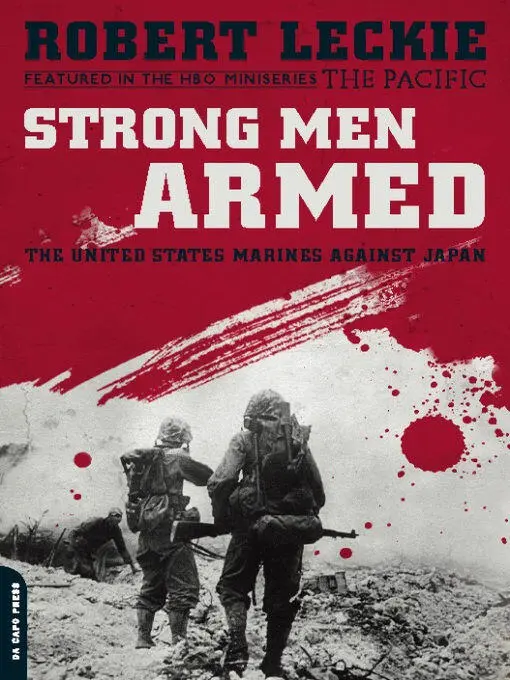
- Название:Strong Men Armed
- Автор:
- Издательство:Da Capo Press
- Жанр:
- Год:2010
- Город:Cambridge
- ISBN:978-0-786-74832-7
- Рейтинг книги:3 / 5. Голосов: 1
-
Избранное:Добавить в избранное
- Отзывы:
-
Ваша оценка:
Strong Men Armed: краткое содержание, описание и аннотация
Предлагаем к чтению аннотацию, описание, краткое содержание или предисловие (зависит от того, что написал сам автор книги «Strong Men Armed»). Если вы не нашли необходимую информацию о книге — напишите в комментариях, мы постараемся отыскать её.
Strong Men Armed — читать онлайн бесплатно полную книгу (весь текст) целиком
Ниже представлен текст книги, разбитый по страницам. Система сохранения места последней прочитанной страницы, позволяет с удобством читать онлайн бесплатно книгу «Strong Men Armed», без необходимости каждый раз заново искать на чём Вы остановились. Поставьте закладку, и сможете в любой момент перейти на страницу, на которой закончили чтение.
Интервал:
Закладка:

By February 23 the Marines began to suspect that they had made no beachhead on Iwo Jima because Iwo was all beachhead. The familiar rhythm of break-in, break-out, breakthrough would not be repeated here. Lieutenant General Smith had said: “We will be ready for an early counterattack in one of three places. We welcome a counterattack. That is generally when we break their backs.”
But there had been no counterattacks and it was the Americans whose backs were breaking on the rock of the Japanese center.
A regiment of the Third Division had been committed there on February 21. The Twenty-first Marines, veterans of the big banzai on Guam, dashed again and again at the center just below the southwestern tip of Airfield Number Two. Small breakthroughs often became disasters. Penetrating Marines were raked from the flanks, chewed up—sometimes wiped out. Tanks that butted through were knocked out by guns blasting from interlocking pillboxes, or were hoisted on the spouting fire-balls of exploding land mines. Engineers crept forward on their knees, probing the black sand for the kettle-shaped killers which the Japanese had buried so abundantly, but they couldn’t find them all. Nor could Marines with flame-throwers and dynamite knock out all the pillboxes. Corporal Hershel Williams won a Medal of Honor by blasting or burning out position after position, but there were 800 pillboxes in this sector 1,000 yards wide and 200 yards deep.
Yet, the center had to move. It was holding up the Fifth Division on the left and the Fourth on the right. When Major General Erskine came ashore with Major General Schmidt on February 23 he ordered the Twenty-first Marines forward the next day “at all costs.”
Lieutenant Colonel Wendell Duplantis had commanded the Third Battalion during that wild night on Guam when Major Yukioka’s suicide troops had shot the gap and surrounded his command post. Now, on Iwo Jima, Duplantis was awaiting the tanks which would lead his battalion forward at nine o’clock.
But the tanks didn’t show.
“Attack must proceed without the tanks,” he signaled his company commanders.
Captain Clayton Rockmore led out I Company and fell dead with a bullet through the throat. Captain Dan Marshall took over.
Captain Rodney Heinze led out K Company and fell wounded. Lieutenant Raoul Archambault took over.
Archambault urged K Company’s Marines forward, into the first line of pillboxes, the wind-blown sand pelting their faces like buckshot. Hurling grenades, they sped through it. They found the Japanese in their trenches and jumped in among them. They jabbed them with bayonets, chased them down those corridors, jumped out again and swept on.
The charge changed to a rush. Far ahead of I Company, the men of K Company were running past mounds of pillboxes and up the slope leading to Airfield Number Two. Marine tanks had entered the fight behind them and were pouring into the hole—mopping up.
Now the riflemen in their baggy green dungarees were flowing across the airfield with a yell. They crossed it raked and struck by bullets. Marines fell, but the others went over the airfield and up to the crest of a 50-foot ridge just on its northern side.
And then, by one of those errors common to war, Marine artillery fire began to fall on them.
Lieutenant Archambault took K Company back down the hill. The shelling stopped. Archambault took them back up. The Japanese drove them off again.
Now I Company was driving through the hole, coming up to the northern edge of the airfield, but now both companies were being struck on their exposed flanks. Still, Archambault led his Marines forward once more. They started up the ridge and a wave of Japanese infantry rose from a gully on its reverse slope to come pouring over the crest and down among them.
The Marines stood back-to-back in ankle-deep sand, fighting with knives, bayonets, clubbed rifles, shovels and fists. In a few minutes the banging and screaming had subsided and there were 50 dead Japanese at the foot of the ridge.
I Company came up and both outfits began digging in. They had come through Kuribayashi’s rugged center “at all costs,” and now their orders were: “Hold at all costs.”
They did. Next day the Third Division’s entire attack flowed through the hole these companies had punched. The Ninth Marines went into battle. They slugged slowly up to vital Hill 199 overlooking the airfield, making the kind of fight immortalized in Admiral Nimitz’ remark that on Iwo Jima, “uncommon valor was a common virtue.”
To win a Medal of Honor in this advance a man’s daring and shrewdness must surely be blessed by the fortunes of war. Only this or the direct intervention of the Almighty could have kept Private Wilson Watson alive as he stood in plain view on top of a ridge line to hold off an entire Japanese company with his BAR. Watson got up there by knocking out a pillbox alone. He came down after he shot 60 Japanese and his ammunition ran out. That was on February 27—the day that the up-island advance at last encompassed Hill 199 and the very heart of Kuribayashi’s First Belt had been pierced. Airfield Number Two had been conquered except for a few yards on its extreme northeastern tip. Southern Iwo Jima was now American and the growl of the bulldozer was already audible on Airfield Number One.
But on the left flank the Fifth Division had been brought up short in an evil pocket known as Hill 362, while on the right the Fourth had entered The Meatgrinder.
6
The Hill, the Amphitheater, and Turkey Knob were the three knives of The Meatgrinder.
The Hill, or Hill 382, was the highest ground on northern Iwo. It rose about a hundred yards east of the northern end of Airfield Number Two. About 600 yards beneath it was the Amphitheater. Just east of the Amphitheater was Turkey Knob. Within this complex was Iwo’s communications center and a maze of crags, rocks and outcroppings from which the Japanese had kept the Marines under observation since the landings.
Tanks buried to their turrets guarded all natural approaches. Antitank guns poked their snouts from scores of cavemouths. There were 75-millimeter antiaircraft guns and twin-mount artillery pieces with muzzles lowered to fire point-blank—and everywhere was a multiplicity of heavy and light machine guns. The Hill, the Amphitheater and Turkey Knob were also mutually supporting. Artillery and mortars could be brought down on all or any of them.
The Meatgrinder, hard shell of this iron nut of an island, could only be taken by storming all its points at once.
Up against The Hill went the Twenty-third Marines. The Twenty-fourth took on the Amphitheater. The Twenty-fifth moved on Turkey Knob.
At the Hill the Marines reached the summit with amazing ease. And then the Japanese struck them to the ground and kept them there with a murderous fire. It even came from the rear, for the Marines’ rush had carried them past a system of well-hidden pillboxes. The Marines came down from The Hill under cover of a smokescreen. The same thing happened the next day, even though Pfc. Douglas Jacobson attended to the pillbox system—knocking out 16 positions and a tank with his bazooka and killing 75 Japanese to win the Medal of Honor.
It happened also down at the Amphitheater and on Turkey Knob behind it. It seemed the Marines could take these heights almost at will, and then be sorry for taking them. The Japanese withdrew each time it became clear they could not hold. Then they called for their artillery and mortars. When the Marines were forced to withdraw at dusk, the Japanese returned.
For seven days—from February 25 to March 3—the Marines were torn on the knives of The Meatgrinder, taking casualties so great that on a single day the Fourth Division used 400 pints of whole blood. Casualties among the doctors and corpsmen were also fierce, and there were many feats of impromptu medical skill as well as of courage among them. Corpsman Cecil Bryan rushed to aid First Sergeant Fred Lunch when a shell fragment shattered Lunch’s windpipe. Bryan seized a section of yellow-rubber transfusion tubing from his pack. He cut off a six-inch length. He inserted it within Bunch’s torn throat and carried him to an aid station, saving both his life and his power of speech.
Читать дальшеИнтервал:
Закладка:
Похожие книги на «Strong Men Armed»
Представляем Вашему вниманию похожие книги на «Strong Men Armed» списком для выбора. Мы отобрали схожую по названию и смыслу литературу в надежде предоставить читателям больше вариантов отыскать новые, интересные, ещё непрочитанные произведения.









Обсуждение, отзывы о книге «Strong Men Armed» и просто собственные мнения читателей. Оставьте ваши комментарии, напишите, что Вы думаете о произведении, его смысле или главных героях. Укажите что конкретно понравилось, а что нет, и почему Вы так считаете.