Robert Leckie - Strong Men Armed
Здесь есть возможность читать онлайн «Robert Leckie - Strong Men Armed» весь текст электронной книги совершенно бесплатно (целиком полную версию без сокращений). В некоторых случаях можно слушать аудио, скачать через торрент в формате fb2 и присутствует краткое содержание. Город: Cambridge, Год выпуска: 2010, ISBN: 2010, Издательство: Da Capo Press, Жанр: nonf_military, на английском языке. Описание произведения, (предисловие) а так же отзывы посетителей доступны на портале библиотеки ЛибКат.
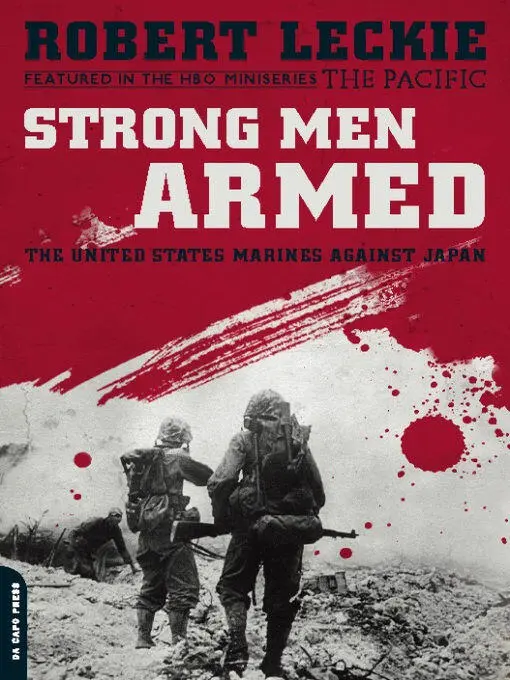
- Название:Strong Men Armed
- Автор:
- Издательство:Da Capo Press
- Жанр:
- Год:2010
- Город:Cambridge
- ISBN:978-0-786-74832-7
- Рейтинг книги:3 / 5. Голосов: 1
-
Избранное:Добавить в избранное
- Отзывы:
-
Ваша оценка:
Strong Men Armed: краткое содержание, описание и аннотация
Предлагаем к чтению аннотацию, описание, краткое содержание или предисловие (зависит от того, что написал сам автор книги «Strong Men Armed»). Если вы не нашли необходимую информацию о книге — напишите в комментариях, мы постараемся отыскать её.
Strong Men Armed — читать онлайн бесплатно полную книгу (весь текст) целиком
Ниже представлен текст книги, разбитый по страницам. Система сохранения места последней прочитанной страницы, позволяет с удобством читать онлайн бесплатно книгу «Strong Men Armed», без необходимости каждый раз заново искать на чём Вы остановились. Поставьте закладку, и сможете в любой момент перейти на страницу, на которой закончили чтение.
Интервал:
Закладка:
“Home alive in ‘45,” they said, a happy revision of Guadalcanal’s gloomy estimate of “The Golden Gate in ‘48.” They sang “Goodbye, Mama, I’m off to Okinawa,” and joked about the latest dreadful estimates of American disaster broadcast by Radio Tokyo.
The Japanese had already made the mistake of believing that the five American carriers damaged by kamikaze during the March 18-19 strikes against Japan would prevent early invasion of Okinawa. Because of this, the kaynikaze were caught unprepared when the Kerama Retto landings began. Only Ushijima’s handful of planes on Okinawa and scattered suicide units from Japan were able to intervene, and though they did extensive damage, it was nothing like the broadcast reports. On March 28 the Marines heard Radio Tokyo announce the sinking of a battleship, six cruisers, seven destroyers and one minesweeper, and then the voice of an American-educated announcer simpering:
“This is the Zero Hour, boys. It is broadcast for all you American fighting men in the Pacific, particularly those standing off the shores of Okinawa… because many of you will never hear another program…. Here’s a good number, ”Going Home“… it’s nice work if you can get it…. You boys off Okinawa listen and enjoy it while you can, because when you’re dead you’re a long time dead…. Let’s have a little juke-box music for the boys and make it hot.… The boys are going to catch hell soon, and they might as well get used to the heat….” Then, having described the varieties of death instantly impending for “the boys off Okinawa,” the voice concluded: “Don’t fail to tune in again tomorrow night.”
Two days later the voice was somber. “Ten American battleships, six cruisers, ten destroyers, and two transports have been sunk. The American people did not want this war, but the authorities told them it would take only a short while and would result in a higher standard of living. But the life of the average American citizen is becoming harder and harder and the war is far from won….”
Two more days and Radio Tokyo had lost its audience: “The boys off Okinawa” had gone ashore.
That was on April 1—Easter Sunday, April Fool’s Day, or L-Day as it was called officially. The L stood for Landing, but the Marines who hit the Hagushi Beaches with hardly a hand raised to oppose them had another name for it.
They called it Love-Day.
11
The Bimbo Butai had broken and fled at almost the first salvo of American guns. The airfields at Yontan and Kadena were left intact, and there were only a few mortars and a handful of riflemen to oppose the hordes of Americans circling offshore beneath overcast skies.
They came in.
On the northern beaches the Marines had anticipated another Tarawa in the reefs barring their passage, in the three-foot sea wall just back of the beaches. But high water bore them over the reefs and they had merely to clamber up the sea wall to get past it.
Only the inevitable confusion of putting 50,000 fighting troops ashore on a beachhead eight miles long hindered the invasion of Okinawa. All along the line the incredible landing was going forward with unbelievable speed.
By midmorning the Sixth Marine Division had reached Yontan Airfield and was moving across it, while the First Marine Division on the right struck out rapidly for Nakagusuku Bay on the east coast, chopping up the remnants of the demoralized Bimbo Butai. Many of these reluctant soldiers threw off the hated Japanese uniform and melted out of sight among their own people. Many true Japanese soldiers who were scattered throughout the landing area also put on dirty blue Okinawan kimonos and turned guerrilla, but there were not enough of these sniping irregulars to do more than badger the advancing Marines. They brushed past them, exulting in the pacific bliss of Love-Day.
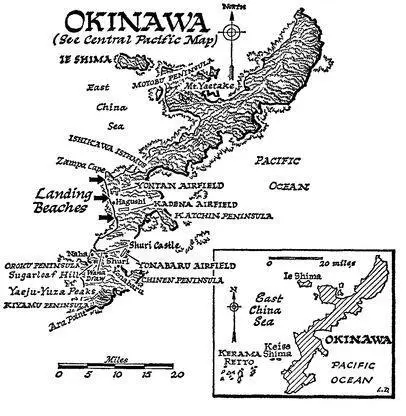
A half-hour after the first of the Sixth Division’s riflemen had swept inland, the Division’s tanks were ashore. They rolled over beaches blessedly free of mines, while behind them came the bulldozers to cut passage through the terraces. American mechanical energy was everywhere moving and shaking, transforming the beachhead, while up front the Marines were succumbing to the Great Loo Choo’s pastoral charm. They were rounding up the shaggy little Okinawan ponies found ambling along narrow dirt roads.
“Ya-hoo! I’m Captain Jinks of the Horse Marines!”
It could have seemed an April Fool’s Day joke, even though here and there a Marine was being shot. In the battalion aid stations along the beaches, the doctors looked almost frustrated.
Out on the command ships among the forests of masts and fluttering signal flags, steady reports of bloodless advance had produced an atmosphere first of disbelief, then relief, then wary suspicion. At noon, Major General Shepherd moved his Sixth Division Headquarters ashore with the smiling remark:
“There was a lot of glory on Iwo, but I’ll take it this way.” Shepherd’s staff sailed shoreward past hospital ships lying lonely and unattended by an invasion’s customary swarming of casualty boats. In one of the new LST-hospitals assigned to the First Marine Division, the ship’s surgeon was impatient. Since the moment the assault amtracks had rolled down the ramp, sailors had been at work transforming the ship. All the litter left behind by the Marines was heaved over the side. The tank deck was hosed down. Rows of cots were set up inside it. Outside the big yawning bow doors a company of Seabees rigged a pontoon-pier for casualty boats. All was accomplished in less than two hours. The surgeon strode out on the pier. He could see columns of Marines vanishing behind the sea wall. But there was no return traffic. He turned anxiously to a corpsman.
“No boats, no wounded?”
“Nothing yet, sir.”
The surgeon shrugged and went back inside the LST. In a moment he was outside again, for he had heard a motor.
A Marine was stepping onto the pier from a casualty boat. “What’s wrong with you, son?”
The Marine held up a spouting finger stump.
“One of my buddies let one go and shot the top of my finger off.”
The surgeon peered at it, ordered it dressed.
“What’s happening in there, son?”
“Don’t ask me, Doc. All I know is everybody’s goin’ in standin’ up.”
The surgeon sighed. He glanced shoreward again, turned and went back inside the ship to eat lunch. He came out. Still no return traffic. He called to his solitary patient, “C’mon, son, let’s go make you a new finger. We’ve got plenty of time to do it in.”
That was Love-Day on Okinawa, a most fortuitous eight hours of daylight during which the Tenth Army captured two airfields and a beachhead eight miles long and three to four miles deep—all at a cost of 28 killed, 27 missing and 104 wounded. Only a few of the dead or missing was from either of the assaulting Marine divisions—but 16 of them were from that Second Marine Division which had drawn the soft assignment of making the feint off southern Okinawa.
Down there a kamikaze crash-dived LST 884 with 300 Marines aboard her. The ship burst into flames. Ammunition began to explode. The LST had to be abandoned temporarily. Eight Marines were killed, eight were missing and 37 were wounded. Another kamikaze put three holes in destroyer Hinsdale and the stricken ship had to be towed away by fleet tugs. The departure may have prompted General Ushijima’s report of having forced the enemy to withdraw “after being mowed down one after another.”
Up north, though, there were 50,000 of the enemy on Okinawa. Objectives which were expected to require three or more days and many lives were firmly in American hands. At Yontan Airfield that dusk of April 1, there were bulldozers clearing away wrecked planes and General Ushijima’s clever dummies of sticks and stones. Already an airplane was touching down. But it had a red ball on its fuselage. It came in as bulldozers stopped and men hopped quickly to the ground. Marines heating their rations stood erect and walked quietly toward the landing strip. The Zero swung seaward and turned back to a smooth landing.
Читать дальшеИнтервал:
Закладка:
Похожие книги на «Strong Men Armed»
Представляем Вашему вниманию похожие книги на «Strong Men Armed» списком для выбора. Мы отобрали схожую по названию и смыслу литературу в надежде предоставить читателям больше вариантов отыскать новые, интересные, ещё непрочитанные произведения.








Обсуждение, отзывы о книге «Strong Men Armed» и просто собственные мнения читателей. Оставьте ваши комментарии, напишите, что Вы думаете о произведении, его смысле или главных героях. Укажите что конкретно понравилось, а что нет, и почему Вы так считаете.