Robert Leckie - Strong Men Armed
Здесь есть возможность читать онлайн «Robert Leckie - Strong Men Armed» весь текст электронной книги совершенно бесплатно (целиком полную версию без сокращений). В некоторых случаях можно слушать аудио, скачать через торрент в формате fb2 и присутствует краткое содержание. Город: Cambridge, Год выпуска: 2010, ISBN: 2010, Издательство: Da Capo Press, Жанр: nonf_military, на английском языке. Описание произведения, (предисловие) а так же отзывы посетителей доступны на портале библиотеки ЛибКат.
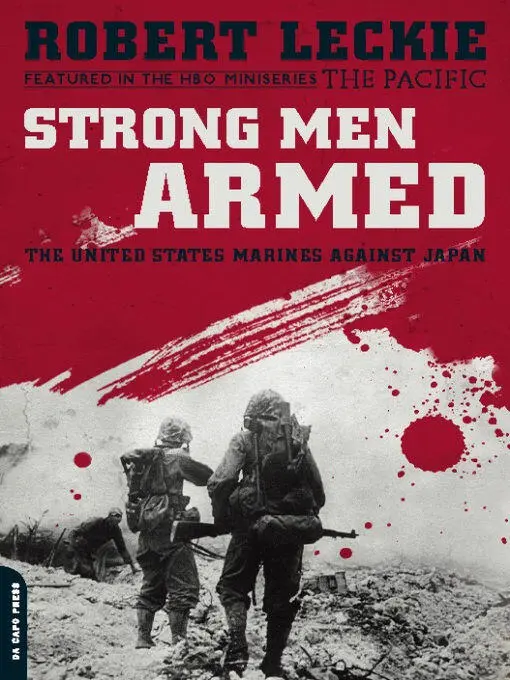
- Название:Strong Men Armed
- Автор:
- Издательство:Da Capo Press
- Жанр:
- Год:2010
- Город:Cambridge
- ISBN:978-0-786-74832-7
- Рейтинг книги:3 / 5. Голосов: 1
-
Избранное:Добавить в избранное
- Отзывы:
-
Ваша оценка:
Strong Men Armed: краткое содержание, описание и аннотация
Предлагаем к чтению аннотацию, описание, краткое содержание или предисловие (зависит от того, что написал сам автор книги «Strong Men Armed»). Если вы не нашли необходимую информацию о книге — напишите в комментариях, мы постараемся отыскать её.
Strong Men Armed — читать онлайн бесплатно полную книгу (весь текст) целиком
Ниже представлен текст книги, разбитый по страницам. Система сохранения места последней прочитанной страницы, позволяет с удобством читать онлайн бесплатно книгу «Strong Men Armed», без необходимости каждый раз заново искать на чём Вы остановились. Поставьте закладку, и сможете в любой момент перейти на страницу, на которой закончили чтение.
Интервал:
Закладка:
These were the 7th, 27th, 77th and 96th Infantry Divisions making up Major General John Hodge’s Twenty-fourth Corps, and the First, Second and Sixth Marine Divisions of Major General Roy Geiger’s Third Corps.
The 27th, which had seen action at Makin and Saipan and was still commanded by Major General George Griner, would be in Tenth Army reserve. The 77th of Major General Andrew Bruce—those “Old Bastards” who had waded ashore at Guam and gone on to Leyte—were to start the battle for Okinawa.
On March 26 the 77th’s soldiers began taking the islands of the Kerama Retto, destroying the lairs of Ushijima’s suicide boats. They also occupied those reef islets of Keise Shima which the Marines of Major Jim Jones’ Reconnaissance Battalion had scouted in night rubber-boat landings. On these islets went the 155-millimeter long toms of the 420th Field Artillery Group. They began laying down a galling fire on southwestern Okinawa, especially in the vicinity of the Hagushi Beaches.
These beaches were to be taken with the Marines on the left or north, the soldiers on the right. Nailing down the right flank was the spearhead team which Hodge had used in the Philippines—the 7th, led by Major General Archibald Arnold and blooded at Attu, Kwajalein and Leyte, and the 96th of Major General James Bradley, also a veteran of Leyte. Once these two divisions were ashore, they were to capture Kadena Airfield, drive east across the island’s waist and then wheel south to attack abreast in that direction.
Geiger’s Third Corps would capture Yontan Airfield, drive east cross-island and turn north to overrun that half of Okinawa. This would be done by the Sixth and First, while the Second made a feint off those southern or Minatoga Beaches which General Ushijima had so carefully fortified.
Covering the landings would be the biggest bombardment force yet assembled—10 old battleships, 10 cruisers and scores of destroyers and gunboats—as well as the far-ranging new battleships and fleet carriers of the Fast Carrier Forces, the flying buffer of the British task force in the southern Ryukyus, the Navy’s minesweepers and Underwater Demolition Teams, the big bombers of the Twentieth Air Force, and the Tenth Army’s own Tactical Air Force made up chiefly of Marine flyers and commanded by a Marine—Major General Francis Mulcahy.
Okinawa was to be the biggest battle of the Pacific, with 548,000 Americans of all services involved, as well as history’s greatest amphibious assault, with an attack force of 183,000 men, of which 154,000 were in the actual combat divisions.
Okinawa would also crown the unique mission of the Marine Corps, one which began after the Allied disaster at Gallipoli in World War One had convinced most military thinkers that hostile and fortified shores could not be overcome by invasion from the sea. The Marines disagreed. They insisted amphibious assault could be successful and developed the craft and techniques to make it so. They also trained the Army in this speciality, which was to be needed in Europe as well as the Pacific. The Army’s first three amphibious divisions—the 1st, 3rd and gth—were trained by Marines. Those very infantry divisions going into Okinawa—the 7th, 77th and 96th —were Marine-trained, while the 81st Division which Lieutenant General Buckner was holding in area reserve in New Caledonia had also been taught by Marines. And the Tactical Air Force led by Major General Mulcahy was to put into the air an overwhelming number of Marine pilots especially trained in the Marine tactic of close-up aerial support.
It was also fitting, in this last battle of the war, that the First Marine Division, which had launched the long counteroffensive, should be in at the kill. The First had a new commander, Major General Pedro del Valle. He had relieved Major General Rupertus, who went back to the States to die in his bed. Del Valle was a Puerto Rican who had gone through Annapolis and had served with Italy’s Marshal Badoglio as an observer in Ethiopia. Hot-tempered—with dark brows the equal of Admiral Turner’s—he was quick-witted as well, an artillerist whose guns had saved the First at Guadalcanal so that the hard-noses could go on to fight at New Britain and Peleliu.
There was the Second Marine Division, which had also come a long way from Guadalcanal, had passed through bloody Betio in Tarawa and fought the grinding fight on Saipan. Major General Thomas Watson still led the Second, and he had broken in 8,000 replacements by setting them to mopping-up Japanese stragglers in the Marianas. The Second’s battalions would make the feint off southern Okinawa. They had done it so well at Tinian, they were being asked to do it again; but even so, there were frequent growls about how come the upstart Sixth was going into the assault on the left of the First.
If the Sixth was new in number, it had a faultless, veteran staff and command under Major General Lemuel Shepherd. It had men such as Brute Krulak, the sawed-off dynamo who had made so much smoke at Choiseul and was now a lieutenant colonel in charge of operations. It had 70 per cent veterans and only two of its battalions had not yet been in battle. The Sixth was “gung ho,” and veterans of other outfits might have been startled to find that the division with a silver Crusader’s sword for its emblem harbored such seemingly passé types as the Glory Kid. He was a brawny red-haired corporal of twenty years and his name was Donald (Rusty) Golar. He had fought with the Twenty-second Regiment on Guam and won a Bronze Star. “I’m a storybook Marine,” Golar said. “I’m lookin’ for glory and I’m lookin’ for Japs.” There were glory-boys from the ranks of collegiate football, too. In the Fourth Regiment commanded by Colonel Alan Shapley, one of the Naval Academy’s finest athletes, there were enough football stars to field two All-American teams. Lieutenant George Murphy of the Twenty-ninth Marines had been captain of the Notre Dame team.
These were the troops of the Third Corps, with their artillery battalions and engineers, their tanks and Navy corpsmen. In all, there were 85,246 of them, nearly as many as the 88,515 soldiers of the four-division Twenty-fourth Corps, for the three Marine divisions, having anticipated heavy casualties early in the battle, were bringing their replacement battalions to Okinawa with them.
Yet, there was hardly any talk of casualties as the great convoy flowed up the curve of the world. Most of the conversation was about The Deadly Habu, a snake something like a cobra which Intelligence reported abundant on Okinawa. Intelligence even had pictures of The Deadly Habu, and because it was indeed a venomous-looking reptile, the habu soon joined the immortal Marine menagerie of the goony-birds of Midway, the pissing-possum of Guadalcanal, the New Zealand kiwi, the lunatic-lunged kookaburra of Australia and the indecent snow-snake of Iceland. The men spoke so much of the habu they almost forgot the Japanese, although officers would frequently “hold school” on the importance of their objective to the war effort.
“From Okinawa,” one lieutenant told his platoon, “we can bomb the Japs anywhere—China, Japan, Formosa…”
“Yeah,” a sergeant mumbled, “and vice versa.”
It was true, of course, that the Japanese had 65 airfields on Formosa to the south and 55 on Kyushu to the north, as well as a few dozen scattered throughout the southern Ryukyus, but such discouraging information is not normally disseminated among the troops. More pointed and helpful information came from veterans such as Corporal Al Biscansin of the Sixth Division, who offered this earnest advice to the boots:
“When you aren’t moving up or firing, keep both ends down! The GI Bill of Rights don’t mean a thing to a dead Marine.”
The GI Bill rivaled the habu as a topic of conversation, for a surprising number of these young men intended to go to college when the war was over. They even expected that great event to happen soon.
Читать дальшеИнтервал:
Закладка:
Похожие книги на «Strong Men Armed»
Представляем Вашему вниманию похожие книги на «Strong Men Armed» списком для выбора. Мы отобрали схожую по названию и смыслу литературу в надежде предоставить читателям больше вариантов отыскать новые, интересные, ещё непрочитанные произведения.









Обсуждение, отзывы о книге «Strong Men Armed» и просто собственные мнения читателей. Оставьте ваши комментарии, напишите, что Вы думаете о произведении, его смысле или главных героях. Укажите что конкретно понравилось, а что нет, и почему Вы так считаете.