John Nichol - Tornado Down
Здесь есть возможность читать онлайн «John Nichol - Tornado Down» весь текст электронной книги совершенно бесплатно (целиком полную версию без сокращений). В некоторых случаях можно слушать аудио, скачать через торрент в формате fb2 и присутствует краткое содержание. Город: London, Год выпуска: 2008, ISBN: 2008, Издательство: Penguin Adult, Жанр: nonf_military, Биографии и Мемуары, на английском языке. Описание произведения, (предисловие) а так же отзывы посетителей доступны на портале библиотеки ЛибКат.
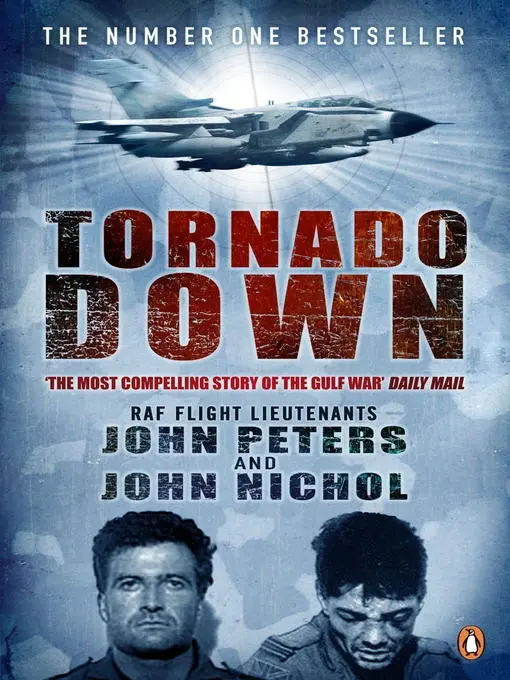
- Название:Tornado Down
- Автор:
- Издательство:Penguin Adult
- Жанр:
- Год:2008
- Город:London
- ISBN:978-0-14-193771-7
- Рейтинг книги:5 / 5. Голосов: 1
-
Избранное:Добавить в избранное
- Отзывы:
-
Ваша оценка:
Tornado Down: краткое содержание, описание и аннотация
Предлагаем к чтению аннотацию, описание, краткое содержание или предисловие (зависит от того, что написал сам автор книги «Tornado Down»). Если вы не нашли необходимую информацию о книге — напишите в комментариях, мы постараемся отыскать её.
In
, John Peters and John Nichol tell the incredible story of their part in the war against Saddam Hussien’s regime. It is a brave and shocking and totally honest story: a story about war and its effects on the hearts and minds of men.
Tornado Down — читать онлайн бесплатно полную книгу (весь текст) целиком
Ниже представлен текст книги, разбитый по страницам. Система сохранения места последней прочитанной страницы, позволяет с удобством читать онлайн бесплатно книгу «Tornado Down», без необходимости каждый раз заново искать на чём Вы остановились. Поставьте закладку, и сможете в любой момент перейти на страницу, на которой закончили чтение.
Интервал:
Закладка:
‘It’s OK,’ said the guard, ‘I’m a friend. How are you?’ Thinking this was another part of the interrogation, or some sort of trick, I shook my head.
‘No,’ he said. ‘Look, I’m trying to help you…’ He brought out some cigarettes from an inside pocket.
‘Do you need to see a doctor, or anything?’ he asked.
At this point, I desperately, desperately wanted to say something to this guy, whom I christened ‘Ahmed’. Though horribly scarred, his was the first friendly face in what felt already like a long age, a potential soft patch in a particularly unpleasant experience. His was the first friendly voice. But still, at the back of my mind, was the idea that he might be a more subtle form of quizmaster. He was very good though. He brought me some cold lentil soup, and I drank a tiny amount; but despite not having touched anything for twenty-four hours, I was just not interested in food; there were other things to think about.
‘Where do you come from?’ he asked.
‘I cannot answer that question.’
The heavy brigade suddenly came in; Ahmed had my blindfold back on just in time. They began interrogating me there and then. ‘Stand up!’ Punch, kick. I blocked them with the usual response. They became furious. ‘You will be sorry, Nichol, you will be sorry.’ A few more blows. They left.
Once they had gone, Ahmed chained me back to the bed by one wrist and took off the blindfold again. My interrogators left me there all that day. And all that day, the air raids came in, the jets screamed overhead, the Triple-A mountings on the roof hammered away, bombs crumped and rattled nearby. During one of these raids, Ahmed was in the room. A bomb went off right next to the building we were in. He looked out of the window, and then said, casually, ‘Someone has just been killed down there,’ and he pointed. I fell asleep again in the afternoon.
Later, still chained to the bed, a heavy kick in the ribs woke me: ‘What’s your name? Rank? Number?’
‘8204846.’
‘Where did you come from?’
‘I cannot answer that question.’
‘You will be sorry, you know that, don’t you, Nichol?’
‘I cannot answer that question.’
‘We will come back for you soon. You will be sorry.’
I know I’m going to be sorry. I’m already bloody sorry.
The psychological terror, the psychological torture, is just as great as the physical torture. You are shit-scared. You desperately want him to come and get you, as soon as possible, to get it over with, so that you can break, so that you can tell him something. But you haven’t suffered enough yet, they haven’t done enough to you yet to tell them anything. You haven’t suffered enough to let anyone down, you haven’t suffered enough to let yourself down; but you do want it to be over, to reach an end.
In the evening they came for me. They unshackled me, put the blindfold on, hauled me upright, dragged me down the stairs, round the streets, back into the interrogation centre; the familiar journey, almost routine by now. The chair: they threw me down into it. One guy was holding my arm on one side, one on the other. I knew in my heart of hearts that this was the time, I knew that it was going to get really rough now.
I was sitting with the solid fist of my own fear in my stomach.
‘What squadron are you from?’
‘I cannot answer that…’
Bang! somebody punched me in the face. Blood came pouring out of my face onto my lap, dripping. I could feel it warm on my thighs. On my lower half, I was wearing a flying-suit, a chemical-warfare suit, long-johns underneath all that, but I could still feel the blood dripping warm onto the upper part of my legs. Someone was hitting me in the face, over and over again. Question. Then somebody standing just to one side hit me hard across the skull with a solid piece of wood. Thwack! My head rang to the blow like some kind of bell. There were brilliant aching lights flashing behind the blindfold. You really do see stars. I was in the middle of the Milky Way. Question.
‘I cannot answer…’ A kick in the stomach – how he got to my stomach I don’t know, they were still holding me down on the chair. I fell over to one side in the chair, my gorge rising; they dragged me up by the hair. Question.
‘I cannot…’ Whack! Someone punched me again, someone hit me with the wood, dazzling bright lights and the sudden downward spiral into blackness. Now I was disorientated, my brain was really starting to shut down, but still I thought, ‘It’s going to take more than this, it’s going to take more than this. I’m not breaking down without good cause.’ Somebody dragged my boot off, tearing it away with a furious wrench. ‘What on earth? What are they going to do to me now?’ Whack! A plastic pipe filled with something hard hit me across the shins. A biting agony across the shins, on and on, biting. Question.
And now, somebody grabs the hair at the nape of my neck, and begins stuffing tissue-paper down the back of my T-shirt. That is appalling. This is terrifying now. I am sitting in a darkened room in the middle of enemy territory, and somebody has just stuffed tissue-paper down the back of my neck. ‘What are they doing that for?’ I know straightaway what they are doing that for, I can imagine only too well. ‘Shit, they are going to set me on fire!’ Now I really want him to ask me another question, I am sorry, I want to say something, I want to tell him something, anything. But he doesn’t ask me a question. He just sets fire to the paper.
I throw my head violently from side to side, to try to escape from the burning, to try to shake the tissue-paper clear of my neck. They are still whacking my shins. Quite soon, mercifully soon, somebody behind me slaps out the flames.
‘What squadron are you from?’
‘Fifteen.’
I had had enough.
Like JP, I could not get over the simplicity, the naïvety of the questions put. Although they were trained interrogators, who could have extracted what they wanted from us, they did not really know what it was that they wanted to know. And that in itself was a tremendous morale booster. It quickly became apparent to them that none of us knew anything about the big strategic picture, about the Schwarzkopf-Powell-De la Billière masterplan for the total annihilation of the Iraqi Armed Forces. So they concentrated on the weapons we carried.
‘What do you carry on the Tornado?’
Anybody could read that in the Independent or the Observer , but, by making them drag each answer out of me, I could try to spin out the time, delaying the more intelligent and difficult questions that I most feared. We crawled down the list, as slowly as I could manage it.
‘What is the main weapon you use against our runways?’
‘JP-233,’ and then would follow a very laboured and slow explanation.
‘What else do you carry?’
‘Iron bombs…’
‘How do you drop them?’
‘That depends…’ Then we could get into the whole business of what bombing might depend on, as vague as I could make it. It took hours, literally, to get through the Tornado war fit alone…
‘A countermeasures pod.’
‘What is the countermeasures pod called?’
‘Skyshadow.’ Satisfied with the name alone, he failed to ask what electronic countermeasures it contained, what systems, what radars its complex electronics could defeat.
Towards the end of a given interrogation session, the Iraqis always waxed philosophical: ‘Why have you come to our country?’
‘Because we were ordered to do it.’
‘Do you agree with this?’
‘It does not matter whether we agree or disagree, it is our duty, it is our job.’
This answer, true though it was, invariably enraged them, invariably resulted in another beating. And while they quickly ran out of dumb questions to ask us, they never ever ran out of their enthusiasm for violence.
Читать дальшеИнтервал:
Закладка:
Похожие книги на «Tornado Down»
Представляем Вашему вниманию похожие книги на «Tornado Down» списком для выбора. Мы отобрали схожую по названию и смыслу литературу в надежде предоставить читателям больше вариантов отыскать новые, интересные, ещё непрочитанные произведения.





Обсуждение, отзывы о книге «Tornado Down» и просто собственные мнения читателей. Оставьте ваши комментарии, напишите, что Вы думаете о произведении, его смысле или главных героях. Укажите что конкретно понравилось, а что нет, и почему Вы так считаете.