John Nichol - Tornado Down
Здесь есть возможность читать онлайн «John Nichol - Tornado Down» весь текст электронной книги совершенно бесплатно (целиком полную версию без сокращений). В некоторых случаях можно слушать аудио, скачать через торрент в формате fb2 и присутствует краткое содержание. Город: London, Год выпуска: 2008, ISBN: 2008, Издательство: Penguin Adult, Жанр: nonf_military, Биографии и Мемуары, на английском языке. Описание произведения, (предисловие) а так же отзывы посетителей доступны на портале библиотеки ЛибКат.
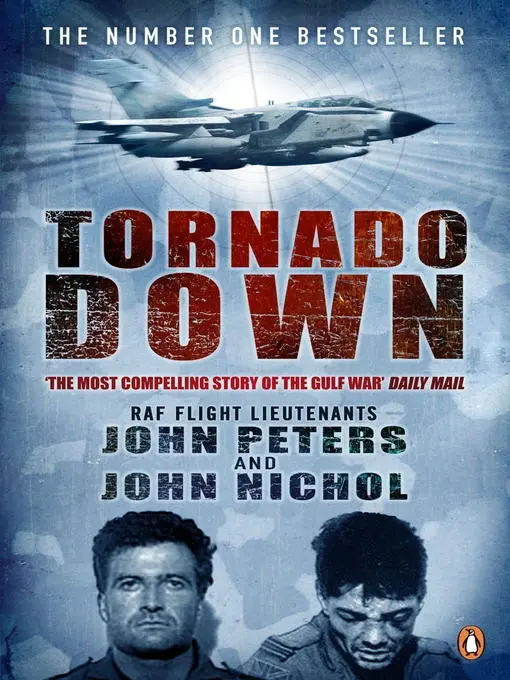
- Название:Tornado Down
- Автор:
- Издательство:Penguin Adult
- Жанр:
- Год:2008
- Город:London
- ISBN:978-0-14-193771-7
- Рейтинг книги:5 / 5. Голосов: 1
-
Избранное:Добавить в избранное
- Отзывы:
-
Ваша оценка:
Tornado Down: краткое содержание, описание и аннотация
Предлагаем к чтению аннотацию, описание, краткое содержание или предисловие (зависит от того, что написал сам автор книги «Tornado Down»). Если вы не нашли необходимую информацию о книге — напишите в комментариях, мы постараемся отыскать её.
In
, John Peters and John Nichol tell the incredible story of their part in the war against Saddam Hussien’s regime. It is a brave and shocking and totally honest story: a story about war and its effects on the hearts and minds of men.
Tornado Down — читать онлайн бесплатно полную книгу (весь текст) целиком
Ниже представлен текст книги, разбитый по страницам. Система сохранения места последней прочитанной страницы, позволяет с удобством читать онлайн бесплатно книгу «Tornado Down», без необходимости каждый раз заново искать на чём Вы остановились. Поставьте закладку, и сможете в любой момент перейти на страницу, на которой закончили чтение.
Интервал:
Закладка:
So we were looking forward to penetrating this all-male territory. But the first onslaught was scheduled for the Friday after John and John went missing, so the Station Commander was going to cancel it.
‘Don’t you dare!’ I said when he told me. ‘Not only are you not going to cancel it, but I’m going – in fact you can get me the first drink!’ Life was going to have to carry on as normally as possible, outwardly, even if it were in fact turned upside-down. Other wives did the same when their husbands went missing, later on in the war: they turned up at the functions and put on a brave face. It had less to do with keeping a stiff upper lip, than avoiding the alternative: sitting miserably on your own at home, brooding.
The bar was packed that night. There was a great spirit on the station, despite all our anxieties, with the squadrons at war. The Station Commander was extremely good. In complete contrast to the Ministry of Defence, he was very candid with me, and gave me and the others tremendous support. This was just as well, because the British tabloid press by now had its teeth sunk firmly into the story.
John has always been my closest friend, as well as my husband. I missed being able to talk to him about what I should do for the best.
John Peters: What is difficult to describe is the sense of utter failure that took hold of me once I had given in. There was an overwhelming sense of shame. I had failed. It was not so much what I had told them. They had asked me a few general questions about the Tornado, mostly what it was carrying when it was shot down. There wasn’t much they could have learned of any major value. I knew another target that was going to be attacked, but by now that attack would have gone through, so it no longer mattered. Anyway, they had not asked me that. More seriously, I knew the transmit codes for the Combat Search and Rescue teams, I knew the sequence of signals that you had to give to call in a rescue mission, the stuff John had given me before we baled out. These codes and signals were good for a week. If the Iraqis had found them out, they could have invented a ‘rescue mission’, with a good English speaker pretending to be a pilot, and simply ambushed it, shot it to pieces. This was one of the few things they could have found out that would have been useful to them, but they hadn’t asked it. That did not matter. What mattered was having broken at all – it now seemed only too soon. When I was left on my own again after answering the questions, the most unbearable feeling of desperation and self-loathing swept through me. I kept on and on, reproaching myself. The iron was in my soul all right. Completely isolated, I thought that I was the weak link, the only weak link, that everybody else would have held out for much longer, that I was letting my mates down. I became obsessed by the idea that I was the wimp in the chain, and it was unbearable. There are different kinds of prison.
After that, they took me to another room, which felt far bigger, and interrogated me further. I was feeling pretty hazy still, and I played on this, using the grogginess to stall them. I was still determined to give as little as possible. I spoke very, very slowly, and said I was confused, which was true up to a point, all the time stalling. That day, and over the next day and a half, two days, they asked me nothing that they could not have found out about Tornado, or about Coalition battle plans, from Warplane magazine, nothing that the average intelligent twelve-year-old could not have pieced together. It was as if they had no clear idea what to ask me. And that was the best feeling in the world. A wonderful wave of relief flowed through me – but it was not to last very long.
Despite the incompetence of the interrogators, the feeling of failure got a whole lot worse when I spoke to John again, when they briefly threw us back together in the same room.
‘I’ve talked a bit to them, but they could read it all in the papers anyway,’ I told him. This was true, there had been quite a few articles in the broadsheets detailing who the Base Commander was at Muharraq, who the Squadron Commander was, that XV Squadron was flying Tornados out of Bahrain.
‘Don’t worry about it,’ he replied.
‘Have you said anything yet?’ I asked him.
‘No.’
I hated him for that. At the same time as not wanting him to speak, to suffer, I wanted the reassurance that in reality I was not the only weak one. But apparently I was. This made it all much worse again.
16
Interrogation
John Nichol: They dragged me back into the room. Silence. But I sensed at least two people, watching. The chair. That’s what I learned to fear: backless, tubular steel, vinyl seat. When they held you down on that…
My body was tensed for some more of the same, but this time there was a warm, gentle voice. ‘It’s OK, we don’t want to know any information. Don’t worry.’ They took the blindfold off. The voice turned out to be a mild-looking, middle-aged man, somebody’s uncle, a twinkle in his eyes. He offered me food and drink, beside him on the table. I refused. ‘Look, it’s not drugged, I am eating it.’ He asked the Big Four: name, rank, number and date of birth. I told him, that’s permitted. This was a style of interrogation I recognised; I’d been warned about it in our combat survival training.
Mr Nice was talking to me again, his warm, reasonable tones filling the room, cosy, warming, lapping gently into my thoughts: ‘We don’t want to know any information. Here is food, here is drink. Don’t worry. Relax.’ He started to slip in the odd question. ‘What squadron are you from, by the way?’
‘I cannot answer that question.’
‘Why can’t you answer that question?’
‘I cannot answer that question.’
And so the tournament began. He wanted me to say something else. That’s the game we were playing. I’d given him the Big Four, the only other thing I could properly say now was ‘I cannot answer that question.’ If I said anything else, I would be striking up a conversation with him, and he’d have got me. I didn’t want to do that. He kept on, softly, genteelly. ‘Why did you come to bomb my country?’
‘I cannot answer that question.’
‘Why can’t you answer that question?’
‘I cannot answer that question.’
‘Why have you attacked us? We haven’t attacked you.’
‘I cannot answer that question.’
This is as difficult as when somebody is beating you and asking you questions. A beating is a very untechnical way of interrogating somebody. Most interrogators will tell you it is not a particularly efficient method of interrogation, because eventually you will start talking in order to stop the pain, and you will tell them what they want to hear, you will say anything, truth or not. The wheedling, the appeals to logic and reason were more subtle, undermining.
My body was still on fire from the last beating, but he was trying to be nice to me, to draw me in, to form a relationship with me. He was going through a list of things that I could actually answer, and not give any information away at all, and I thought, ‘I’d love to answer this, I’d love to say something different, but I can’t, I’ve got to keep saying “I cannot answer that question.” ’ It sounded ridiculous, when you kept on repeating it.
He tried a different approach: ‘Your friends bombed my family at the airfield tonight. What do you think of that?’
‘I cannot answer that question.’
‘OK… Fine. I see you are wearing a chemical warfare suit. Why are you wearing a chemical warfare suit? Is it because you’re dropping chemical weapons on my country?’
Now I was thinking, ‘Oh no.’ I desperately wanted to deny the accusation, but I could not. If I replied ‘No’, he’d have got me. He realised from the look on my face that he was onto something; he concentrated on that for a while. ‘You are dropping chemical weapons onto my country, aren’t you?’
Читать дальшеИнтервал:
Закладка:
Похожие книги на «Tornado Down»
Представляем Вашему вниманию похожие книги на «Tornado Down» списком для выбора. Мы отобрали схожую по названию и смыслу литературу в надежде предоставить читателям больше вариантов отыскать новые, интересные, ещё непрочитанные произведения.





Обсуждение, отзывы о книге «Tornado Down» и просто собственные мнения читателей. Оставьте ваши комментарии, напишите, что Вы думаете о произведении, его смысле или главных героях. Укажите что конкретно понравилось, а что нет, и почему Вы так считаете.