David Rosenberg - Inside Pine Gap
Здесь есть возможность читать онлайн «David Rosenberg - Inside Pine Gap» весь текст электронной книги совершенно бесплатно (целиком полную версию без сокращений). В некоторых случаях можно слушать аудио, скачать через торрент в формате fb2 и присутствует краткое содержание. Город: Melbourne, Год выпуска: 2011, ISBN: 2011, Издательство: Hardie Grant Books, Жанр: Биографии и Мемуары, Политика, на английском языке. Описание произведения, (предисловие) а так же отзывы посетителей доступны на портале библиотеки ЛибКат.
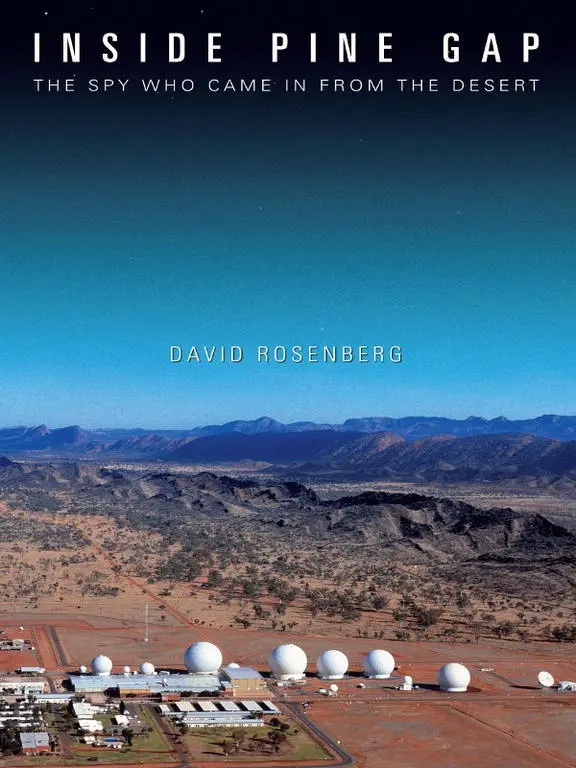
- Название:Inside Pine Gap
- Автор:
- Издательство:Hardie Grant Books
- Жанр:
- Год:2011
- Город:Melbourne
- ISBN:978-1-742-70173-8
- Рейтинг книги:4 / 5. Голосов: 1
-
Избранное:Добавить в избранное
- Отзывы:
-
Ваша оценка:
Inside Pine Gap: краткое содержание, описание и аннотация
Предлагаем к чтению аннотацию, описание, краткое содержание или предисловие (зависит от того, что написал сам автор книги «Inside Pine Gap»). Если вы не нашли необходимую информацию о книге — напишите в комментариях, мы постараемся отыскать её.
Author David Rosenberg details his career with an American intelligence agency during a tumultuous period in history that covered the terms of three American Presidents, four Australian Prime Ministers, the end of the Cold War, a peace treaty between Israel and Jordan, two wars in Iraq, genocide in Rwanda, as well as the ‘War against Terror’ and the emergence of North Korea as a nuclear-armed nation. This is a fascinating glimpse inside the top-secret world of military surveillance.
[This book contain a table.]
Inside Pine Gap — читать онлайн бесплатно полную книгу (весь текст) целиком
Ниже представлен текст книги, разбитый по страницам. Система сохранения места последней прочитанной страницы, позволяет с удобством читать онлайн бесплатно книгу «Inside Pine Gap», без необходимости каждый раз заново искать на чём Вы остановились. Поставьте закладку, и сможете в любой момент перейти на страницу, на которой закончили чтение.
Интервал:
Закладка:
Contractors have always played a key role at Pine Gap, and over the past forty years many have helped with the mission in Operations and overall maintenance. Raytheon, the primary contractor inside the secure building, is tasked with manning positions within Operations, and its operators are referred to as ‘rack jocks’ because each operator sits in front of a tall rack of equipment, monitoring data and alerting Operations to anything new that might indicate an impending event. Raytheon also manages the computer network, equipment maintenance and the Engineering division. In times past, Boeing Australia administered the contract for grounds maintenance, housing and the motor pool, but Raytheon successfully obtained this contract in 2004–05, making it by far the largest contractor currently at Pine Gap.
Pine Gap is also the largest employer in Alice Springs, with well over a thousand local residents working at the Base or contracted to help maintain the housing, kitchen and grounds, including the maintenance of more than 200 houses and flats required by the families who work at Pine Gap and ongoing maintenance of the ground facilities at the Base and in town. Also among the personnel are security officers, bus drivers who transport the employees to and from work, mechanics who maintain the transport vehicles, and kitchen and laundry/cleaning staff who prepare meals and maintain the guest quarters. While Alice Springs certainly attracts tourist dollars, if Pine Gap was to close, the local housing market would collapse and many local businesses would close along with the Base. As the largest employer in Alice Springs, Pine Gap has been, and remains, absolutely vital to the economic health of this small outback town.
So Pine Gap maintained a quiet presence in Alice Springs, growing with the pace of increasingly complex technology. The progression of satellites began with Rhyolite but advanced in complexity and capability under various program names, including Aquacade, Magnum, Orion and Advanced Orion. [6] Ball, Desmond, ‘The US-Australian Alliance: The Strategic Essence’, paper prepared for the Australian Journal of International Affairs , July 2001, Strategic and Defence Studies Centre, Australian National University, Canberra, July 2001, p. 7.
As Desmond Ball has said of the latter, ‘The latest geostationary SIGINT satellites, Advanced Orion, weigh some 4,650 kilograms, or about twice as much as the Magnum/Orion satellites, and are able to intercept an even broader range of signals.’ [7] ibid.
Professor Ball also pointed out that Pine Gap operates under the direction of the National Reconnaissance Office (NRO) and states that the NRO is the intelligence community’s ‘super-secret intelligence satellite coordinating agency’. [8] Ball, Pine Gap , p. 1.
Established in 1961, [9] http://en.wikipedia.org/wiki/National_Reconnaissance_Office
the NRO directs the building of spy satellites and manages their tasking, operation and control. He also says that ‘the Pine Gap facility (codenamed Merino) was originally established as the ground station for the Rhyolite satellites’ [10] Ball, Pine Gap , p. 1.
and that ‘there are NSA personnel at the US Embassy in Canberra, at the Pine Gap and Nurrungar Rhyolite and DSP…’ [11] Richelson & Ball, The Ties that Bind , p. 190.
He expands on this in another publication when he states that Pine Gap ‘comprised… personnel from ██████████████████████████████████████ [the Intelligence Community and Service] Cryptological Agencies’. [12] Kealy, The Pine Gap Saga , p. 10 (Introduction).
California-based TRW (later acquired by Northrop-Grumman) designed and built the Rhyolite satellites. These early satellites were capable of intercepting ‘telemetry, radars, and communications’ with an intercept capability that ‘extends across the VHF, UHF, and microwave frequency bands’. [13] Richelson & Ball, The Ties that Bind , p. 177.
(Much of the early Rhyolite satellite program was compromised to the benefit of the Soviet Union by a TRW employee, Christopher Boyce, whose story was told in the movie The Falcon and the Snowman . [14] http://en.wikipedia.org/wiki/The_Falcon_and_the_Snowman
)
An additional, well-documented capability of satellites is the ability to locate the origin—the location on Earth—of an electronic signal. [15] http://en.wikipedia.org/wiki/Satellite_geolocation
Search-and-rescue beacons [16] http://en.wikipedia.org/wiki/Aircraft_emergency_frequency
are perhaps the best-known signal type; for over thirty years there have been stranded mariners whose ships’ search-and-rescue beacons have been located by satellites, resulting in them living to tell the tale. Military pilots are required to carry beacons for the same reason and thanks to the geolocation capability of satellites, a great number of ‘downed’ pilots have also survived—Captain Scott O’Grady is one such pilot whose story will be told in a later chapter.
It wasn’t until 1988 that then Australian Prime Minister Bob Hawke publicly acknowledged that Pine Gap performed government arms-control functions, admitting that the function of the satellites was ‘to collect intelligence data which supports the national security of both Australia and the US’ and adding that ‘Intelligence collected at Pine Gap contributes importantly to the verification of arms control and disarmament agreements’. From this statement and the secrecy surrounding Pine Gap, it was acknowledged that the satellites performed government security and intelligence collection functions.
Nevertheless, the Australian Government was still careful not to reveal too much information; there was no disclosure, for example, of which agencies used this intelligence or exactly how many satellites were controlled by Pine Gap. Important technical data was also withheld, leaving observers to speculate on the exact nature of the satellites’ operations.
Since the 1970s, the secrecy surrounding Pine Gap has resulted in protests by Australians demanding the public revelation of Pine Gap’s function and the true nature of the intelligence collected there. The intelligence obtained at Pine Gap is unrestrictedly shared with Australian government intelligence directorates exactly as it is shared in the United States—on a ‘need-to-know’ basis. The concept of ‘need-to-know’ relates only to those who possess the security clearance required to perform the work there, or to make decisions derived from some of the intelligence collected at Pine Gap. Those who don’t possess this clearance obviously don’t need to know any of the intelligence collected at Pine Gap in order to do their job. [17] Some people believe that Australian and US taxpayers have a ‘right to know’ what happens at Pine Gap since their tax dollars support the facility. However, for Pine Gap to operate effectively, details on how Pine Gap performs its mission and the value of the intelligence collected must remain classified. Just as companies have information that they must safeguard in order to protect their business (the secret recipe for Coke® is a simple example), governments are within their rights to classify and withhold sensitive information required to protect their citizens.
In 1975, thirteen years before the official disclosure by Prime Minister Hawke, reports began to emerge that Labor Prime Minister Gough Whitlam wanted to close Pine Gap. It was claimed that the Prime Minister believed his government had been misled over key operational and management issues after discovering that ‘Pine Gap was a United States wholly administered operation commanded by ██████████. [18] ‘Foreign Intelligence Services in Australia’, Hansard (House of Representatives), 4 May, 1977, p. 1520.
Other reports suggested that Whitlam believed Australian intelligence services worked with █████████████████ to bring down the government of Salvador Allende, the president of Chile, on 11 September 1973, and he had threatened to close the facility at Pine Gap as a result. [19] Tarpley, WG & Anton Chaitkin, George Bush: The Unauthorized Biography , Executive Intelligence Review, Washington DC, 1992, http://www.tarpley.net/bush15.htm
According to Australian author Richard Hall in his book The Secret State , the United States Government was also reportedly concerned when Whitlam refused to allow his staff to undergo customary security checks, reportedly prompting █████████████████ to threaten to withhold intelligence information to Australia. [20] Hall, The Secret State .
Whitlam eventually agreed to reinstate the security checks, but his rift with the Australian intelligence community continued, culminating in the removal of the heads of the Australian Security Intelligence Organisation (ASIO) and the Australian Secret Intelligence Service (ASIS) in 1975.
Интервал:
Закладка:
Похожие книги на «Inside Pine Gap»
Представляем Вашему вниманию похожие книги на «Inside Pine Gap» списком для выбора. Мы отобрали схожую по названию и смыслу литературу в надежде предоставить читателям больше вариантов отыскать новые, интересные, ещё непрочитанные произведения.










Обсуждение, отзывы о книге «Inside Pine Gap» и просто собственные мнения читателей. Оставьте ваши комментарии, напишите, что Вы думаете о произведении, его смысле или главных героях. Укажите что конкретно понравилось, а что нет, и почему Вы так считаете.