Erin Bow - Plain Kate
Здесь есть возможность читать онлайн «Erin Bow - Plain Kate» весь текст электронной книги совершенно бесплатно (целиком полную версию без сокращений). В некоторых случаях можно слушать аудио, скачать через торрент в формате fb2 и присутствует краткое содержание. Год выпуска: 2010, ISBN: 2010, Издательство: Scholastic Inc., Жанр: Старинная литература, на английском языке. Описание произведения, (предисловие) а так же отзывы посетителей доступны на портале библиотеки ЛибКат.
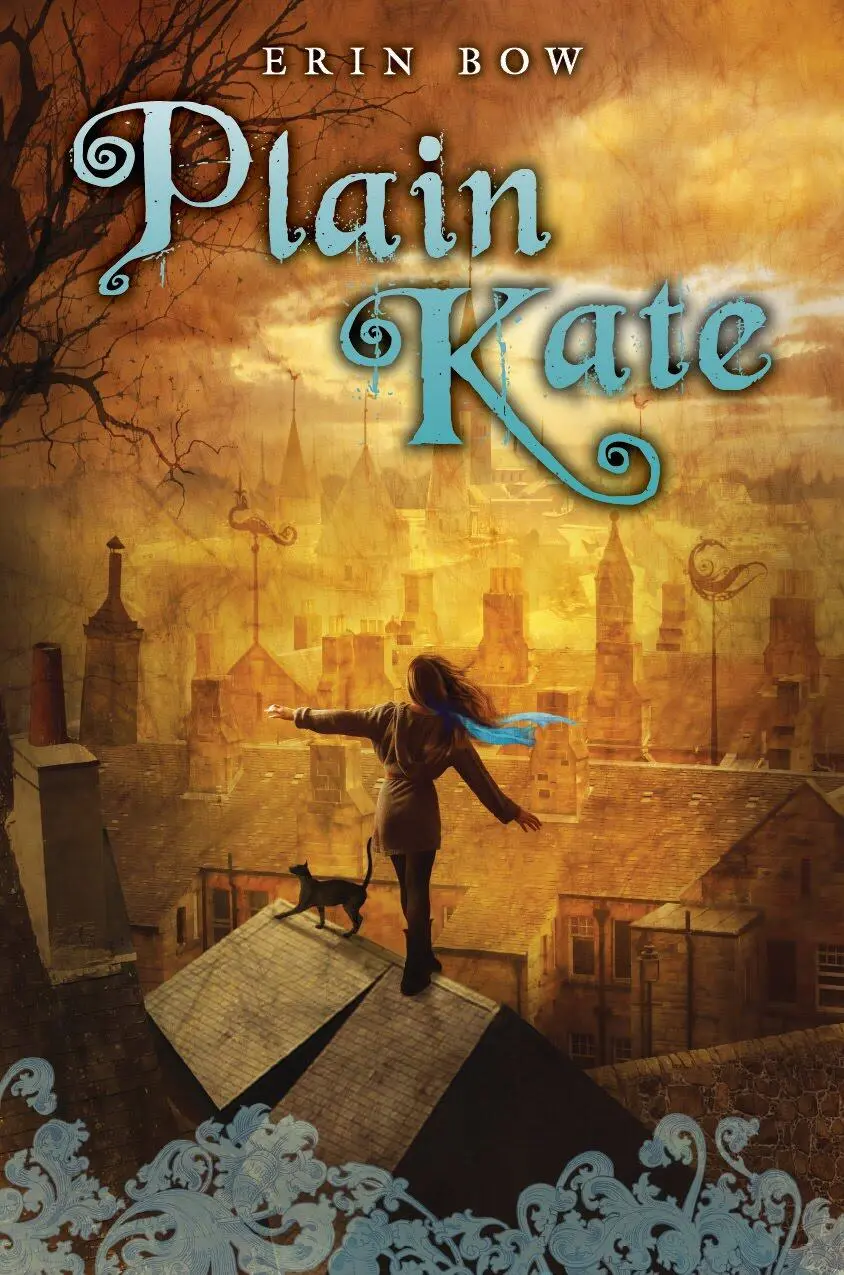
- Название:Plain Kate
- Автор:
- Издательство:Scholastic Inc.
- Жанр:
- Год:2010
- ISBN:9780545166645
- Рейтинг книги:3 / 5. Голосов: 1
-
Избранное:Добавить в избранное
- Отзывы:
-
Ваша оценка:
Plain Kate: краткое содержание, описание и аннотация
Предлагаем к чтению аннотацию, описание, краткое содержание или предисловие (зависит от того, что написал сам автор книги «Plain Kate»). Если вы не нашли необходимую информацию о книге — напишите в комментариях, мы постараемся отыскать её.
Plain Kate — читать онлайн бесплатно полную книгу (весь текст) целиком
Ниже представлен текст книги, разбитый по страницам. Система сохранения места последней прочитанной страницы, позволяет с удобством читать онлайн бесплатно книгу «Plain Kate», без необходимости каждый раз заново искать на чём Вы остановились. Поставьте закладку, и сможете в любой момент перейти на страницу, на которой закончили чтение.
Интервал:
Закладка:
There were only a few men about; Plain Kate could hear them farther off, moving among the horses. But to her surprise, Behjet was sitting on a stone near the fire, whittling. He looked up at her, cold and blank, as if he didn’t know her at all. Could this be courtesy? It was like a door slammed in the face.
Daj led her to where an old man sat on a carved and painted bench. His face was grooved like a winter road. A cane rested at each knee; his feet were almost in the fire. Daj curtsied to him, not elaborately, but the way a sandpiper might dip its beak, natural and fast, without reverence. “If a woman might pass among you and speak,” said Daj. And then, without waiting for an answer, she said: “Rye Baro. I have brought a guest. This is Plain Kate Carver, of Samilae. She would go the Roamer way.”
Rye Baro had eyebrows like caterpillars before a long winter. He raised one. “With these vardo ?”
“Aye,” said Daj. “She’s orphan, I’m told, and has nowhere else.”
Behind them, someone said, “Are we a pack of dogs, then, taking in strays?” Plain Kate turned. The man had Behjet’s face, but the whole way he held himself was different. He sat hunched up like a drawn bow.
“Are we dogs, then, talking piss at the fire?” Daj clouted the man on the head affectionately. “Show manners, Stivo.”
The man—Stivo—shrugged. Twins, Plain Kate realized. Behjet and Stivo were the twins she had seen selling horses in the Samilae market, a few weeks before.
“Well, it wouldn’t be manners to set her loose in wild country, would it?” said Rye Baro. He had a voice like a fine rasp: rough but polishing. “Makes a man wonder how she got into wild country with the Roamers in the first place.”
“Hmmm,” said Daj with a wink in her voice. “That is a puzzle.”
No one seemed puzzled or much surprised. “Behjet says her people want to burn her for a witch,” said Stivo.
“Aye,” said Daj. “He said that to me too.”
The whole circle turned to Stivo, and waited. He poked at the fire, sending sparks spiraling up into the rainy darkness. The fire hissed. Stivo said nothing. A log snapped and crackled. And still Stivo said nothing.
At last Daj spoke again. “Plain Kate is a carver,” she said. “We need one of those.”
“We get by well enough, seems to me,” Rye Baro mused.
“If the yellow vardo goes another week before the tongue snaps, it will be by the Black Lady’s mercy,” said Daj. “But I was thinking: She can make real coins to clink together.”
“Do they carve those now?” Firelight played across Rye Baro’s face. “I hadn’t heard.”
“She makes objarka.” Daj wrapped an arm around Plain Kate like a wing around a chick. “Best I’ve seen. They’ll sell, and for silver too, not copper.”
“In the market of Toila?” said Rye Baro.
Daj nodded. “That was my mind.”
“Come here, gadje child,” said Rye Baro. Plain Kate stepped toward him, and—guided by Daj’s hand on her shoulder—knelt. The old man pointed to her objarka, and Kate took it off and offered it up to him. He took it, and as Daj had done, studied it in silence. Kate stayed kneeling, her leggings wicking water up from the wet ground, her cheek and ear getting hot where they faced the fire. At last, Rye Baro looked down at her. “The matter of witch burning is not our affair,” he said. “It is your trouble and you must not bring it upon us. But your work is fine. Stand up.”
Plain Kate stood up.
“This is your duty, then, child,” said Rye Baro. “To earn a place by your skill, and coins for your clan.” Plain Kate took a step back, staggered by the weight of the words your clan . She almost didn’t hear Rye Baro add: “Have your objarka ready for Toila. And make them burji. Times are bad.”
Burji. While objarka drew good luck, objarka burji scared bad luck away. They had the faces of demons.
Plain Kate had no interest in ugly things, but she answered, “Yes, Rye Baro.”
And back at her own fire she lifted her face into the kiss of the rain.
Only much later did she remember what Behjet had said: My brother’s wife was burned for a witch. And she wondered what Stivo had been seeing in that fire.

The Roamer vardo went on through wild country. The road looped along the river, and where the banks grew too marshy, back into the woods. There were riders or carters, but only occasionally. In the woods, only fingers of chimney smoke going up into the gray sky told them of other people. On the river, sometimes they saw a boat or one of the small painted barges that made Plain Kate think of Linay, standing and watching her catch the enchanted fish. There was a green one that made her head turn sharply whenever she saw it—but it was always trailing them, and never came near.
Plain Kate greased her boots and bandaged her feet, and soon she could walk like a Roamer born. She helped Drina with the water and the wood, and in the long, wet evenings she carved the objarka burji.
Plain Kate carved fast and learned slowly. She learned to ride a horse, or at least hold on to a horse. She learned to cook goulash: a spicy stew of peppers and whatever meat could be scrounged. She learned to snag a chicken with the flick of a crook. She learned the Roamer language and the ways, which were many and complicated. She learned, for instance, how each camp must have a stream, and each stream must have four buckets, and each bucket was used for something different: the first for drinking and cooking, the second for washing, the third for the animals, the fourth for the latrine. But a woman bleeding must use the fourth bucket even to wash.
She was bewildered much of the time, but Daj called her mira again, and when she asked Drina what it meant, the girl replied, “It means she likes you. It means you’re family.”
Family. It could have kept her walking for a hundred miles. And she did walk far. The country grew rougher and quieter, with deer browsing in the middle of the road. The rain kept falling. The vardo wheels grew thick with mud, and at night socks were propped up on sticks at the fire like toasting sausages. It was miserable, but secretly Plain Kate was glad. She didn’t have to look at her shadow.
Every once in a while, when the rain broke into gusts of drizzle and sun, she saw it: what was left of her shadow. It moved in ways she did not. It stood in the air where no shadow could stand. It was too long and too thin, and it pointed, sometimes, in the wrong direction. She was losing it, and she was not sure what would happen when it was gone.
Plain Kate lay next to Drina at night, with Taggle in the crook of one arm. She closed her eyes and the vardo seemed to spin. She set her back against Drina’s warm back, and pulled Taggle closer to her, and listened to Daj snore. Often she dreamt she had two wings, and one was frightened, and one was happy.

All the time they drew closer to Toila, where the Roamers would decide whether to keep her or abandon her. It depended on her carving.
Plain Kate obeyed Rye Baro and made her objarka as burji as she could stand, ugly enough to scare off even a return of the skara rok . She made a man with a pig snout, a bat-faced thing with comically hinged ears, a face that was nothing but teeth. She made the screaming face of the woman she’d glimpsed burning in the witch fire. She made the impossible face she saw sometimes in dreams, a blankness with eyes of hair. They would sell, she thought. Surely they would sell.
Taggle, meanwhile, made himself popular, killing rats and bringing a rabbit into camp every evening, preening in the praise—silently, thank God, though at night he recounted choice bits to Kate: “Rye Baro says I am a princeling; he split the leg bone for me so that I could eat the marrow. They love me. And I’m sure they’ll keep you too.”
Читать дальшеИнтервал:
Закладка:
Похожие книги на «Plain Kate»
Представляем Вашему вниманию похожие книги на «Plain Kate» списком для выбора. Мы отобрали схожую по названию и смыслу литературу в надежде предоставить читателям больше вариантов отыскать новые, интересные, ещё непрочитанные произведения.






Обсуждение, отзывы о книге «Plain Kate» и просто собственные мнения читателей. Оставьте ваши комментарии, напишите, что Вы думаете о произведении, его смысле или главных героях. Укажите что конкретно понравилось, а что нет, и почему Вы так считаете.