Erin Bow - Plain Kate
Здесь есть возможность читать онлайн «Erin Bow - Plain Kate» весь текст электронной книги совершенно бесплатно (целиком полную версию без сокращений). В некоторых случаях можно слушать аудио, скачать через торрент в формате fb2 и присутствует краткое содержание. Год выпуска: 2010, ISBN: 2010, Издательство: Scholastic Inc., Жанр: Старинная литература, на английском языке. Описание произведения, (предисловие) а так же отзывы посетителей доступны на портале библиотеки ЛибКат.
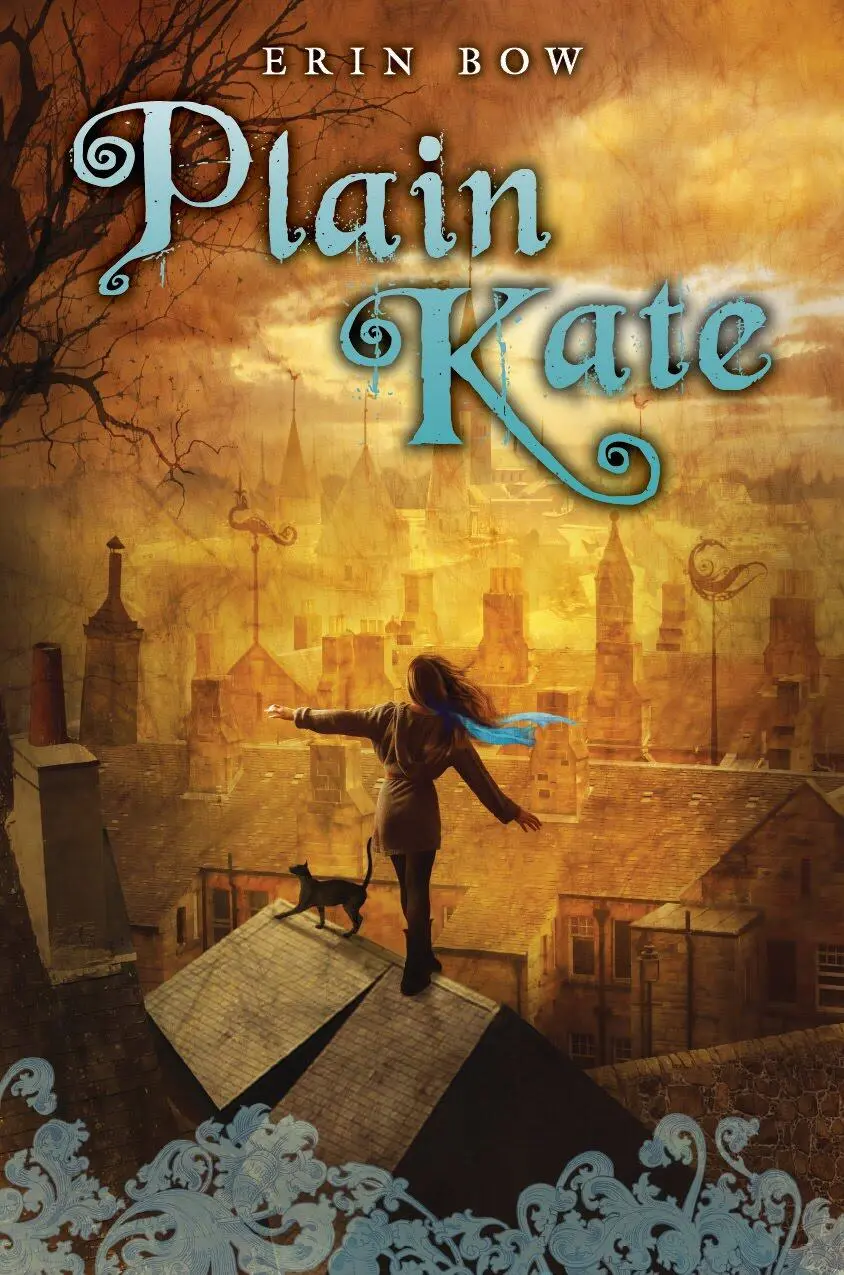
- Название:Plain Kate
- Автор:
- Издательство:Scholastic Inc.
- Жанр:
- Год:2010
- ISBN:9780545166645
- Рейтинг книги:3 / 5. Голосов: 1
-
Избранное:Добавить в избранное
- Отзывы:
-
Ваша оценка:
Plain Kate: краткое содержание, описание и аннотация
Предлагаем к чтению аннотацию, описание, краткое содержание или предисловие (зависит от того, что написал сам автор книги «Plain Kate»). Если вы не нашли необходимую информацию о книге — напишите в комментариях, мы постараемся отыскать её.
Plain Kate — читать онлайн бесплатно полную книгу (весь текст) целиком
Ниже представлен текст книги, разбитый по страницам. Система сохранения места последней прочитанной страницы, позволяет с удобством читать онлайн бесплатно книгу «Plain Kate», без необходимости каждый раз заново искать на чём Вы остановились. Поставьте закладку, и сможете в любой момент перейти на страницу, на которой закончили чтение.
Интервал:
Закладка:
“Maybe,” said Drina. And then, because hope will break the heart better than any sorrow, she started to cry. “It’s what my mother taught me.”

In the morning, they held what funeral they could, with nothing to bury but the charred fragment of Kate’s carving: an eye and forehead, bit of wing. “For Lenore,” said Kate. “And Linay.”
“We don’t say…” Behjet corrected her gently, but Drina interrupted, saying it softly: “For Lenore and Linay.”
And Taggle said what was the traditional blessing in that country: “May all the graves have names.”
“I will carve a marker for them,” said Kate. “But there is something I must do first. Linay stole me a knife once. I am going to go get it.”
Behjet frowned. “That city—it might still be dangerous.”
“Nonsense,” said Taggle stoutly. “She is fearless. And anyway, I am going with her.”
And so Kate and Taggle walked together, back toward Lov. They started early, their shadows stretched together, cat and human, down the long road behind them. “Your voice,” said Kate. “How…how long?”
“A—” Taggle stopped, head tilted. “I cannot make sense of time.”
“It’s not a matter for cats,” said Kate softly.
“No.”
“You will always be my friend,” she said.
His tail quirked and he growled fiercely, “I should think so.”
A last day. The country seemed as if a great curse had been lifted. White clouds drifted across the mirrored puddles on the road. Kate’s shadow grew stronger as the sun swung up the sky.
“Do you remember that horse of Behjet’s?” said Taggle. “The one who gave us such a jouncing?”
“Xeri,” said Kate.
“I clawed his ankle. And the camp dog, the brown one. I rode on his back for half a mile.”
“I remember.”
“And the—the—” he stuttered. “That bird, big—”
“The heron.”
“I could—”
“You could have killed him,” said Kate. “You could have taken him from above.”
“Ah,” said Taggle.
“You’re the king of the creatures,” said Kate. “You’re a panther, you’re a lord.”
They went in silence for a while. The road’s edges were embroidered with aster and wild carrot, glowing white and purple in the sun.
“Taggle?”
“Mmmmm…” he mewed.
“It’s nothing.”
“I’m here,” he said, thick-tongued. “I—”
“You will always be my friend,” she said.
Evening, the bridge to Lov. Ahead of them, Kate’s shadow was spread like a cape across a puddle. Taggle leapt the water in a silver arch, effortless, graceful. He turned back and quirked his whiskers: a cat’s beckoning.
“Taggle?”
“K-Katerina,” he stuttered. “Yessss…” My voice is still here, he meant. But it was a cat’s hiss in his answer.
“Let me carry you,” said Kate, and picked him up.
“Merow,” he said, and butted fondly at her ear.
They came round the city. Small boats bobbed in the pool outside the water gate. White storks paced among them. And there was the green barge. Kate hoisted Taggle onto her shoulder and waded out and climbed aboard.
So much had happened to her here: The tiny piece of decking seemed too small to contain it. But the red vardo was small too. And the lowest drawer of her father’s cabinet had been smaller still. Perhaps it was time to stop choosing small places.
Taggle poured himself out of her arms and hopped down into the hold.
She followed. That space too seemed smaller than it had, and more ordinary. The coiled ropes were looser, the wild herbs more stale. Lightning had lived there, but now it was gone.
The bunk was made up, and the box that had once held her shadow was resting in the middle of it. The stag on the box lid seemed almost alive in the swaying light. Beside it on the blanket was her white dress with its lace trimmings, the jar of salve that had healed her hands, the roll of hand tools, the knife she had refused to take. They were bundled together and tied with a red ribbon that had cost a kopek or two. Kate pictured Linay making up the bed and heading off to die. Had he been thinking of her? Had he wanted her to have the things that he’d given her, in the strange time when they had been almost friends?
She opened the box. It was no longer filled with the eerie, clotted darkness. It was just a box. There was a plain leather bag at the bottom. Remembering the weight, Kate drew open the purse strings. There was a scrap of paper, and—
The bag was full of thin, gleaming coins, mostly silver, but a few copper or—now that Kate looked—they were gold. It was a guild fee. A hundred times a guild fee. A thousand.
“Taggle,” she said. “Look!”
“Ca-ca-cat,” he stuttered. “K-Katerina. Cat.”
She knew it was the moment, and she turned to him. The cat looked up at her with the last trace of his broken heart, and then turned to look at the gold coins with simple gold-coin eyes. He said nothing. Forever after that, he said nothing.
“Taggle…” said Kate. Her voice broke. “T-Taggle…”
On the paper, in a hand so fierce it threatened to topple and break like a wave, Linay had written:
Kate. I hope you live.
Something flashed through her, surprising her with a sting of tears. She thought it was bewilderment, anger, fear—before she recognized it: grief.
“I did,” she told the paper softly. “We both did.” She picked up the cat, who whirred and purred and flowed up onto her shoulder. “And we’ll keep on living.”
And so they did, not always without trouble, but happily, and well, and for a long time thereafter.
acknowledgments
It took me six years to write this book, and in those years have accumulated many debts.
Let me start with my fellow writers. First among these are my dear friends at the Hopeful Writer’s Group: Susan Fish, Nan Forler, Kristen Mathies, Pamela Mulloy, Esther Regehr. Seeing me through between Hopeful gatherings are my online friends at the well: Thanks, guys. And thank you, R.J. Anderson, for reading early drafts and crying in all the right places.
And then there are the people who played midwife to this book, bringing it into the world. First is my agent, Emily van Beek of Pippin Properties. Emily, you changed my life. My editor, Arthur Levine, is a genius and a warm and wonderful human being. Thank you, Arthur—and thank you, Emily Clement, left half of Arthur’s brain. And I mustn’t forget my mother-in-law, Patricia Bow, who proofread this manuscript seven times.
Finally, there’s my family. Thank you, Wendell Noteboom, my dad; thank you, Rosemarie O’Connor, my mom. You’ve been supporting me since the day care days when I demanded to have my song lyrics written down. Thank you, Vivian and Eleanor, my own lovely lively little girls, for your patience with “Mommy is writing.” And thanks to my beloved husband James, fellow YA novelist, for endless idea bouncing, hand-holding, and coffee making. I could never have written this book—or any novel—without you.
This book is dedicated to my sister Wendy Ewell. Wendy drowned before she got to read the ending of this story, before she got to meet the niece she was looking forward to, before a lot of things. I could level a city out of grief. Instead I’ll say: Baby sister, I miss you. This, my first novel, is for you.
about the author
Erin Bow was born in Des Moines and raised in Omaha. She studied particle physics in college, eventually working at the cern laboratory near Geneva, Switzerland. She then decided to leave science in order to concentrate on her love of writing. She has since written two books of poetry and a memoir. Her poetry has won the CBC Canadian Literary Award, whose previous winners include Michael Ondaatje and Carol Shields, as well as several other awards. She lives in Kitchener, Ontario. This is her first novel.
Интервал:
Закладка:
Похожие книги на «Plain Kate»
Представляем Вашему вниманию похожие книги на «Plain Kate» списком для выбора. Мы отобрали схожую по названию и смыслу литературу в надежде предоставить читателям больше вариантов отыскать новые, интересные, ещё непрочитанные произведения.

Обсуждение, отзывы о книге «Plain Kate» и просто собственные мнения читателей. Оставьте ваши комментарии, напишите, что Вы думаете о произведении, его смысле или главных героях. Укажите что конкретно понравилось, а что нет, и почему Вы так считаете.