Erin Bow - Plain Kate
Здесь есть возможность читать онлайн «Erin Bow - Plain Kate» весь текст электронной книги совершенно бесплатно (целиком полную версию без сокращений). В некоторых случаях можно слушать аудио, скачать через торрент в формате fb2 и присутствует краткое содержание. Год выпуска: 2010, ISBN: 2010, Издательство: Scholastic Inc., Жанр: Старинная литература, на английском языке. Описание произведения, (предисловие) а так же отзывы посетителей доступны на портале библиотеки ЛибКат.
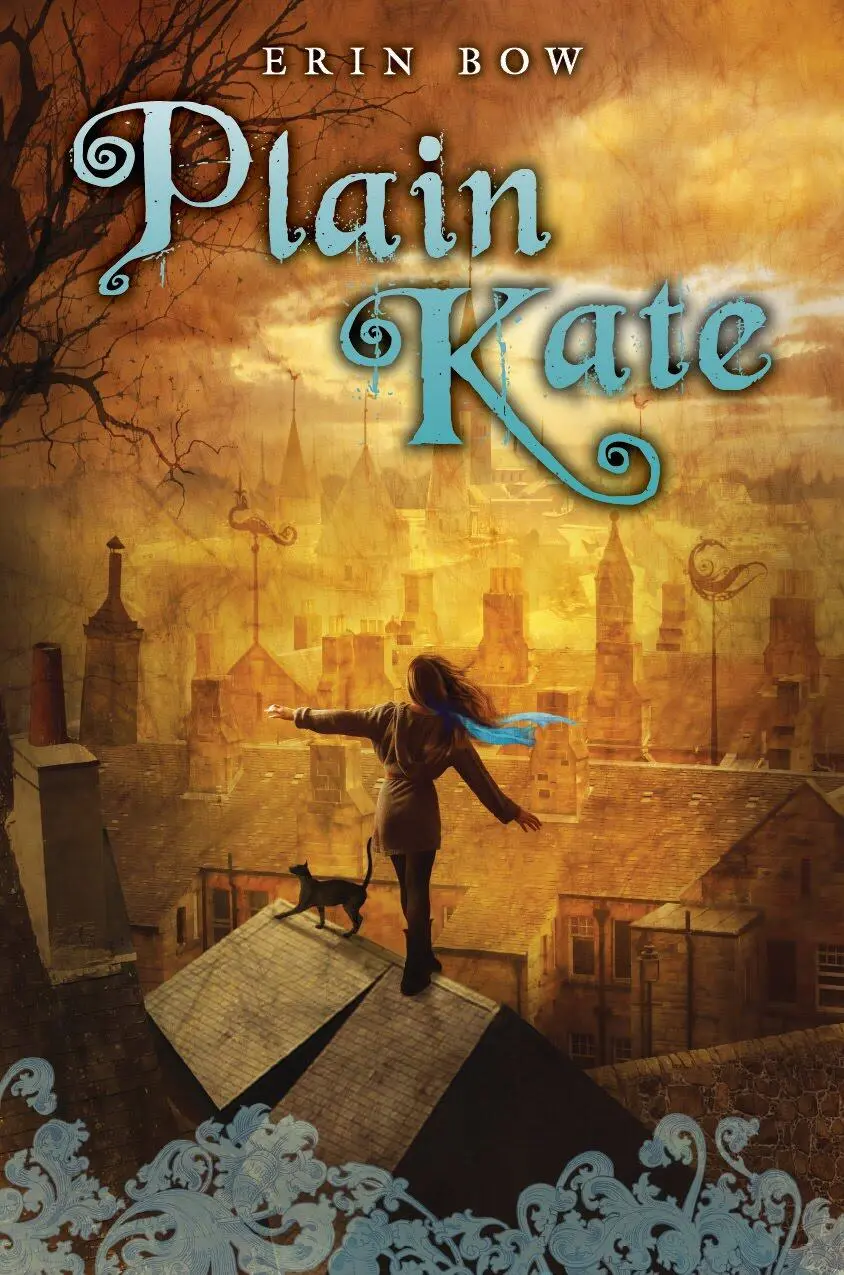
- Название:Plain Kate
- Автор:
- Издательство:Scholastic Inc.
- Жанр:
- Год:2010
- ISBN:9780545166645
- Рейтинг книги:3 / 5. Голосов: 1
-
Избранное:Добавить в избранное
- Отзывы:
-
Ваша оценка:
Plain Kate: краткое содержание, описание и аннотация
Предлагаем к чтению аннотацию, описание, краткое содержание или предисловие (зависит от того, что написал сам автор книги «Plain Kate»). Если вы не нашли необходимую информацию о книге — напишите в комментариях, мы постараемся отыскать её.
Plain Kate — читать онлайн бесплатно полную книгу (весь текст) целиком
Ниже представлен текст книги, разбитый по страницам. Система сохранения места последней прочитанной страницы, позволяет с удобством читать онлайн бесплатно книгу «Plain Kate», без необходимости каждый раз заново искать на чём Вы остановились. Поставьте закладку, и сможете в любой момент перейти на страницу, на которой закончили чтение.
Интервал:
Закладка:
“Lenore,” Linay breathed, “I love…” But his breath quavered and he could only blink at her. Lenore smoothed what had been his hair back from his forehead, singing. The life-tension was going out of him, like a frozen rope thawing in a puddle of water. Kate watched, with Taggle’s body stiffening against hers. “He’s dead,” said Lenore, holding the limp body in her arms. “My brother is dead! What is happening?”
“The guard will be coming,” Kate said. “Listen.” It seemed to her she could hear the whole city, thousands of sounds jumbled into the pounding in her ears.
“Who are you?” Lenore stood and seized Kate’s arm. Kate jerked away, twisting to keep her body around Taggle—but Lenore didn’t let go, and Kate’s arm was pulled straight and her sleeve fell back, baring the cuts of the bloodletting. The woman who had been the rusalka shivered. “I know you.”
“Dajena…” Drina tugged at her hand. “She’s my friend. Let her go.”
But Lenore ignored her daughter, looking around. “I remember this. I was dead. They tried to burn me.” She looked into the pyre, and down at the charred fragments of her own face. “Look.” She stooped, scooping up a black-edged piece: an eye and a twist of hair, a glimpse of wing.
Drina eased the charred thing out of her hand. “Dajena.”
Lenore let the carving go and sleepwalked to the edge of the platform, where she stood looking down at the dark surface of the canal. “I died here. I remember it.” Her face went strange. “And,” she said in a voice that could have withered grass, “I remember after.”
“You don’t have to think about that,” said Drina. “You’re saved. We saved you.”
Lenore shook herself and turned. “My daughter. Oh, Drina.” She fingered Drina’s chopped black hair. The sun was just coming out, long fingers of light piercing them, making the woman shine like a wax-cloth window. “You’ve grown.” She took Drina by both shoulders, her eyes huge. “You are marvelous,” she said. “You are brave as the sun.”
And Kate held Taggle’s body tighter. Star of My Heart. Her father had died saying that and for years she had thought he was seeing her mother, standing at the door of death. But he had looked at her, just as Lenore was looking now. He had seen her. Her father had seen her.
“Let us go,” said Lenore, and swept down the stairs like a beam of light. Kate and Drina followed.
nineteen
the names of the dead
Kate walked through the streets of Lov with Taggle’s body in her arms. A thin shadow was growing at her heels. The light was murky, but Lenore shone like the moon, with Drina like a shy star at her side.
The streets were still empty, though here and there they found a window being opened, or a huddle of refugees looking about, like survivors of a storm. Voices began again, slowly filling the town like birdsong in the morning. And Kate hated them all—all the thousands and thousands. They were not worth it: They were nothing beside the little weight in her arms.
Lenore paused in the open space of the gate square, where the cobbles were still stained with blood. “It cannot be so easy,” she said. But the gate was open, and no one tried to stop them. They just went through.
The mud in front of the city was churned and hummocked with the half-abandoned camp. It looked as if there had been a battle. Lenore looked around. “I should not be alive,” she said. But no one came to kill them. They just walked on.
In the birch grove, the red vardo sat where they had left it, neat as a kettle in the afternoon sun. Kate was only half aware of Drina’s exclaiming and dismay: Cream was nowhere in sight. But the horse had not gone far. As they came around the vardo , they saw Cream’s backside and swishing tail. They went farther and saw Behjet sitting on the steps.
The Roamer man was trying to shave, pulling his skin taut over his jawbone and scraping at it with the edge of a knife. The blade trembled in his hand and cast little ripples of light toward them. Cream was nuzzling at him as if he were a foal.
If the rusalka is saved, Linay had said, then the sleepers might wake too. But he didn’t care about them, and Kate could not rouse herself to care either. Drina, though, shouted with a joy so hoarse there were no words in it. Lenore stopped. “Husband,” she breathed, and paled from linen to snow.
Drina took her mother’s elbow as if to guide her through blindness. “It’s not—” she whispered. But before she could explain to Lenore that this was not her husband but his twin, Behjet tottered to his feet. The knife fell and sank its point in the wet earth with a sound that made Kate wince. “Am I dead? Are you my burned ones, come to take me off to hell?”
“No one is dead,” said Drina, but Lenore said “I do not know if I am dead,” and Kate said, “Why did it have to be you?”
“What?” Behjet was bewildered and shivering inside a skin that hung from him as if he were indeed a walking corpse.
“Linay is dead,” Kate said. “And those people in front of the gate, and the ones in the square. And Stivo and Ciri, and my father, and—” She could not speak Taggle’s name. “My—my heart is dead.” She picked up his knife and stood looking at it, the darkness of the mud on the blade. “Of everyone who could have lived, why did it have to be you?”
And she pushed past him, up into the golden quiet of the vardo .

Outside, Drina, Behjet, and Lenore murmured together like mourners standing about at a wake. Kate thought that they were telling one another pieces of their long, strange story. Then she thought of how the story ended, and she stopped caring.
She sat down on the bunk. It still smelled of Behjet’s long sickness. The blanket folds were stiff with sweat-grime. Taggle was dead. It should have wiped clean the world, yet here was washing to be done. Kate took a big breath, and put his body down.
His beautiful fur was matted with blood. He would hate that. She got out one of the horse brushes. She brushed until the bristles were thick as if with rust, and his fur was perfect. She liked the grain of it, how it followed the lines of his bones and muscles. It swirled in knots over his joints, and stood in a soft ridge along his breastbone, just beside the wound that had killed him. It was strange that his fur was still so soft, while his body was stiffening.
She sat beside him, numb, forever.
She had never been the sort for ghosts, though she had seen too much of them. But she would have cut off her carving hand to glimpse one now. It wasn’t fair. There should at least be a ghost.
But there was no ghost. Only Behjet, and Drina behind him, hovering at the curtain. She hadn’t seen them come in.
“Plain Kate,” the Roamer man said. His voice was soft as if he were gentling a horse. “I have prayed—Plain Kate—”
“Just Kate.”
“What?”
“Kate.” She was as plain as she had ever been. And over that she was burn scarred and half bald. But Taggle had thought she was beautiful. “My name is Katerina Svetlana. Kate.”
“I’m sorry,” he said.
And no one said anything for a while. The canvas arch around them glowed with sun.
Then Behjet said, “Your cat. Drina has told me—”
“He was more than a cat,” she said.
Another silence. “What should we do with…” said Drina.
Taggle’s body was what she didn’t say. Kate had been thinking about that. She had been thinking about nothing else. “That place where we met: the meadow by the river. He was happy there. We had sausages.” She looked up. “We can bury—”
But she couldn’t finish.
Читать дальшеИнтервал:
Закладка:
Похожие книги на «Plain Kate»
Представляем Вашему вниманию похожие книги на «Plain Kate» списком для выбора. Мы отобрали схожую по названию и смыслу литературу в надежде предоставить читателям больше вариантов отыскать новые, интересные, ещё непрочитанные произведения.



Обсуждение, отзывы о книге «Plain Kate» и просто собственные мнения читателей. Оставьте ваши комментарии, напишите, что Вы думаете о произведении, его смысле или главных героях. Укажите что конкретно понравилось, а что нет, и почему Вы так считаете.