Erin Bow - Plain Kate
Здесь есть возможность читать онлайн «Erin Bow - Plain Kate» весь текст электронной книги совершенно бесплатно (целиком полную версию без сокращений). В некоторых случаях можно слушать аудио, скачать через торрент в формате fb2 и присутствует краткое содержание. Год выпуска: 2010, ISBN: 2010, Издательство: Scholastic Inc., Жанр: Старинная литература, на английском языке. Описание произведения, (предисловие) а так же отзывы посетителей доступны на портале библиотеки ЛибКат.
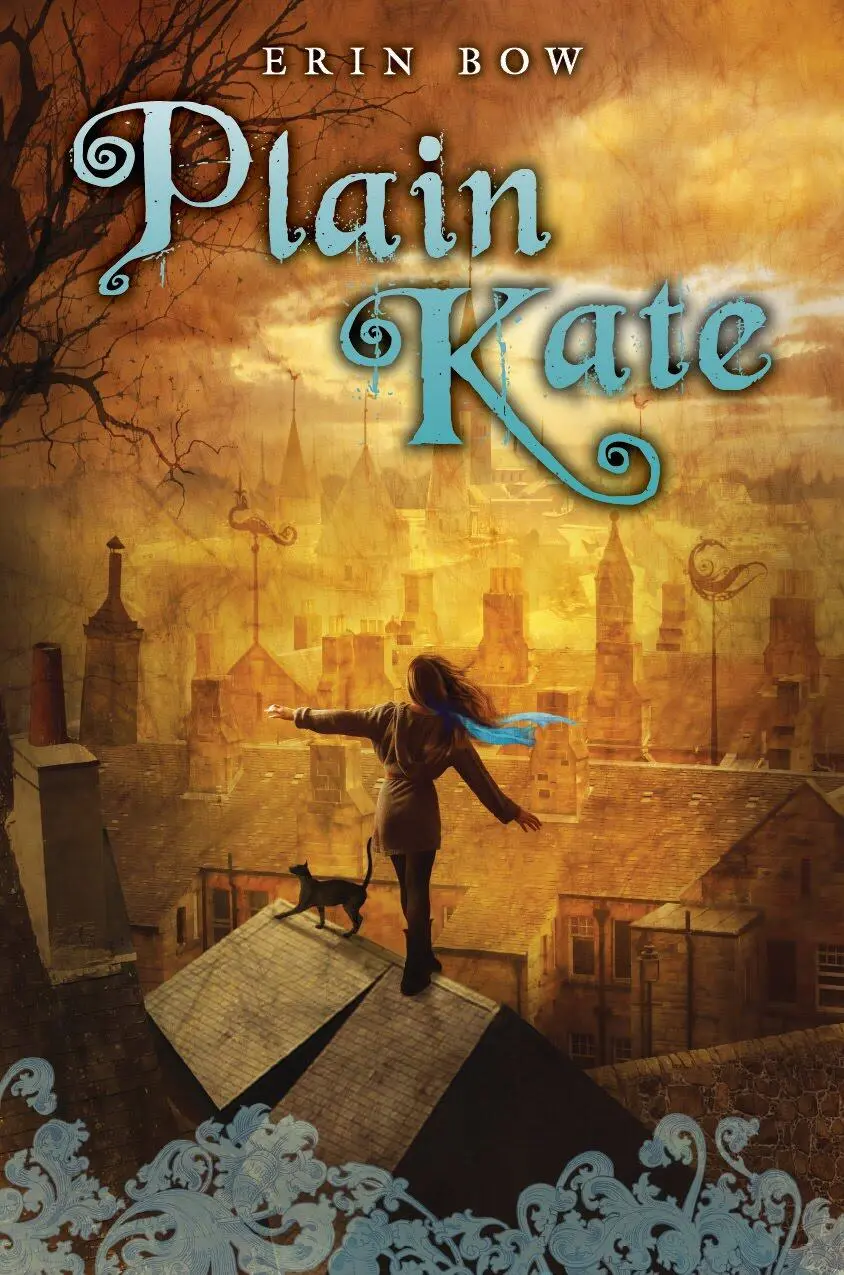
- Название:Plain Kate
- Автор:
- Издательство:Scholastic Inc.
- Жанр:
- Год:2010
- ISBN:9780545166645
- Рейтинг книги:3 / 5. Голосов: 1
-
Избранное:Добавить в избранное
- Отзывы:
-
Ваша оценка:
Plain Kate: краткое содержание, описание и аннотация
Предлагаем к чтению аннотацию, описание, краткое содержание или предисловие (зависит от того, что написал сам автор книги «Plain Kate»). Если вы не нашли необходимую информацию о книге — напишите в комментариях, мы постараемся отыскать её.
Plain Kate — читать онлайн бесплатно полную книгу (весь текст) целиком
Ниже представлен текст книги, разбитый по страницам. Система сохранения места последней прочитанной страницы, позволяет с удобством читать онлайн бесплатно книгу «Plain Kate», без необходимости каждый раз заново искать на чём Вы остановились. Поставьте закладку, и сможете в любой момент перейти на страницу, на которой закончили чтение.
Интервал:
Закладка:
“I’ll show you,” offered Taggle, who was still drowsing on her coat.
“Tomorrow,” she whispered, and hoped she could keep him quiet that long.
The Roamers hoisted the iron cage onto the top of one of the wagons with a block and tackle. Kate didn’t know how to use a block and tackle. She didn’t know why the one wagon was like a little house on wheels, built of solid wood, while the others were like tents. She couldn’t even keep the three women straight: one was Daj’s daughter, and the other two some sort of complicated cousins. She wasn’t sure where the men were or whether she was allowed to talk to them, since the other women did not.
But she did know how to scrub a pot. It was not too different from smoothing a finished carving, and was done with a folded square of leather, dipped wet into sand. Plain Kate scoured pots until they gleamed black as the night reflected in the river, and by the time that was done, the Roamers were ready to go.
And when they went, Plain Kate went with them.
five
the road and the rain
Despite what Drina had said, it turned out you could go the Roamer way without riding. Mostly, you walked.
The caravan bunched and inched down the road. People on foot went first, where the road was merely sticky and rutted with water. Then came the loose horses, with the horsemen among them. And finally, churning up the mud and the new horse dung, came the wagons. And last of all came Plain Kate.
Walking at the back was Daj’s idea, to keep Plain Kate out of sight until they were far from town. “Harder for some fool to turn you loose, then,” she’d said. Plain Kate had been taken aback; she’d thought her place among the Roamers was Daj’s to give. But, no, explained Drina. Big decisions like that were a matter for the men. “Never fear, kit,” said Daj. “Trust Mother Daj. I know how to lead from the last wagon.”
So Kate walked in the back. It was hard going. She’d lived her life on cobbles, and the mud of the road was new to her. It clutched at her heels like a dying thing. Her boots grew dark with water. Her tall socks got wet and her feet squelched and soon blistered. But she said nothing, and kept walking.
Her little town sank behind her. Samilae. She had never left it before, and had never had to think of its name. Her father when he was alive had been only Father. Dead he was Piotr Carver, and she had to say his name sometimes. And now her home was Samilae. She looked back and saw it become a huddle of roofs, with the tall spire of the weizi above them—her father’s handiwork, casting its finger of shadow after her. She did not cry, and kept walking.
Drina spent the day walking beside Plain Kate and then dashing forward to be among the horses, then dashing back again. She turned cartwheels for no reason, and sang like a lark tossing up ribbons of tune into the air. Once she made Plain Kate’s hair stand on end, singing the song Linay had been singing by the docks, long ago but only yesterday, a sad tune about ghosts in the river.
The rain drizzled down. Plain Kate got soaked and began to ache: She was strong, but walking was unfamiliar work. The straps of her pack basket rasped her thin shoulders. Taggle spent the day asleep inside the basket, just between her shoulder blades. His warmth made her hurt less.
Finally they stopped, deep in the summer evening.
Through the day the country had thinned into a strip of fields between the river and the heavy, wooded darkness of the hills. And now there was nothing but woods and water.
They stopped in a patch of meadow, sending deer leaping into the woods and rabbits scampering. There was a scrambling between Kate’s shoulder blades, and, a moment later, a cat on her shoulder. “Rra—” he started, and Kate was sure he was going to say “rabbits,” but he stopped, peered at Daj watching them, and said, “Meow.”
“Now that,” said the old woman, “is a soft way to travel. Hello, king of cats.”
Taggle preened and leapt down, heading over to twine around Daj’s ankles.
The Roamers set camp in two rings and built two big fires. Plain Kate and Drina were sent to fetch water, then again to find fallen branches for the fire. When they came back the horses were picketed and the chickens were loose, the rugs laid, the pots bubbling. Trestle benches had appeared. Plain Kate sank onto one of them and pulled off her damp socks. Her feet were wrinkled with wet and had a dozen dead white blisters big as thumbprints.
“Goose grease,” said Daj. She was squatting by the fire, stirring a sliced onion around in a pan. “Tomorrow I’ll get you some grease for your boots, to keep the water out. Silly not to think of it before.” She gave the pot of goulash a poke and stood up, creaking. “Tonight we will go to the men’s fire. Let me present you to Rye Baro.”
Plain Kate was startled by present . People got presented to the mayor or the guild masters or the lord executioner. “Who is Rye Baro?” she said.
“ Baro means big man, and Rye is our Baro : the leader of these vardo —wagons, that is. If you go our way, you’re his to judge, his to keep or turn loose.”
Kate stood up and squared her thin shoulders. “Will he turn me loose?”
“Oh, no,” laughed Daj. “He’ll not say no to me.”
Kate thought she didn’t sound entirely sure.
“Sit and let me see those feet, kit,” rumbled Daj. Kate sat. Daj lifted her feet in her hands. “You can’t go among the men bleeding,” she said, and Kate saw that, indeed, her heel was blistered deep and seeping blood. It didn’t hurt much more than any other part of her feet, and she hadn’t noticed. But Daj was wrapping it with a scrap of green scarf.
Kate was embarrassed. “It’s not bothering me.”
Daj shook her head. “Among the Roamers blood is powerful,” she said. “A woman’s blood specially. Some women can work great magics while in their blood—scares the menfolk down to their socks, knowing that. When we get our monthly blood, they make us sit where they can keep an eye on us.”
“I’m not, though,” said Kate. “I can’t do magic. I’m not a witch.”
“And I’m not a muskrat,” said Daj. “But neither one of us will walk about bleeding. I’ll explain our ways, town child, when I think of it, but whether you understand them or not, you must respect.”
“I—” Plain Kate began, but Daj silenced her with a finger on her cheek. Kate found herself fixed on the texture of Daj’s hands: so calloused and worn with work that they were glossy-smooth, like the inside of an ox yoke or the edge of an oarlock. Smooth as dry dust. Her father’s hands had been a little like that. Such hands had not touched her in a long time. Daj tucked Kate’s frizzing hair behind her ears. “Come with me now, mira . I’d say be brave, but that I can see you are.”

Daj led the way from one fire to another, and Kate followed her, feeling the soaked, loamy earth give like soft bread beneath her feet, feeling the bandage on her heel grow loose with wet. She was trying to take in the labyrinth of rules Daj was telling her: Don’t pass between a man and a fire. Don’t walk between two men who are facing each other. Ask permission to speak. If you walk near a man, gather up your skirt so that it does not brush him.
“I don’t have a skirt,” said Kate. She was wearing, as always, the striped smock that had been her father’s. It skimmed her knees, but it was no dress. Among the bright layered scarves of the Roamers, the russet and indigo stripes seemed drab.
“Ah, so you don’t,” said Daj. “Well, don’t mind it, child. For here we are.” And Kate followed Mother Daj into the circle of firelight as silently and solemnly as if into a church.
Читать дальшеИнтервал:
Закладка:
Похожие книги на «Plain Kate»
Представляем Вашему вниманию похожие книги на «Plain Kate» списком для выбора. Мы отобрали схожую по названию и смыслу литературу в надежде предоставить читателям больше вариантов отыскать новые, интересные, ещё непрочитанные произведения.









Обсуждение, отзывы о книге «Plain Kate» и просто собственные мнения читателей. Оставьте ваши комментарии, напишите, что Вы думаете о произведении, его смысле или главных героях. Укажите что конкретно понравилось, а что нет, и почему Вы так считаете.