Gary Rivlin - Broke, USA
Здесь есть возможность читать онлайн «Gary Rivlin - Broke, USA» весь текст электронной книги совершенно бесплатно (целиком полную версию без сокращений). В некоторых случаях можно слушать аудио, скачать через торрент в формате fb2 и присутствует краткое содержание. Город: New York, Год выпуска: 2010, ISBN: 2010, Издательство: HarperCollins Publishers Inc., Жанр: Старинная литература, на английском языке. Описание произведения, (предисловие) а так же отзывы посетителей доступны на портале библиотеки ЛибКат.
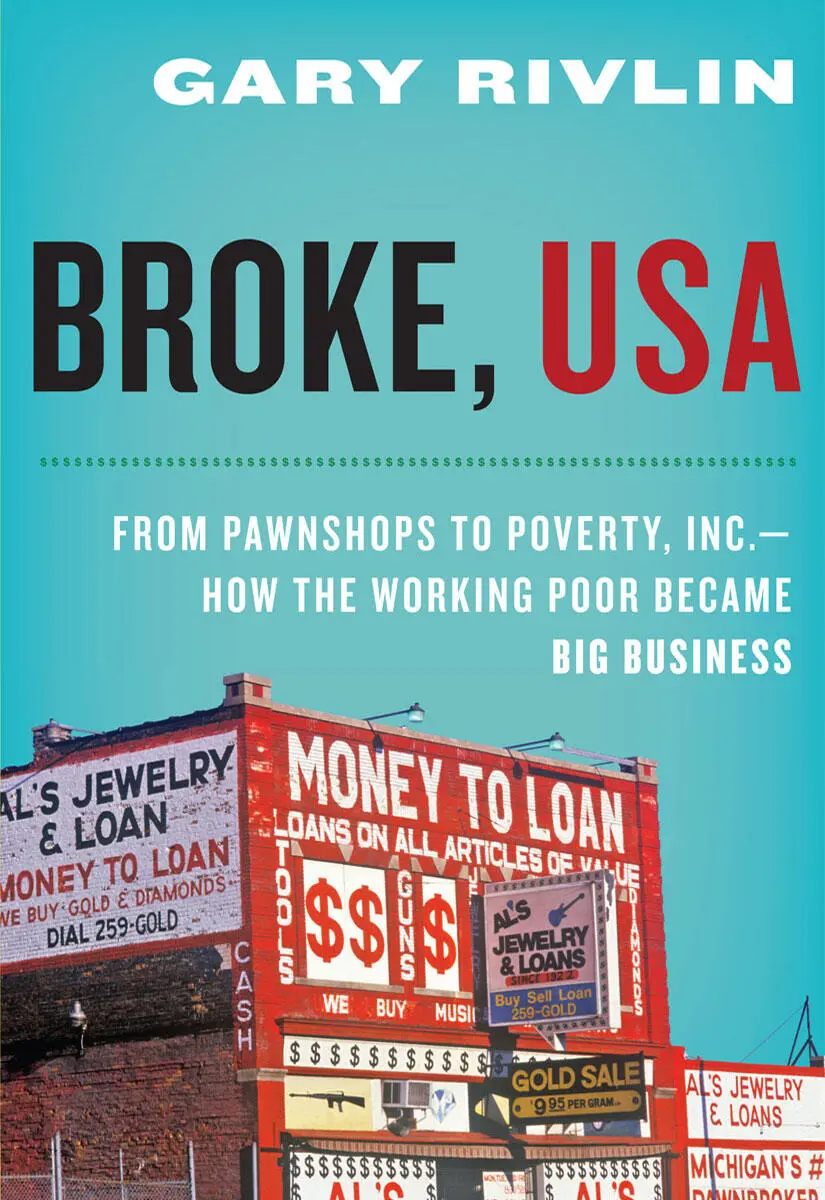
- Название:Broke, USA
- Автор:
- Издательство:HarperCollins Publishers Inc.
- Жанр:
- Год:2010
- Город:New York
- ISBN:978-0-06-199794-5
- Рейтинг книги:3 / 5. Голосов: 1
-
Избранное:Добавить в избранное
- Отзывы:
-
Ваша оценка:
Broke, USA: краткое содержание, описание и аннотация
Предлагаем к чтению аннотацию, описание, краткое содержание или предисловие (зависит от того, что написал сам автор книги «Broke, USA»). Если вы не нашли необходимую информацию о книге — напишите в комментариях, мы постараемся отыскать её.
Broke, USA — читать онлайн бесплатно полную книгу (весь текст) целиком
Ниже представлен текст книги, разбитый по страницам. Система сохранения места последней прочитанной страницы, позволяет с удобством читать онлайн бесплатно книгу «Broke, USA», без необходимости каждый раз заново искать на чём Вы остановились. Поставьте закладку, и сможете в любой момент перейти на страницу, на которой закончили чтение.
Интервал:
Закладка:
Payday lenders charged their customers a collective $7 billion in fees in 2008. The country’s rent-to-own shops collectively took in about $7 billion in revenues that year. By comparison, movie theaters in North America generated $11 billion in ticket sales in 2008.
The pawnbrokers booked roughly $4 billion in revenues that year and the check cashers $3 billion. Toss in businesses like the auto title lenders (short-term loans in which a car serves as collateral) and all those tax preparers offering instant tax refunds (one chain, Jackson Hewitt, with 6,500 offices scattered across the country, is more pervasive than KFC) and that adds up to $25 billion. By comparison, the nation’s funeral business is around a $15 billion a year industry and the country’s liquor stores and other retailers sell around $30 billion in beer, wine, and spirits each year. Include the revenues generated by the money-wiring business (Western Union alone did $5 billion in revenues in 2008 and MoneyGram $1.3 billion) plus all those billions the banks and other companies selling debit cards charge in activation fees, withdrawal fees, monthly maintenance fees, and the dollar some charge for every customer service inquiry, and revenues in the poverty industry easily exceed those of the booze business.
There are any number of ways of describing this relatively new financial subculture that has exploded in popularity over the past two decades. I typically used “fringe financing” or the “poverty business” when describing this project, but FiSCA chairman Joe Coleman absolutely beamed when I used the term “alternative financing” to describe his world. Investment bankers tend to stick to even safer rhetorical shores and use the more genteel “specialty financing.”
But whatever descriptor one prefers, this sector of the economy encompasses a wider cast than was represented in Las Vegas in the fall of 2008. The Poverty, Inc. economy includes the subprime credit card business—the issuing of cards to those with tarnished credit who are so thankful to have plastic in their pocket that they’re willing to pay almost any interest rate (one lender, First Premier Bank, sent a mailer to prospective customers in the fall of 2009 offering an APR of 79.9 percent)—and the used auto financing business. Regulators don’t require banks to publicly disclose what portion of their revenues are derived from subprime borrowers versus those with higher credit scores, but the Wall Street financial analysts monitoring the publicly-traded companies issuing subprime credit cards (a list that includes Capital One, American Express, and JPMorgan Chase) estimate that the banks and others in the business are making at least $50 billion a year off subprime credit card borrowers. A sampling of Wall Street analysts estimate the size of the subprime auto financing world at somewhere between $25 billion and $30 billion a year in revenues. And there’s also all those subprime mortgage lenders that had peddled products at once so destructive and so popular that they triggered the worst economic downturn since the Great Depression.
In time subprime lenders would target a demographic much broader than those who could reasonably be called the working poor or the lower middle class. CNBC’s Rick Santelli would infamously rant on the floor of the Chicago Mercantile Exchange about being forced to bail out neighbors who borrowed to build new bathrooms they could not afford. Even Edmund Andrews, a New York Times economics reporter who earned a six-figure salary—he was responsible for covering the Federal Reserve Bank, no less—would write a book about getting caught up in the subprime madness. Rather than rent or find a suitable place in a less expensive neighborhood, Andrews was able to buy a handsome brick home in Silver Spring, Maryland, using what people in the industry called a “liar’s loan” because they required so little in documentation that they practically begged an applicant to fib.
Yet long before the subprime loan became an easy way for all those people desiring a $500,000 or $600,000 house on a salary good enough to buy a home for half that price, they targeted people who owned properties worth $100,000 or less. In that regard, the subprime industry serves as more than a unique lens for examining America’s prolonged and unhealthy love affair with debt; it also offers a street-level narrative exposing the very roots of the subprime crisis. The poverty industry pioneered the noxious subprime mortgage loan during the 1980s and it was the huge profits generated by companies like Household Finance that inspired the likes of Countrywide Financial and Ameriquest to get into the business and eventually expand their market to include the middle class. In the early days there would be no debate about whether homeowners relying on a subprime loan were greedy or foolish or somehow had themselves to blame. There was something unmistakably predatory about this earliest iteration of the subprime story. Solicitations for easy money came in the mail and over the phone and sometimes with a knock on the door by a home repair huckster working in tandem with a mortgage broker. As it played out in working-class enclaves through the 1990s and into the early 2000s, the subprime mortgage was often a scam, an easy way for many big banks to goose their profits. However, it was nearly always as toxic for a borrower as eventually it would be for the world economy.
There were plenty of would-be heroes offering urgent warnings about the destructiveness of these loans, but they might as well have been wearing tinfoil hats and grousing about radio devices implanted in their teeth; those in power failed to heed their cries. The contagion needed to enter the general population—or at least spread to neighborhoods where editors and reporters and the politicians and their friends live—before the rest of the populace could be warned of its dangers. And then of course it wasn’t people’s individual tales of woe but the stock market’s great fall and the failure of a few investment banks that functioned as a collective smack to the head.
“This whole crisis we’re in has been an emergency situation for a long time,” said Howard Rothbloom, an Atlanta lawyer who is among those who have been complaining the longest about the perils of the subprime loan. “But it only became a crisis once it was investors who lost all that money.”
The country’s subprime mortgage lenders and their confederates were generating an estimated $100 billion in annual revenues at the peak of the subprime bubble in the mid-2000s. And no doubt a large portion of that $100 billion a year was still being sold to the working poor. There’s a race element to the story as well. How else does one explain all those studies that repeatedly show that a black applicant was several times more likely to be put into a subprime loan than someone white at the same income level and with the same general credit rating? But even if the lower classes account for just half of the subprime mortgage industry’s revenues, that would mean the Poverty, Inc. economy was around a $150 billion a year industry at its peak. By comparison, the country’s casinos, Indian casinos included, collectively rake in around $60 billion in gambling revenues each year, and U.S. cigarette makers book $40 billion in annual revenues.
“The thing about dealing with the subprime consumer is that it’s just a nickel-and-dime business.” That’s what Jerry Robinson, a former investment banker who had logged nearly twenty years in the subprime business, told me. Robinson’s résumé includes stints in rent-to-own, payday, used car finance, and four years with a subprime credit card company. “But the good news,” Robinson continued, “is there’s a whole lot of nickels and dimes” to be had. All those waitresses and store clerks and home health-care workers might not make much, but in the aggregate they can mean big bucks. Whereas the banker seeks 100 customers with $1 million, people inside the payday industry like to say they covet a million people who only have $100 to their name. Bad credit. No credit. No problem.
Читать дальшеИнтервал:
Закладка:
Похожие книги на «Broke, USA»
Представляем Вашему вниманию похожие книги на «Broke, USA» списком для выбора. Мы отобрали схожую по названию и смыслу литературу в надежде предоставить читателям больше вариантов отыскать новые, интересные, ещё непрочитанные произведения.







Обсуждение, отзывы о книге «Broke, USA» и просто собственные мнения читателей. Оставьте ваши комментарии, напишите, что Вы думаете о произведении, его смысле или главных героях. Укажите что конкретно понравилось, а что нет, и почему Вы так считаете.