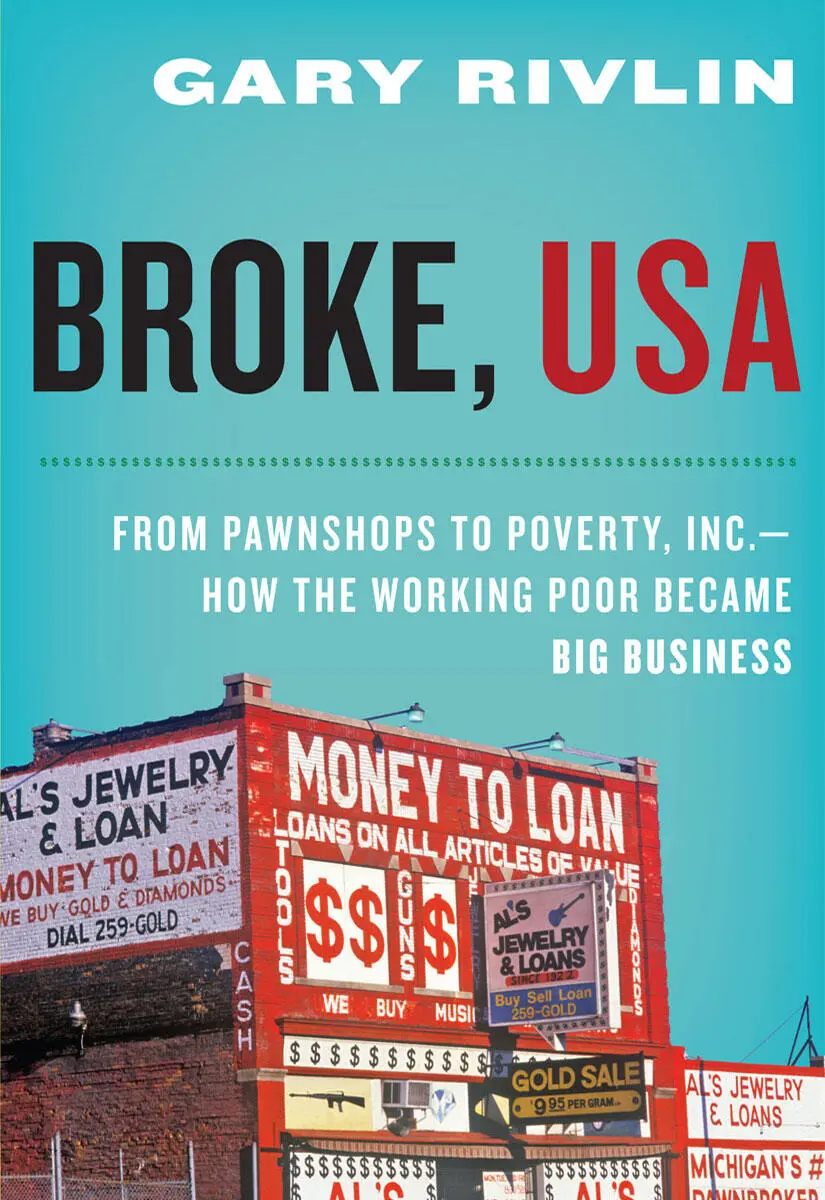
Gary Rivlin - Broke, USA
Здесь есть возможность читать онлайн «Gary Rivlin - Broke, USA» весь текст электронной книги совершенно бесплатно (целиком полную версию без сокращений). В некоторых случаях можно слушать аудио, скачать через торрент в формате fb2 и присутствует краткое содержание. Город: New York, Год выпуска: 2010, ISBN: 2010, Издательство: HarperCollins Publishers Inc., Жанр: Старинная литература, на английском языке. Описание произведения, (предисловие) а так же отзывы посетителей доступны на портале библиотеки ЛибКат.
- Название:Broke, USA
- Автор:
- Издательство:HarperCollins Publishers Inc.
- Жанр:
- Год:2010
- Город:New York
- ISBN:978-0-06-199794-5
- Рейтинг книги:3 / 5. Голосов: 1
-
Избранное:Добавить в избранное
- Отзывы:
-
Ваша оценка:
Broke, USA: краткое содержание, описание и аннотация
Предлагаем к чтению аннотацию, описание, краткое содержание или предисловие (зависит от того, что написал сам автор книги «Broke, USA»). Если вы не нашли необходимую информацию о книге — напишите в комментариях, мы постараемся отыскать её.
Broke, USA — читать онлайн бесплатно полную книгу (весь текст) целиком
Ниже представлен текст книги, разбитый по страницам. Система сохранения места последней прочитанной страницы, позволяет с удобством читать онлайн бесплатно книгу «Broke, USA», без необходимости каждый раз заново искать на чём Вы остановились. Поставьте закладку, и сможете в любой момент перейти на страницу, на которой закончили чтение.
Интервал:
Закладка:
McCarthy could sympathize. Since the late 1990s, he and his allies had been trying to alert people in the state capital, Columbus, about the destructive practices of seemingly legitimate subprime lenders like Household Finance. “We were met by this very arrogant ‘Who are you, you’re just a bunch of community organizers, we know and you don’t’ attitude,” McCarthy said. For the time being at least, there would be no help from the state or, for that matter, the federal government.
In the meantime, Fair Housing beat the hustings in search of local lawyers willing to take on the cases of those believing themselves to be victims of predatory loans. Among the few who answered the call was Matthew Brownfield, an attorney who lived in Cincinnati, one hour to the south. Brownfield filed a class-action suit against Household in November 2001, listing the Myerses among a small group of named plaintiffs. The basis of the lawsuit was the charge that the company had violated federal mortgage disclosure laws and therefore the loans should be rescinded. The suit claimed more than one thousand potential plaintiffs. Gary Klein, who as a staffer for the National Consumer Law Center in Boston had helped write the materials that lawyers across the country use when litigating these types of cases, helped Brownfield. That gave Myers a tickle: A big-time lawyer from Boston was helping him go after Household.
Brownfield encouraged the Myerses to remain in the house. Household—perhaps because the Myerses had sought legal protection—had yet to take action against them over their failure to pay on the home equity loan. Don’t worry about the main loan, either, he advised the couple. Pay a set amount each month into an escrow account I’ll help you set up. That way you can demonstrate good faith to a judge.
Myers, however, was thinking about the aggravation this whole mess was causing Marcia, who was still recovering from open-heart surgery. So at the end of 2001, six years after they had bought their first home but not five months after they walked into that Household Finance office in Huber Heights, the Myerses walked away from their house and mortgage and moved into a trailer park in a suburb south of Dayton. The place wasn’t too bad, they said. Space was tight but they had access to a community swimming pool. There were trees, the grounds were well maintained, the neighbors were nice. All in all, it didn’t seem too terrible a place to recover while waiting for the courts to rule on their claim.
The Myerses wouldn’t need to wait terribly long; the company’s aggressive new lending policies were sparking lawsuits all across the country. Household Finance was facing legal action for its alleged deceptive practices in Illinois, California, Oregon, New York, and Minnesota. The community organization ACORN had filed a national class-action suit against the company, charging it with widespread consumer fraud, and AARP joined a similar class-action suit filed against the company in New York.
The company was also attracting the attention of regulators around the United States, starting with Christine Gregoire, then the attorney general of Washington state. One case that spurred Gregoire into action was that of a seventy-year-old Bellingham man who had been talked into buying a credit insurance policy limited to those sixty-five or younger. There was also the family of five in Auburn, paying $900 more a month than they had been paying before they turned to a Household salesman for a refinance. A group of attorneys general began meeting with company officials in the summer of 2002 and a joint settlement was announced that fall. Household agreed to $484 million in fines—the largest consumer fraud settlement in U.S. history—and assented to a series of reforms, including a 5 percent cap on up-front fees and utilizing “secret shoppers” whom the company would hire to police its own sales people. William Aldinger even claimed he was sorry after a fashion. In a written statement, he apologized to the company’s customers for “not always living up to their expectations” but did not admit to any specific wrongdoing.
The $484 million settlement sounded enormous—until one did the arithmetic. The money was to be divided among the roughly 300,000 people in forty-four states who had refinanced with Household between 1999 and the fall of 2002. Even forgetting about legal fees and the money set aside for compliance, that worked out to an average of $1,600 per person. Household, by contrast, had logged sixteen straight record quarters in a row. In 2001 alone, the year the Myerses signed their deal, Household reported $1.8 billion in profits. The company had made big promises but its executives told analysts that they didn’t expect its consent agreement to cost them more than ten cents a share over the coming year. Household’s share price spiked by one-third in the forty-eight hours after news of the settlement spread. Investors seemed relieved that the penalty hadn’t been larger or the reforms more sweeping.
The national settlement presented the Myerses with a difficult decision. The state attorney general had announced that Ohio residents who did business with Household could receive up to $5,200 per family. But agreeing to a settlement meant the Myerses would have to drop out of their lawsuit. They opted out of the negotiated deal so they could continue to press their specific case in court.
In the end, it hardly made a difference what they chose. The confidentiality agreement Myers and Marcia signed with Household means they can’t reveal the size of their cash settlement, but suffice it to say that in retrospect the monetary difference between the two deals was minimal. They received a better payout than the state would have given them but not so much more that it had been worth all their anguish. The bottom line is that it was a mere pittance compared to what Household had cost them. “It wasn’t worth all the fuss, I’ll tell you that much,” Myers said. “I told my lawyers, ‘The only ones making any money on this are you people.’”
One month after settling with the attorneys general, William Aldinger stood before the cameras for one more blockbuster announcement: Household was being acquired by HSBC, the London-based financial giant, for $16.4 billion. Later, long after the financial crisis of 2008 had done so much damage, Floyd Norris, the New York Times columnist, would dub this acquisition, consummated in 2003, “the deal that fueled subprime.” This sector, the CEO of New Century Financial, a large subprime lender, said at the time of the acquisition, gets “beat up on a regular basis. So it’s refreshing when a highly-qualified suitor sees value.” Under the deal, Aldinger was paid an immediate bonus of $20.3 million and given a new contract that guaranteed him at least $5.5 million a year over the next three years.
Myers was not nearly so fortunate. Even factoring in his wife’s medical costs and the loss of her income for almost a year, Myers figures that he would have saved enough to retire in 2002 or 2003 at the latest if he had not been lured into a deal with Household. Instead, shortly before resolving their legal case, the Myerses filed for bankruptcy. “You know, you hear all these people saying they’re ashamed to have filed bankruptcy,” Myers said. “That’s not me. They screwed me, and the way I figure it, one screw job is good for another screw job.”
Myers was still working when I visited him at the end of 2008, a week shy of his seventy-fourth birthday. He was too old to be delivering boxes to restaurants so his boss put him to work in the warehouse, packing boxes of tomatoes and the like. His workweek starts on Saturday night at midnight. He works until 8 or 9 A.M. on Sunday morning and then returns to the plant Sunday night to work the same hours. He picks up a third shift during the week. “Ain’t too bad,” he said with an amiable smile.
Читать дальшеИнтервал:
Закладка:
Похожие книги на «Broke, USA»
Представляем Вашему вниманию похожие книги на «Broke, USA» списком для выбора. Мы отобрали схожую по названию и смыслу литературу в надежде предоставить читателям больше вариантов отыскать новые, интересные, ещё непрочитанные произведения.










Обсуждение, отзывы о книге «Broke, USA» и просто собственные мнения читателей. Оставьте ваши комментарии, напишите, что Вы думаете о произведении, его смысле или главных героях. Укажите что конкретно понравилось, а что нет, и почему Вы так считаете.