Gary Rivlin - Broke, USA
Здесь есть возможность читать онлайн «Gary Rivlin - Broke, USA» весь текст электронной книги совершенно бесплатно (целиком полную версию без сокращений). В некоторых случаях можно слушать аудио, скачать через торрент в формате fb2 и присутствует краткое содержание. Город: New York, Год выпуска: 2010, ISBN: 2010, Издательство: HarperCollins Publishers Inc., Жанр: Старинная литература, на английском языке. Описание произведения, (предисловие) а так же отзывы посетителей доступны на портале библиотеки ЛибКат.
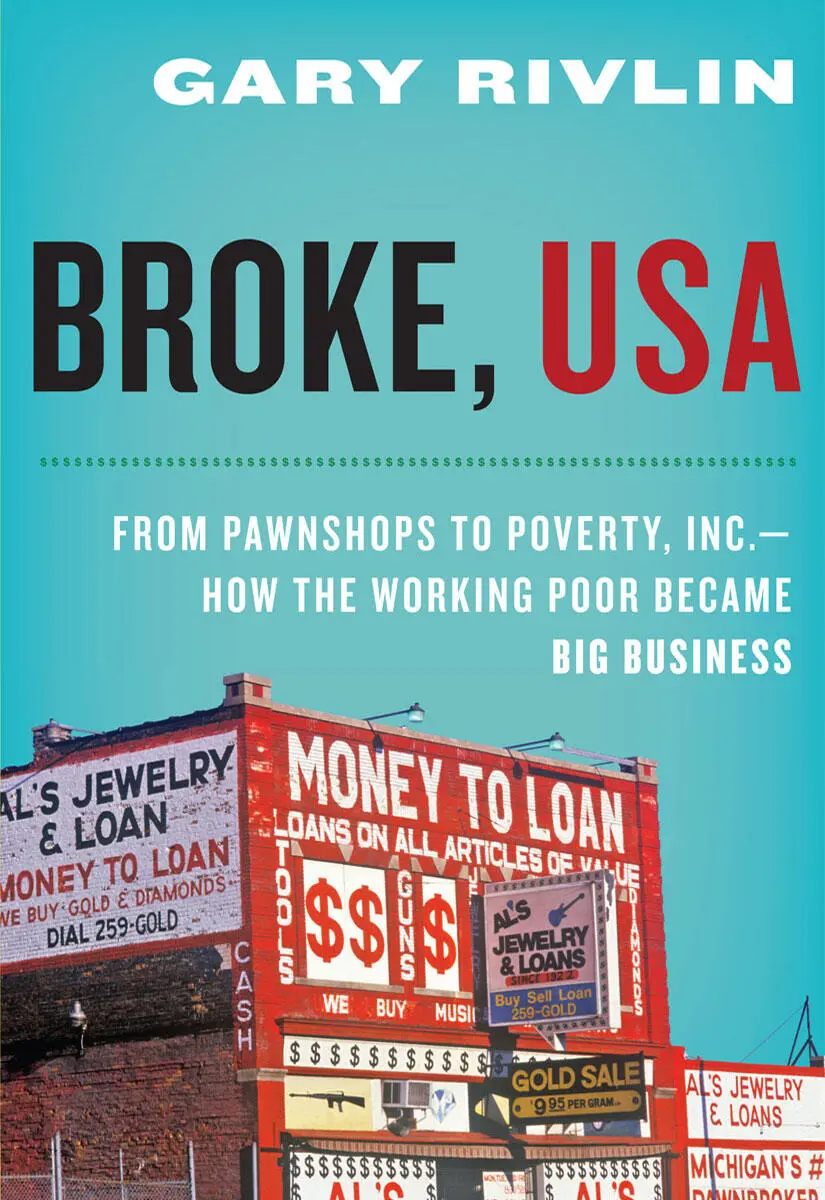
- Название:Broke, USA
- Автор:
- Издательство:HarperCollins Publishers Inc.
- Жанр:
- Год:2010
- Город:New York
- ISBN:978-0-06-199794-5
- Рейтинг книги:3 / 5. Голосов: 1
-
Избранное:Добавить в избранное
- Отзывы:
-
Ваша оценка:
Broke, USA: краткое содержание, описание и аннотация
Предлагаем к чтению аннотацию, описание, краткое содержание или предисловие (зависит от того, что написал сам автор книги «Broke, USA»). Если вы не нашли необходимую информацию о книге — напишите в комментариях, мы постараемся отыскать её.
Broke, USA — читать онлайн бесплатно полную книгу (весь текст) целиком
Ниже представлен текст книги, разбитый по страницам. Система сохранения места последней прочитанной страницы, позволяет с удобством читать онлайн бесплатно книгу «Broke, USA», без необходимости каждый раз заново искать на чём Вы остановились. Поставьте закладку, и сможете в любой момент перейти на страницу, на которой закончили чтение.
Интервал:
Закладка:
It turns out that the salesman who had been calling was also a Household broker who could write loans. “He tells me, ‘How about me taking your house, your credit card bills, everything, and we’ll combine it into a single loan at 7.2 percent?’” He would end up owing more in principal and pay a slightly higher interest rate than they were paying on the mortgage but one that was significantly less than the interest on their credit card debt. That sounded great to Myers, who told the man to draw up the papers. “We want to get this all taken care of and get you back on your feet,” Myers remembers him saying.
The nearest Household Finance office was just off the interstate in a first-ring Dayton suburb called Huber Heights. There on a Friday evening in the fall of 2001, out by the big air force base, in a shopping center populated by an Applebee’s and an Uno pizza parlor, they met with the salesman who had been calling them. He greeted the couple with a toothy Dentyne smile—and right away Marcia was mistrustful. “She flat tells him,” Myers said of his crocodile wife, “‘Anytime I talk to somebody and all I see is teeth and eyeballs, I don’t trust ’em.’”
“I can tell a phony grin from a mile away,” Marcia said. “And this man was too smiley for me.” The phone rang and things went from bad to worse. It was a friend of the broker calling, apparently to work out the details of a trip to a nearby amusement park the next day. “This is a big deal to us,” Myers said, “but we’re sitting there for like twenty minutes—”
Marcia: “ At least twenty minutes.”
“—at least twenty minutes while he’s talking about this trip and all the rides he’s looking forward to.”
The man was all business once he was off the phone. It was Myers’s impression that he was in a rush to get home. Myers would kick himself in the coming months for acting so accommodating despite the stakes, but Saturday was a workday and there was Marcia to worry about. She didn’t feel anything close to 100 percent. Marcia had spoken up one final time. “I don’t want to do this whole thing,” she said, but then she abdicated to her husband. You’re the one who understands this stuff, she said. You’re the one who handles the money. “I don’t understand interest and that whole mess,” she remembers saying. “So if you think this is the right idea, then go for it.” Myers felt confident he was making the right decision. He thought he knew the questions he needed to ask. This particular broker might feel wrong to him but the deal felt right.
Anyone who has been to a real estate closing knows that disorienting feeling that comes while staring at a thick stack of impenetrably complex documents, each reading as if written by the Committee for the Full Employment of Lawyers. Myers fixated on a single detail: the new interest rate. “I asked him point-blank, ‘So what I’m signing here, this means I’m paying 7.2 percent,’” he said. “And he looked me straight in the eye and said, ‘Just trust me. You make your payment every other week, that brings your interest rate down to 7.2.’ I didn’t think too much about it. I just thought, 7.2, good, that’s right.”
The rest of their meeting was a blur. They signed and initialed until their hands cramped up. The Myerses had thought it was just the three of them in Household’s offices that night when a man appeared out of the gloaming when the time came to have the papers notarized. They were there less than an hour, including the time the broker was on the phone with a friend.
“You make your payment every two weeks…” Those words gnawed at Myers’s subconscious all weekend but it wasn’t until Monday that he pulled out the papers and asked one of his daughters, who knew something about mortgages, to take a look. “She says to me, ‘Dad, you got took.’”
Under Ohio law a borrower has three days to change his or her mind about a home loan. Myers didn’t contact Household until the next morning, four days after they had signed the papers, and the man he met with on Friday night refused his request to rescind the deal. “Partially it’s my fault for not saying I want to come back when we’re not all in this big rush,” Myers said. It was when he received the bill for his first mortgage payment that he began to appreciate the magnitude of his mistake. He knew his monthly payment would be higher than the $526 he had been paying but he was figuring on a bump of maybe $50. Instead it had nearly tripled to $1,400 per month.
The main culprit was the interest rate. The annual percentage rate, or APR, on the loan Household sold the Myerses was 13.9 percent, not 7.2 percent. In time, it would be revealed that Household agents around the country were routinely claiming that customers would be paying lower interest rates than they were actually being charged. Each used the same sleight of hand: Because its customers were required to make biweekly payments, they were making the equivalent of thirteen monthly payments during the year rather than twelve. Financial planners recommend making thirteen payments each year because by doing so borrowers pay off a standard thirty-year fixed-rate mortgage in just over twenty-one years. The mortgage holder is paying the same interest rate on the money, of course, whether he or she is paying the standard twelve months a year or thirteen, but over the life of the loan they’ll pay significantly less interest because those extra payments are whittling away at the principal on the front end. Yet even this rhetorical trick practiced by Household agents doesn’t get a borrower from an interest rate of 13.9 percent to 7.2 percent.
People with tarnished credit, naturally, can expect to pay a higher interest rate than those with good credit. They present a greater risk of default and lenders need to charge a higher rate to cover any additional losses. But Tommy and Marcia Myers had excellent credit. The generally accepted definition of a “subprime” borrower is a person with a credit score of below 620 on a scale between 300 and 850, though some institutions use a cutoff of 640 or higher. But the Myerses weren’t even close to the margins. Myers contends that the couple had a FICO score (FICO is named for the Fair Isaac Corporation, which created the credit rating system) in the mid-700s. If so, that meant that had Myers gone to a traditional bank rather than Household, he would have secured the loan he had been seeking.
A credible lender might charge its subprime customer an interest rate one or two percentage points more than what its customers with good credit receive. But in his interview with the Journal ’s Jeff Bailey, Household’s William Aldinger dismissed this idea of competing on price. They would compete instead using aggressive marketing and sales techniques. The Myerses thought they were borrowing $80,000 at an interest rate of 7.2 percent. That would have meant a monthly house payment of $543. Instead they were charged an APR roughly seven percentage points higher than the rate a prime borrower could have secured in the fall of 2001. That translated to a monthly payment of $942.
But the interest rate proved only one factor in the near tripling of the monthly payment. The Myerses ended up borrowing $95,000, not $80,000, because of a pair of extra charges Tommy learned about only after the fact. Everyone carps about closing costs, the fees that lenders invariably tack onto a mortgage: escrow fees, loan origination fees, attorney’s charges, and the like. Commonly those add a percentage point or two to the cost of a loan. Fannie Mae, the quasi-government mortgage finance company that sets the standards for the industry, won’t approve a loan if the fees and points exceed 5 percent of the total cost of the loan. In the case of the Myerses, though, Household hit the couple with slightly over 8 percent in points and fees. That bumped the amount the couple needed to borrow by $7,700.
Читать дальшеИнтервал:
Закладка:
Похожие книги на «Broke, USA»
Представляем Вашему вниманию похожие книги на «Broke, USA» списком для выбора. Мы отобрали схожую по названию и смыслу литературу в надежде предоставить читателям больше вариантов отыскать новые, интересные, ещё непрочитанные произведения.









Обсуждение, отзывы о книге «Broke, USA» и просто собственные мнения читателей. Оставьте ваши комментарии, напишите, что Вы думаете о произведении, его смысле или главных героях. Укажите что конкретно понравилось, а что нет, и почему Вы так считаете.