Gary Rivlin - Broke, USA
Здесь есть возможность читать онлайн «Gary Rivlin - Broke, USA» весь текст электронной книги совершенно бесплатно (целиком полную версию без сокращений). В некоторых случаях можно слушать аудио, скачать через торрент в формате fb2 и присутствует краткое содержание. Город: New York, Год выпуска: 2010, ISBN: 2010, Издательство: HarperCollins Publishers Inc., Жанр: Старинная литература, на английском языке. Описание произведения, (предисловие) а так же отзывы посетителей доступны на портале библиотеки ЛибКат.
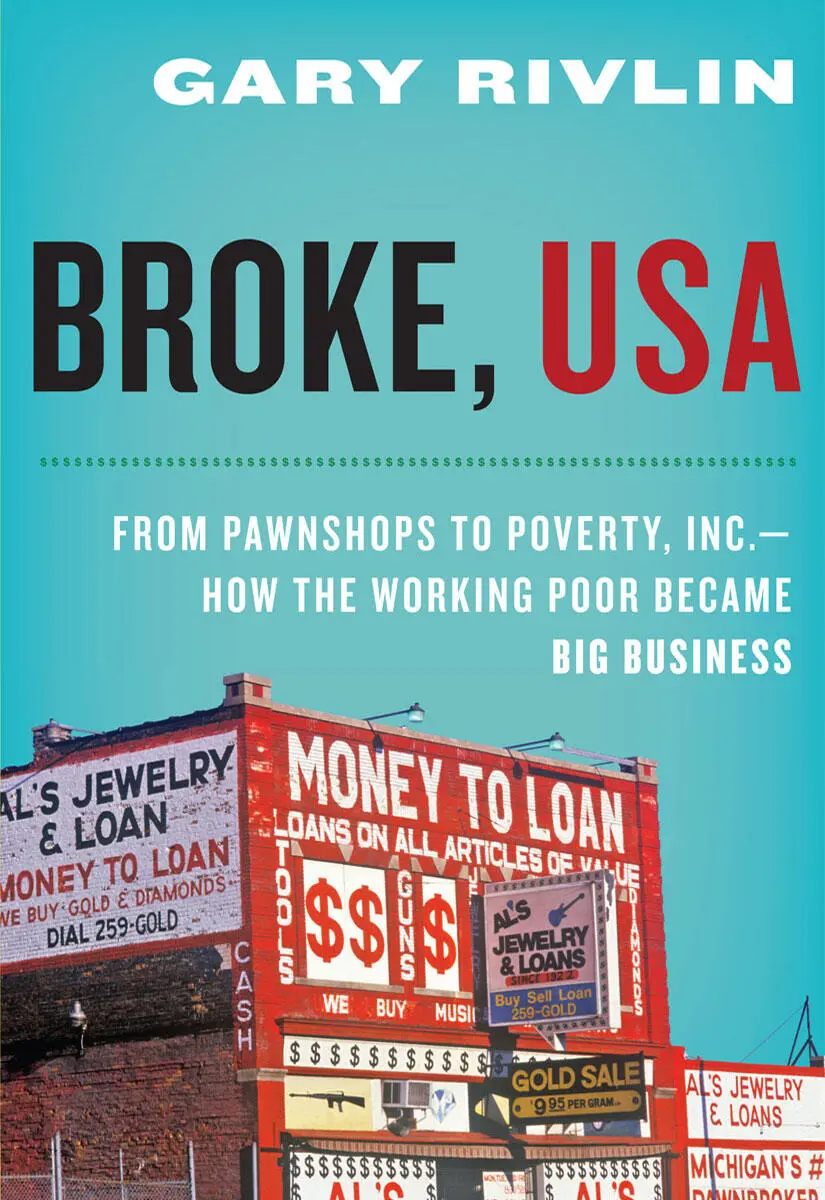
- Название:Broke, USA
- Автор:
- Издательство:HarperCollins Publishers Inc.
- Жанр:
- Год:2010
- Город:New York
- ISBN:978-0-06-199794-5
- Рейтинг книги:3 / 5. Голосов: 1
-
Избранное:Добавить в избранное
- Отзывы:
-
Ваша оценка:
Broke, USA: краткое содержание, описание и аннотация
Предлагаем к чтению аннотацию, описание, краткое содержание или предисловие (зависит от того, что написал сам автор книги «Broke, USA»). Если вы не нашли необходимую информацию о книге — напишите в комментариях, мы постараемся отыскать её.
Broke, USA — читать онлайн бесплатно полную книгу (весь текст) целиком
Ниже представлен текст книги, разбитый по страницам. Система сохранения места последней прочитанной страницы, позволяет с удобством читать онлайн бесплатно книгу «Broke, USA», без необходимости каждый раз заново искать на чём Вы остановились. Поставьте закладку, и сможете в любой момент перейти на страницу, на которой закончили чтение.
Интервал:
Закладка:
Their savior was a Brooklyn-born dockworker’s son named William Aldinger, who had been working as a top executive at Wells Fargo. Aldinger sold off the insurance company. He gave walking papers to those who had been hired to beef up its private banking business and fired the company’s art curator. The people generating the real profits, he understood, weren’t those in shiny shoes and sober dark suits looking to woo the business of the very wealthy. It was all those sales people in their off-the-rack JCPenney specials manning the company’s mini-empire of strip mall storefronts. Under Aldinger, the company’s consumer finance division would no longer need to compete for the brass’s attention.
The turnaround reigns as one of the financial world’s classic feel-good tales, and it fell on a Wall Street Journal reporter named Jeff Bailey to tell Household’s story in 1996, two years after Aldinger’s arrival. During that time, Household’s share price had more than doubled. “At Household, formerly a sprawling and ill-focused conglomerate,” Bailey wrote, “a single-minded devotion to consumer loans is leading a significant turnaround.” Aldinger had refocused Household on what Bailey dubbed “lunchpail lending.” Loaning money to the little guy, whether via a credit card, a used car loan, a home equity line, or a furniture store, was proving far more profitable than nearly any alternative banking activity—and Wall Street was beginning to notice.
On one level, Aldinger, a man with humble beginnings, was returning Household Finance to its original roots. Yet it seemed the new Household and the company Frank Mackey had started more than a century earlier shared nothing aside from the same core customer base. Before Aldinger, Household had competed for consumers by offering lower interest rates. Under Aldinger, the company raised its rates but also intensified its marketing efforts. The gambit worked. Loan volume went up, not down, and profits soared. The company would deluge working-class neighborhoods with mailers—and then follow up these come-ons with repeated phone calls. “Nobody applies for a loan,” a Household executive told Bailey. “It’s all push.”
To make its point, the company invited Bailey to play a fly on the wall at a branch the company operated on the suburban fringes of Chicago. There, in an office next to a Jenny Craig weight-loss center, he sat watching as local branch manager Bob Blazek and his staff trolled an internal database in search of customers deep in credit card debt who also owned a home. “I love to see five to ten” credit cards, Blazek explained. “We target them first.” When Blazek reached a couple who owed $28,000 on eight cards, he treated them like prime prospects rather than dangerous credit risks. He sold them a high-rate home equity loan sized to pay off their credit cards and upped their credit by another $20,000, “just in case the spending bug bites again.” Later, Blazek confessed to Bailey that had a second customer, a retiree, gone to a conventional bank instead of talking with him, he almost certainly could have gotten much more favorable terms than the 15.25 percent annual interest rate he would be paying to Household.
The company made little effort to collect from borrowers who were falling behind on payments. Those customers, executives explained to Bailey, were instead treated as top prospects for a new loan—at a higher rate, of course, and with a new set of up-front fees tacked on. Many sales people chose to leave the company, and Household fired another three hundred during Aldinger’s first two years for failing to meet company quotas. The company, Bailey found, experienced a 60 to 70 percent annual turnover rate among its sales people. Those who could stand the pressure, though, were paid far more than they were likely to earn elsewhere. Branch managers were paid a salary of $40,000 a year plus performance-based bonuses that let top managers such as Blazek make as much as $100,000 a year.
In 1998, a few years before Tommy Myers would become a Household customer, Aldinger made his boldest move yet. Household bought its best-known competitor, Beneficial Finance. So where once HFC could claim roughly 1,000 storefronts in working-class neighborhoods across the country, the company now operated nearly 2,000. The deal increased Household’s debt, placing even more pressure on the sales staff to make loans. The Beneficial employees, who had been working on a straight salary, saw their wages slashed and replaced by the possibility of the rich commissions and sales bonuses they might earn peddling Household’s high-priced products.
Not everyone was as impressed as Wall Street by the creative means that businesses like HFC were devising to earn fat profits off those with thin wallets. “They’re sucker pricing,” one critic, Kathleen Keest, a deputy in the Iowa attorney general’s office, told Bailey. Keest’s quote high up in the Journal ’s story—and the presence of the phrase “sucker pricing” in the article’s headline—showed that even the paper sometimes called Wall Street’s daily bible was queasy about the changing nature of lunchpail lending.
Unfortunately, Tommy Myers didn’t read the Wall Street Journal .
The calls started shortly after the Myerses moved into their home in 1995. “Every month we were getting another letter from Household,” Myers said. After a time, the phone started ringing as well. “Hello, Mr. Myers, how are you today?” It was the same man who was signing the letters from Household. “I was never so popular,” Myers said, “as when I owned that house.”
Myers doesn’t consider himself a sucker. The mortgage on his home was a standard A-grade loan obtained through a mainstream lender. He’s never resorted to borrowing money from a pawnshop and he never wasted a 2 or 3 or 4 percent share of his paycheck relying on a check casher. He can’t imagine himself ever going to one of those rent-to-own stores that long ago figured out how to sell $500 television sets for $1,200. I asked if he’d ever gone to one of the thousands of shops around the country offering “rapid refunds” to people so desperate for quick cash that they’ll give over a portion of their tax refund to save waiting a couple of weeks and Myers looked at me as if I’d insulted him. “Never, never, never,” he said. “I would never pay a third of my money for that.”
His reaction to a question about payday loans was even stronger. Stores offering a cash advance against a person’s next paycheck were sprouting up all around Dayton starting in 1997 yet he had never been tempted to stop at one. The rates they charged, he said, $15 on every $100 borrowed, were too high. “I may just have me a kindergarten education,” Myers said, “but they ain’t never getting me with one of them things.”
At first the salesman from Household was as easy to ignore as the rest of these peddlers of high-priced credit. He’d employ any number of gambits, Myers recalled, to convince him to start using his home as a kind of ATM machine. You’re building up equity in your home, he would counsel; make that equity work for you. Fix up your home. Consolidate your bills. Take that pretty wife of yours on a trip, he’d cajole. Myers would always politely decline.
But then in 2001 Marcia started to have trouble breathing. Walking up a flight of stairs left her feeling as if she had just run a marathon. She couldn’t go to work and then the news got worse when the doctors discovered a congenital heart problem and told her she needed surgery. The long recovery meant the pair would be without her paycheck for the better part of a year.
Myers puzzled over what to do about their new, more perilous financial situation. They were suddenly carrying more than $10,000 in credit card debt. They were paying a relatively low 7 percent on their mortgage but getting hit by interest rates as high as 10 percent on their three credit cards. “My thinking there was ‘Let’s refinance the house, put everything in one bill, it’d be easier to handle,’” he said. Now it was Myers who was calling Household.
Читать дальшеИнтервал:
Закладка:
Похожие книги на «Broke, USA»
Представляем Вашему вниманию похожие книги на «Broke, USA» списком для выбора. Мы отобрали схожую по названию и смыслу литературу в надежде предоставить читателям больше вариантов отыскать новые, интересные, ещё непрочитанные произведения.










Обсуждение, отзывы о книге «Broke, USA» и просто собственные мнения читателей. Оставьте ваши комментарии, напишите, что Вы думаете о произведении, его смысле или главных героях. Укажите что конкретно понравилось, а что нет, и почему Вы так считаете.