Gary Rivlin - Broke, USA
Здесь есть возможность читать онлайн «Gary Rivlin - Broke, USA» весь текст электронной книги совершенно бесплатно (целиком полную версию без сокращений). В некоторых случаях можно слушать аудио, скачать через торрент в формате fb2 и присутствует краткое содержание. Город: New York, Год выпуска: 2010, ISBN: 2010, Издательство: HarperCollins Publishers Inc., Жанр: Старинная литература, на английском языке. Описание произведения, (предисловие) а так же отзывы посетителей доступны на портале библиотеки ЛибКат.
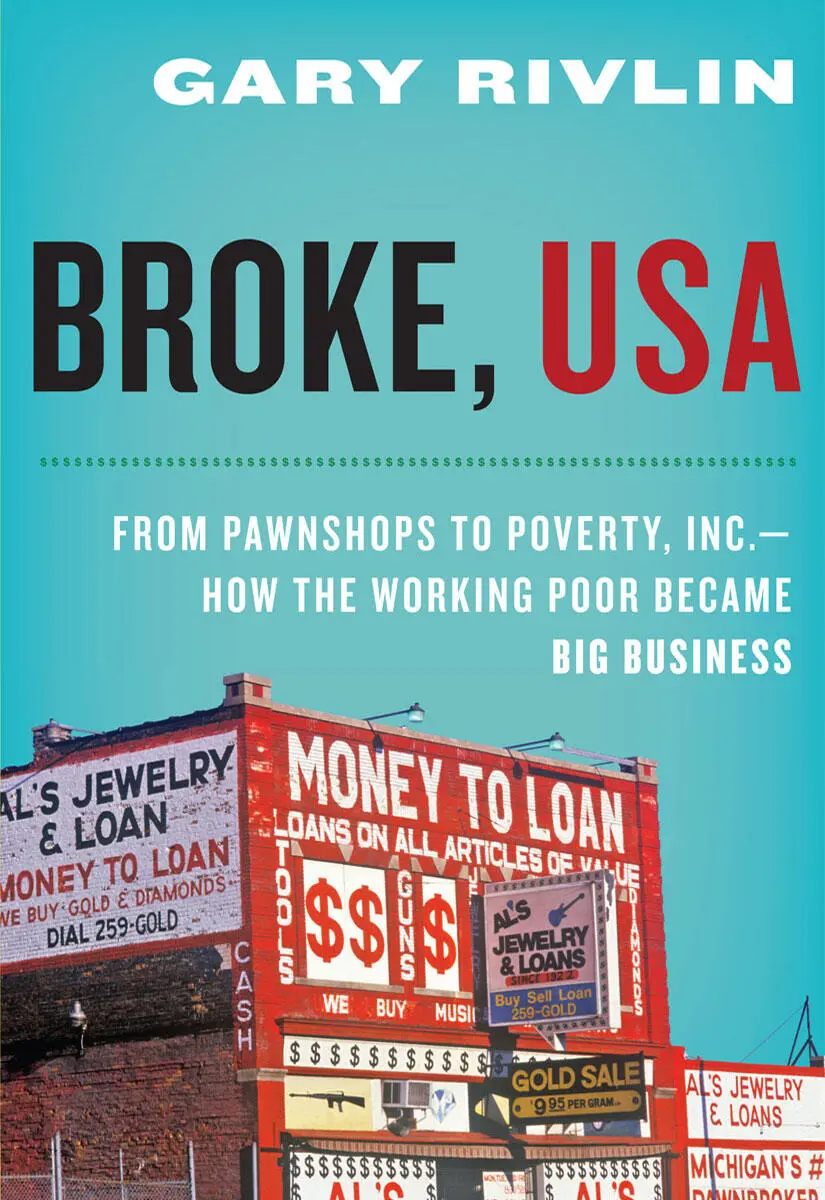
- Название:Broke, USA
- Автор:
- Издательство:HarperCollins Publishers Inc.
- Жанр:
- Год:2010
- Город:New York
- ISBN:978-0-06-199794-5
- Рейтинг книги:3 / 5. Голосов: 1
-
Избранное:Добавить в избранное
- Отзывы:
-
Ваша оценка:
Broke, USA: краткое содержание, описание и аннотация
Предлагаем к чтению аннотацию, описание, краткое содержание или предисловие (зависит от того, что написал сам автор книги «Broke, USA»). Если вы не нашли необходимую информацию о книге — напишите в комментариях, мы постараемся отыскать её.
Broke, USA — читать онлайн бесплатно полную книгу (весь текст) целиком
Ниже представлен текст книги, разбитый по страницам. Система сохранения места последней прочитанной страницы, позволяет с удобством читать онлайн бесплатно книгу «Broke, USA», без необходимости каждый раз заново искать на чём Вы остановились. Поставьте закладку, и сможете в любой момент перейти на страницу, на которой закончили чтение.
Интервал:
Закладка:
Myers admits he didn’t even notice that number on that Friday night they were in Household’s offices signing papers. “My mind was on two things,” he said. One was that 7.2 percent interest rate; the other was his wife’s health. “She was fixing to have her operation and I wanted to get these obligations out of the way so I could pay attention to her,” he said.
The other nasty surprise was an insurance policy he had unknowingly purchased. Myers acknowledges that the broker had brought up the issue of insurance during the closing, but he figured it was part of the deal, like a warranty automatically included as part of the purchase. He certainly didn’t mention its cost, Myers said.
“He tells us, ‘I had a couple of people, had the loans for two or three months when they got injured; we paid the loans off and everything.’ He’s telling me how this is this great thing, part of the loan we’re getting. Well, I got to reading the fine print: $7,600 for insurance.” Without quite realizing it, Myers had fallen into another costly and controversial financial trap, the so-called “single-premium credit insurance policy.” For years single-premium policies were a staple of subprime loans. Those selling the policies argued that they protected borrowers in case of death or an accident, but banks and other lenders rarely even bothered to pitch the same product to those in the market for a conventional loan. That’s because a middle-class borrower is more likely to buy a standard life insurance or disability policy to protect against disaster.
People typically make monthly or annual payments when buying an insurance policy. Single-premium policies, however, are paid off in one lump sum at the start of the contract. If that contract is financed, as it invariably is, that means interest accrues on the entire cost of the policy. That’s what happened to the Myerses. The policy, as written, expired after five years, but Tommy and Marcia would be paying off its costs over the entire life of the mortgage. At 13.9 percent interest, that meant the actual cost of the policy would work out to around $32,000, not $7,557.
Myers received the final shock a few weeks after signing the deal when the couple received a second bill from Household. At roughly $325 per month, this one was much smaller than the first bill but it enraged Myers more than any other aspect of the loan. While working their way through a stack of papers at the closing, they had unknowingly signed the paperwork for two loans: the original home refinance and also a home equity loan. This was becoming a common tactic inside Household: Agents would lend money through a home equity loan at the same time they were writing a refinance, even though that often meant (as in the case of the Myerses) that customers were left owing more than the actual value of their homes. Household charged the Myerses an interest rate of 19.9 percent on this second loan.
“We knew nothing about a second bill coming in,” Myers said. “A home equity loan? First we hear a thing about it is when this bill here comes in the mail.” (Myers would claim that later when he had a chance to examine all the loan documents, he noticed initials that looked nothing like his or Marcia’s.) He rushed to the Household office the first time he had a free moment to confront his broker. “You must think I’m awfully fucking dumb,” he began. He laid out his case in one big emotional gush but he casts the man as smug rather than defensive. “You can’t sue me, there’s nothing you can do, you signed the papers,” he remembers being told.
“I said to him, ‘You snookered me on that 7.2 percent interest. But you ain’t snookering me on this line of credit at 19.9 percent.’” Myers was resigned to paying the monthly amount on the new mortgage; he felt he had no one to blame but himself for agreeing to a lousy deal. But he wouldn’t pay a dime on the home equity loan. “He tells me, ‘You have to pay.’ And so I says, ‘We’ll see about that.’”
Myers phoned his state senator, where an aide informed him that a lender can charge basically whatever he wants so long as the terms are spelled out in the contract. He heard pretty much the same from an aide inside the governor’s office, who told him that even if everything he said was true, it wasn’t against the law. Myers phoned the White House. He tried reaching the secretary of the U.S. Department of Housing and Urban Development (HUD) and the U.S. attorney general. He ranted at random Beltway bureaucrats who seemed indifferent to what had happened to him. But mainly he pestered the people at Household.
Myers could have paid his bill by mail, but then he would have denied himself the pleasure of stopping by the Household office before work every other week. “I enjoyed seeing ’im,” Myers said of his broker. “I enjoyed sticking it to him for the screwing they took me for.” He’d park right out front and wait for them to open and invariably be the first person in the door. “I’d basically raise hell every time I’d go in there,” he said. “I’d razz him for being a crook; I’d talk about what a job they did on me. I didn’t care who was in there. I’d just give him what for.
“I’ll be honest with you,” Myers said. “I’m very, very stubborn. I try and be fair about things. But don’t tick me off. Just don’t tick me off.”
Among those Myers called to complain about Household was a local advocacy group called the Miami Valley Fair Housing Center (Dayton is located on the Great Miami River). Myers is white and the Fair Housing Center was a group known for fighting the racial discrimination that denied homes to qualified black buyers in the Miami Valley, but he figured someone there would know something about abusive lending practices.
Actually, the mission of the Fair Housing Center was already starting to change by the time of Myers’s call. Just as strong currents of change were beginning to flow through a newly deregulated financial world, the strategies of housing activists were shifting with them. It was no longer a matter of lenders refusing to make loans in certain neighborhoods; rather, it was now something like its opposite: Lenders were now targeting those same neighborhoods and aggressively peddling mortgages and home equity loans on terms that left borrowers worse off than if they had been denied a loan in the first place. This new scourge had first shown itself in the city’s black precincts but quickly spread to its white working-class neighborhoods and to the crumbling first-ring suburbs. Myers didn’t realize it at the time but his hometown had become a hotbed in the fight against predatory lending, and Fair Housing’s executive director, Jim McCarthy, was one of the people pushing hardest for a confrontation with these lenders. The county had recently given McCarthy and his allies $600,000 to fund a public awareness campaign to warn people about these abusive loans and to create a group they were calling the Predatory Lending Solutions Project to help people untangle themselves from situations like the one that had ensnared Tommy and Marcia Myers.
Fair Housing opened more than 650 case files in 2001 and nearly 900 more the next year. McCarthy invited me to go through the center’s files, where I found the names of more than seventy-five people who had contacted their organization about a Household loan. Not every person who showed up in their offices was a victim, McCarthy said, but many shared tales not all that different from the one that Tommy Myers told. He remembered Myers—remembers liking him and feeling great sympathy for what had happened to him—but called up his file to refresh his memory. He filled me in on details that Myers had left out, such as the stiff prepayment penalty Household had written into his loan terms—another staple of abusive mortgages. Just as it had cost Myers dearly for the privilege of taking out a Household loan, it would cost him plenty to get out of the loan inside of five years. Myers also didn’t mention that Household had paid a subsidiary of itself to do the appraisal on his home and then stuck it on his tab. Technically that’s not illegal but it’s certainly not the accepted practice, either. Phone logs for the organization showed that Myers had initially contacted the Fair Housing Center to ask whether it was true that there were no predatory lending laws in Ohio. He was told that there weren’t.
Читать дальшеИнтервал:
Закладка:
Похожие книги на «Broke, USA»
Представляем Вашему вниманию похожие книги на «Broke, USA» списком для выбора. Мы отобрали схожую по названию и смыслу литературу в надежде предоставить читателям больше вариантов отыскать новые, интересные, ещё непрочитанные произведения.







Обсуждение, отзывы о книге «Broke, USA» и просто собственные мнения читателей. Оставьте ваши комментарии, напишите, что Вы думаете о произведении, его смысле или главных героях. Укажите что конкретно понравилось, а что нет, и почему Вы так считаете.