Gary Rivlin - Broke, USA
Здесь есть возможность читать онлайн «Gary Rivlin - Broke, USA» весь текст электронной книги совершенно бесплатно (целиком полную версию без сокращений). В некоторых случаях можно слушать аудио, скачать через торрент в формате fb2 и присутствует краткое содержание. Город: New York, Год выпуска: 2010, ISBN: 2010, Издательство: HarperCollins Publishers Inc., Жанр: Старинная литература, на английском языке. Описание произведения, (предисловие) а так же отзывы посетителей доступны на портале библиотеки ЛибКат.
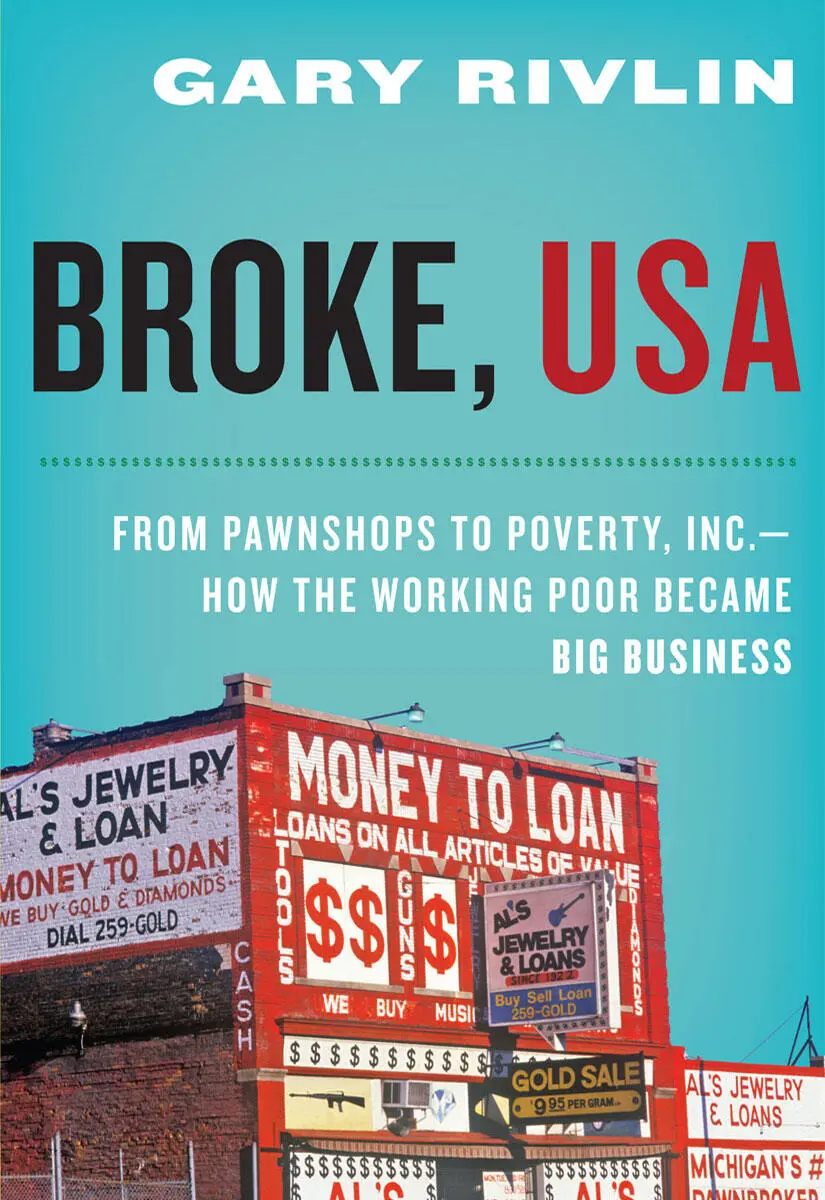
- Название:Broke, USA
- Автор:
- Издательство:HarperCollins Publishers Inc.
- Жанр:
- Год:2010
- Город:New York
- ISBN:978-0-06-199794-5
- Рейтинг книги:3 / 5. Голосов: 1
-
Избранное:Добавить в избранное
- Отзывы:
-
Ваша оценка:
Broke, USA: краткое содержание, описание и аннотация
Предлагаем к чтению аннотацию, описание, краткое содержание или предисловие (зависит от того, что написал сам автор книги «Broke, USA»). Если вы не нашли необходимую информацию о книге — напишите в комментариях, мы постараемся отыскать её.
Broke, USA — читать онлайн бесплатно полную книгу (весь текст) целиком
Ниже представлен текст книги, разбитый по страницам. Система сохранения места последней прочитанной страницы, позволяет с удобством читать онлайн бесплатно книгу «Broke, USA», без необходимости каждый раз заново искать на чём Вы остановились. Поставьте закладку, и сможете в любой момент перейти на страницу, на которой закончили чтение.
Интервал:
Закладка:
“Believe me, Ohio was the wake-up call for a lot of us,” Joe Coleman said.
All these major corporations, chain franchises, and newly hatched enterprises specifically catering to the working poor—were they financial angels to the country’s great hardworking masses, by making homes and cars and emergency cash available to those otherwise shunned by the mainstream financial institutions? Or were these businesses tilling the country’s working-class neighborhoods so aggressively that they endangered the very survival of these communities? Were they vultures carelessly adding to the economic woes of a single mother of two working as a chambermaid at the local Holiday Inn? This question, which preoccupied me in my time on the subprime fringes—the morality of making a much higher profit on the working poor than on more prosperous citizens—was also one the country would need to ask once the new administration was out of crisis mode and legislators could turn their attention to various bills addressing the profits being earned by the poverty industry.
“When someone makes a profit in low-income communities, the presumption is that they must be doing something wrong,” Joe Coleman had said to me in Las Vegas when I ran into him in the hallway between events. An excitable man, Coleman got so revved up during our talk that he told me that if his life were a movie, he wouldn’t be Mr. Potter in It’s a Wonderful Life but rather the man who protects the working stiff from the rapacious and coldhearted financier. “We’re the George Baileys here,” he blurted. “We’re Jimmy Stewart!”
Two
The Birth of the Predatory Lender
If you think that if only there had been some warnings, the subprime lenders could have been stopped before they practically destroyed the world economy, then you should avoid the office of the Atlanta public interest lawyer Bill Brennan. It would be too upsetting.
Since that day in 1991 when eighty-year-old Annie Lou Collier sat across from his desk because a bank was threatening to take her home of thirty-eight years, William J. Brennan, Jr., has been talking about virtually nothing else but the need for people in power to impose some basic regulatory standards on the country’s lenders. A staff attorney for the Atlanta Legal Aid Society, Brennan has paid his own way to Washington, D.C., numerous times to testify before Congress and the Fed. He has spent more than he wants to admit doing reconnaissance work at industry-sponsored subprime lending conferences. Over the years he’s put so many flights and hotel stays and subscriptions and overnight deliveries on credit cards that for a time he put himself and his spouse, Lynn Simmons, a schoolteacher, in debt. “My wife wasn’t happy with me but we don’t need to get into that,” he says sheepishly. His collection of subprime-related material began small: some articles, a few key memos, a legal brief somebody had sent him. But when Brennan reached twenty or so cartons, Simmons put her foot down. She banished every last box from their home, so on top of everything else, Brennan now spends around a hundred and fifty dollars each month on a storage locker.
“Ninety-eight percent of everything good that’s happened in the fight against predatory lending is because of Bill,” his friend Howard Rothbloom told me. Back in the early 1990s, Rothbloom, then a young bankruptcy lawyer, called Brennan hoping to get up to speed on a new rash of predatory lending he was seeing in Atlanta. “Bill offers to send me a couple of articles he thought I’d find interesting,” Rothbloom said—and the next day a FedEx van was delivering a heavy box to his office. “Just quickly…,” Brennan will say when leaving a voice mail for his boss, Steve Gottlieb, the executive director of Atlanta Legal Aid. But it’s never quick. The Legal Aid voice mail system gives callers five minutes to leave a message but Brennan invariably needs to call again to finish a message and sometimes he needs to call a third time. Gottlieb asked Brennan to stand at his wedding but he has also banned his friend from using the office copier.
Brennan has no tolerance for halfway measures. He became a regular reader of the New York Times business section and he bought a subscription to the Wall Street Journal . And when he learned that the lenders he was following were reading something called Inside B&C Lending (its motto: “Everything you need to know about subprime mortgage lending—making loans with less than ‘A’ credit”), he decided he would read that as well, though an annual subscription cost $495. He has unusual dedication and focus. Brennan once spotted Steve Gottlieb walking down the street at seven or eight o’clock at night as Gottlieb and his wife were heading to a restaurant for dinner. “Steve! Steve!” Gottlieb heard—and he turned to see Brennan, tall and lanky, dashing toward him with a large packet of materials in his hand. He had stopped his car in the middle of the road and ran from it with the engine still running and a door wide open.
Brennan has a kind, open face and a gentle disposition. He’s bald, with a fringe of gray hair, a thin gray mustache, and gold-framed glasses. He has a courtly manner and dresses smartly at the office, preferring ties and blazers and trousers with sharp creases. He smiles a lot, but often it is the pained smile of someone who feels the world’s burdens more heavily than the average person does. He stoops slightly when standing, as if apologizing for his height. Jim McCarthy, a housing activist in Dayton, Ohio, was anxious the first time he called Brennan at the end of the 1990s when McCarthy was starting to get involved in the fight against predatory subprime lending. “Here I was, this nasal-voiced kid from Ohio who knew next to nothing,” McCarthy said, “and he gave me all the time in the world.” Of course, a FedEx box filled with follow-up materials arrived at McCarthy’s office the next day.
Bill Brennan wanted to be a Catholic priest, but after entering the seminary he found cloistered life too confining and so transferred to Emory University. His parents, who had grown up poor, pushed their son to attend law school but Brennan felt ambivalent about a legal career even after graduating from Emory Law School in 1967. He took a job teaching at a school for the mentally disabled in a poor black community in Atlanta and threw himself into the politics of the day. He marched on the Pentagon in 1968 to protest the Vietnam War, and got involved on the periphery of the civil rights struggle. He was driving his car when he heard a speech on the radio by the man then running Atlanta Legal Aid. Martin Luther King, Jr., had just been assassinated and this lawyer was talking about using the law to battle poverty, racism, and other social ills. Brennan went for an interview the next day and has toiled in the trenches of legal aid ever since.
Brennan seemed to have a nose for crusades that pit him against people seeking to get rich off the poor. In his first year on the job he exposed a pair of city inspectors who bought apartment buildings on the cheap after citing the original owners for code violations and then jacked up the rent without making repairs. Several years later he took on a former top housing official under Atlanta mayor Andrew Young for demanding under-the-table payments from the Section 8 tenants (those receiving rent subsidies from the federal government) living in properties he owned. The man was sentenced to five years in prison. In 1989, Bill Dedman of the Atlanta Journal-Constitution won the Pulitzer Prize for an astonishing series that could be summed up in a pair of nearly identical maps, one showing the city’s predominantly black neighborhoods, the other identifying those communities where banks almost never made a loan. Brennan was a key member of the housing group that had first gone to the newspaper with the original idea of an investigative piece exposing the redlining policies of the city’s largest banks.
Читать дальшеИнтервал:
Закладка:
Похожие книги на «Broke, USA»
Представляем Вашему вниманию похожие книги на «Broke, USA» списком для выбора. Мы отобрали схожую по названию и смыслу литературу в надежде предоставить читателям больше вариантов отыскать новые, интересные, ещё непрочитанные произведения.









Обсуждение, отзывы о книге «Broke, USA» и просто собственные мнения читателей. Оставьте ваши комментарии, напишите, что Вы думаете о произведении, его смысле или главных героях. Укажите что конкретно понравилось, а что нет, и почему Вы так считаете.