Gary Rivlin - Broke, USA
Здесь есть возможность читать онлайн «Gary Rivlin - Broke, USA» весь текст электронной книги совершенно бесплатно (целиком полную версию без сокращений). В некоторых случаях можно слушать аудио, скачать через торрент в формате fb2 и присутствует краткое содержание. Город: New York, Год выпуска: 2010, ISBN: 2010, Издательство: HarperCollins Publishers Inc., Жанр: Старинная литература, на английском языке. Описание произведения, (предисловие) а так же отзывы посетителей доступны на портале библиотеки ЛибКат.
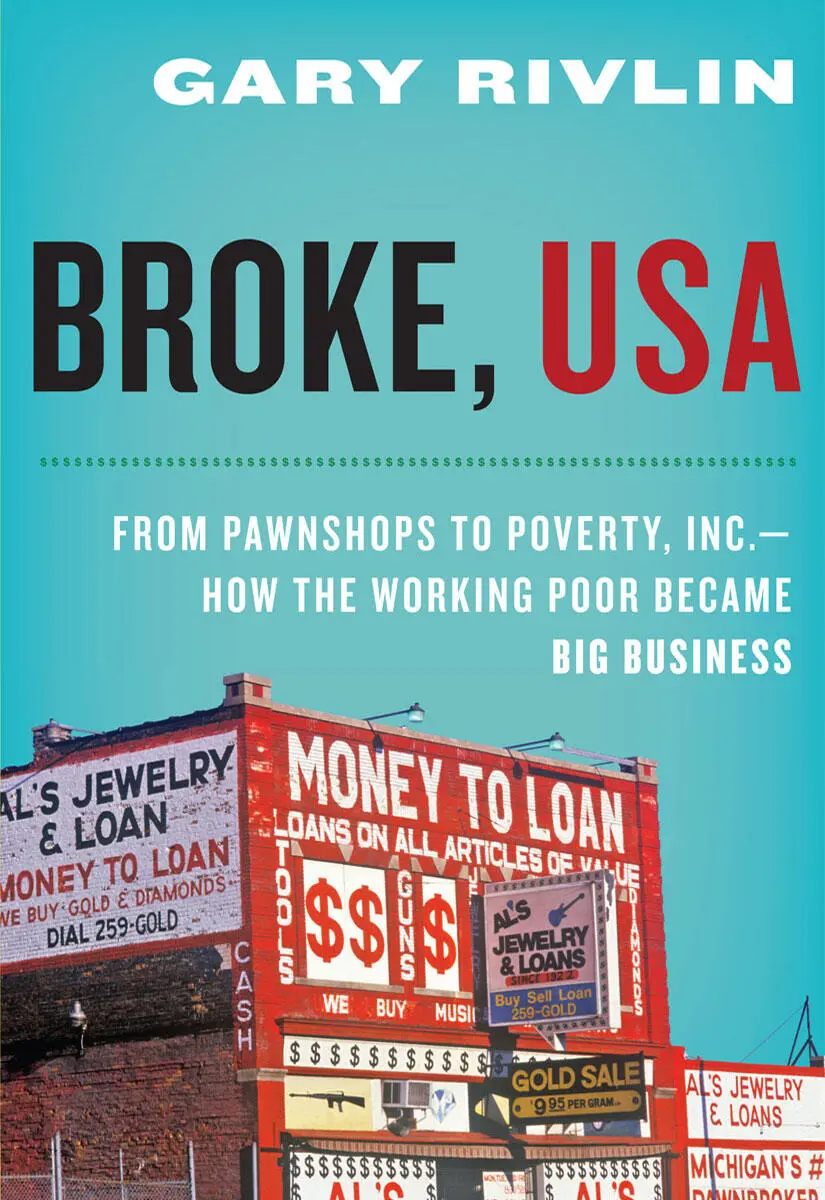
- Название:Broke, USA
- Автор:
- Издательство:HarperCollins Publishers Inc.
- Жанр:
- Год:2010
- Город:New York
- ISBN:978-0-06-199794-5
- Рейтинг книги:3 / 5. Голосов: 1
-
Избранное:Добавить в избранное
- Отзывы:
-
Ваша оценка:
Broke, USA: краткое содержание, описание и аннотация
Предлагаем к чтению аннотацию, описание, краткое содержание или предисловие (зависит от того, что написал сам автор книги «Broke, USA»). Если вы не нашли необходимую информацию о книге — напишите в комментариях, мы постараемся отыскать её.
Broke, USA — читать онлайн бесплатно полную книгу (весь текст) целиком
Ниже представлен текст книги, разбитый по страницам. Система сохранения места последней прочитанной страницы, позволяет с удобством читать онлайн бесплатно книгу «Broke, USA», без необходимости каждый раз заново искать на чём Вы остановились. Поставьте закладку, и сможете в любой момент перейти на страницу, на которой закончили чтение.
Интервал:
Закладка:
The corner pawnbroker can be a lifesaver for the person needing quick cash for a bus ticket home to attend a favorite aunt’s funeral. A person without a bank account needs someone like a check casher to survive in today’s modern world. I spent a day in Spartanburg, South Carolina, with Billy Webster, who had a net worth exceeding $100 million on the day his company, Advance America, the country’s largest payday lending chain, went public in 2004. To him there is something noble about the way he attained his wealth. How else could a person struggling by on $20,000 or $25,000 or $30,000 survive if not for access to the quick cash his company and its competitors offer? “People who use our service like us and appreciate us,” Webster said. “It’s only the consumer critics who don’t like us.”
Yet the poverty industry can seem less lofty when one considers the collective financial burden these businesses place on all those that regularly use its services. There are 40 million or so people in the United States living on $30,000 or less a year, according to the Federal Reserve. There are no doubt some people making more than $30,000 a year borrowing against their next paycheck with a payday lender (just as there are people getting by on $20,000 who would never use a check casher or a subprime credit card), but $30,000 seems a useful cutoff if trying to describe the working poor: those who earn too much to qualify for government entitlements but who earn so little there’s no hope they’ll ever save much money given the rising cost of housing, health care, transportation, and everything else one needs to live life in twenty-first-century America. If each person living on under $30,000 a year donated equally to the poverty industry, that would mean their annual share of that $150 billion is $3,800. For the warehouse worker supporting a family on $25,000 per year, that works out to a 15 percent annual poverty tax.
Publicly traded companies feel great pressure to grow their revenues year over year. So too does any ambitious entrepreneur. It doesn’t make a difference that the target market is those who can least afford to lose another $1,000 or $2,000 or $3,000 a year from their take-home checks. The task of teaching the country’s payday lenders and check cashers and pawnbrokers tricks for shaking even more from their customers falls to people like Jim Higgins, who arrived in Las Vegas for the twentieth annual check cashers’ convention to give a ninety-minute presentation he dubbed “Effective Marketing Strategies to Dominate Your Market.”
Higgins, a squat man with silver-framed glasses and aquiline nose who calls to mind Vincent Gardenia, the actor who played Cher’s father in Moonstruck, gave his talk twice that weekend. The session I attended was standing-room only and Higgins’s talk brimmed with practical suggestions. Employ customer loyalty programs, as the airlines have done so effectively. Mine your databases and divide customers into several categories, from those who have only visited you once or twice to those who come in at least a couple of times a month. Devise a targeted mailer for each. Send out “Welcome!” mailers to each new customer and sweeten the hello with a cash incentive to return. For those who are semi-regulars offer a “cash 3, get 1 free” deal. “These are people not used to getting anything free,” Higgins said. “These are people not used to getting anything, really.” Use these tried-and-true methods, he advised, and you can “turn your store into an effective selling machine.”
It’s not hard, he reassured them. Pens scribbled furiously as he tossed out specifics such as various ideas for contests and giveaways and other come-ons that have worked for the big boys. Raffle off an iPod or consider a scratch-and-win contest. Do whatever it takes to turn someone into a loyal customer, he counseled them. “Get a customer coming to you regularly,” Higgins said, “and they could be worth $2,000 to $4,000 a year.”
Ihad the good fortune to have knocked on the door of the people at FiSCA—and on the doors of any number of swashbuckling entrepreneurs who have figured out how to get very rich off those with very little—at a time when many of the pioneers of this industry felt misunderstood and under public attack. A few harbored resentment toward the press and declined to talk, but most proved eager to meet with me. FiSCA was typical. The check cashers don’t normally allow outsiders to attend their events, Stephen Altobelli, who works for an agency that does public relations for FiSCA, had told me. But I was granted an all-access pass that allowed me to roam the halls freely and chat with whoever was willing to talk with me. I had told Altobelli that I would be spending time with critics such as Martin Eakes, whose name had come up any number of times in Las Vegas as the crusader the people in the room most love to hate. I told him, too, that I would be meeting with people, such as Tommy Myers, who consider themselves victims of the poverty industry. He didn’t care. “Our people want to get their stories out there,” Altobelli said.
That seemed fine by me. Our country was experiencing the worst economic times since the Great Depression and his people resided in an upside-down world in which people with little money in their pockets boded well for their bottom lines. There’s something undeniably brilliant about the person who figures out how to make a 150 percent markup on a $500 television by renting it by the week, or a person like Allan Jones who sees the potential to become a triple-digit millionaire several times over by loaning people $200 or $400 at a time. Who are these people who one day wake up and decide that they’re going to make their mark and their millions charging potentially confiscatory interest rates to the working poor?
These were jittery times inside the Mandalay conference center. Less than one month earlier the government had allowed Lehman Brothers to fail while helping to arrange a shotgun marriage between Merrill Lynch and Bank of America. The financial industry’s future looked tenuous and even if those in this room could expect to see demand for their products go up, so too would defaults rise. If nothing else, the deep credit freeze that had descended on much of the world meant the end, at least temporarily, of the days when a small entrepreneur could dream of the inflated payout from a chain anxious to grow big fast. And then there were the normal competitive pressures of running a business in twenty-first-century America. The big threat in 2008 was Walmart, which was moving aggressively into a couple of the poverty industry’s more lucrative areas. Other giant retailers were starting to nibble around the edges of their market as well.
Yet all these seemed minor concerns compared to changes in the political climate. From the podium, in the corridors, in breakout sessions, and in the bars you could hear the fear and also the rage. They were blameless for the current financial meltdown, they told themselves, victims of a crazy housing bubble just like everyone else. But of course that wasn’t quite true. They, like the country’s subprime mortgage lenders, had taken advantage of the same deep and restless pools of capital looking for a high return. The fall of real wages among working Americans had created an artificial demand for expensive credit and the people gathering in meeting rooms on the grounds of the Mandalay Bay were among those who had moved in to meet the need, amassing fortunes in the process. And even if they didn’t buy the idea that they were partially responsible for the nation’s financial woes, they recognized that others would blame them. The country’s biggest banks and Wall Street’s best-known financial houses had belly-flopped into the subprime soup and the members of FiSCA knew they were in danger of being swamped by the wash. “You better hurry on down to Cleveland [Tennessee] if you want to meet with me,” Allan Jones, the man who invented the modern-day payday industry, drawled over the phone when we spoke a few weeks before the FiSCA meeting. “I’m not sure I’ll have any business to still visit next year.” Even as people were commemorating their twentieth meeting, there were already those who were anticipating a much smaller crowd for the twenty-fifth. The obsession in Las Vegas that weekend was Ohio, where, in three weeks, voters would be asked to greatly restrict the fees a payday lender could charge on a loan. Ohio was a top-five payday market and in fact prime territory for any number of Poverty, Inc. businesses.
Читать дальшеИнтервал:
Закладка:
Похожие книги на «Broke, USA»
Представляем Вашему вниманию похожие книги на «Broke, USA» списком для выбора. Мы отобрали схожую по названию и смыслу литературу в надежде предоставить читателям больше вариантов отыскать новые, интересные, ещё непрочитанные произведения.








Обсуждение, отзывы о книге «Broke, USA» и просто собственные мнения читателей. Оставьте ваши комментарии, напишите, что Вы думаете о произведении, его смысле или главных героях. Укажите что конкретно понравилось, а что нет, и почему Вы так считаете.