Gary Rivlin - Broke, USA
Здесь есть возможность читать онлайн «Gary Rivlin - Broke, USA» весь текст электронной книги совершенно бесплатно (целиком полную версию без сокращений). В некоторых случаях можно слушать аудио, скачать через торрент в формате fb2 и присутствует краткое содержание. Город: New York, Год выпуска: 2010, ISBN: 2010, Издательство: HarperCollins Publishers Inc., Жанр: Старинная литература, на английском языке. Описание произведения, (предисловие) а так же отзывы посетителей доступны на портале библиотеки ЛибКат.
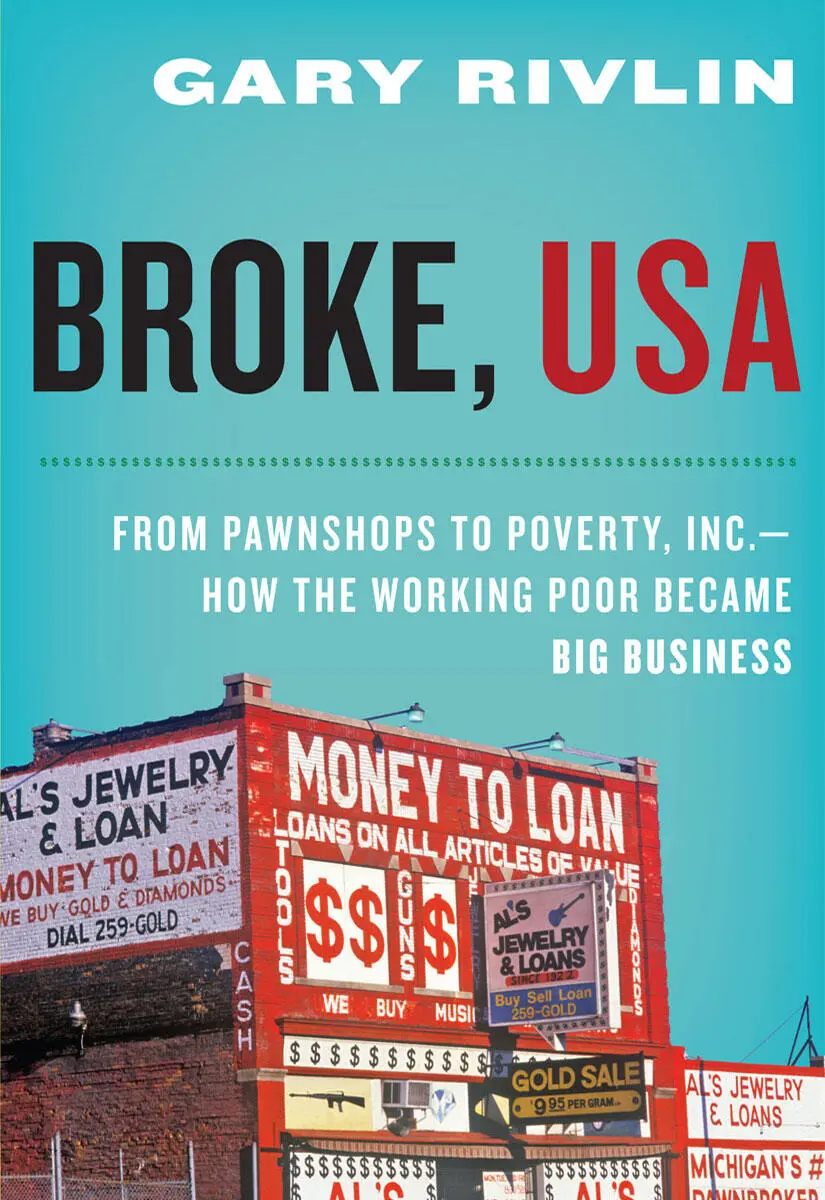
- Название:Broke, USA
- Автор:
- Издательство:HarperCollins Publishers Inc.
- Жанр:
- Год:2010
- Город:New York
- ISBN:978-0-06-199794-5
- Рейтинг книги:3 / 5. Голосов: 1
-
Избранное:Добавить в избранное
- Отзывы:
-
Ваша оценка:
Broke, USA: краткое содержание, описание и аннотация
Предлагаем к чтению аннотацию, описание, краткое содержание или предисловие (зависит от того, что написал сам автор книги «Broke, USA»). Если вы не нашли необходимую информацию о книге — напишите в комментариях, мы постараемся отыскать её.
Broke, USA — читать онлайн бесплатно полную книгу (весь текст) целиком
Ниже представлен текст книги, разбитый по страницам. Система сохранения места последней прочитанной страницы, позволяет с удобством читать онлайн бесплатно книгу «Broke, USA», без необходимости каждый раз заново искать на чём Вы остановились. Поставьте закладку, и сможете в любой момент перейти на страницу, на которой закончили чтение.
Интервал:
Закладка:
At that point Jones was a successful businessman with around 250 employees. He was wealthy enough to own his own plane but he was also in the debt collection business, which meant he spent his days dealing with unhappy people. The people behind the businesses who paid his bills were constantly bellyaching that his collection agents weren’t aggressive enough and he was forever hearing complaints from the debtors that they were too gung-ho. After an hour or so of watching Eaton deal with his customers, he was struck by how friendly it all was. “People would thank him,” Jones recalled. “They would thank him and thank him and thank him.” The other thing that stuck in his mind was that these were working folk, not poor people. They drove decent cars. They dressed in good clothes.
Jones wondered about the fee Eaton was charging. Wasn’t 20 percent too steep for a short-term loan of maybe a week or two? “Ale-ann. Ale-ann,” Eaton drawled, and then pointed out that his customers’ banks would charge them at least that much on a bounced check.
“That’s when the lightbulb went off in my head,” Jones said.
Eaton, of course, said no to Jones’s job offer. “I sure do appreciate you coming on up here,” Eaton told him, “but this is the happiest business I’ve ever been in. I’m happy, my clients are happy. They just love me.”
On the plane ride home, Hixson recalled, Jones was there but not there. “I couldn’t hardly say a word to him,” Hixson said.
They’re happy, I’m happy.
Collections is a tough business. All those hospitals and department stores and credit card companies always on your back.
They just love me.
All those deadbeats demanding to talk with him because his people were rough with them over the phone.
Cheaper than a bounced check.
Jones thought of the grateful look on people’s faces when Eaton handed over the money. And Eaton? How could he help feeling anything but ecstatic making 20 percent on his money? He kept thinking about that steep fee and how his customers saw it as a bargain. Jones sat on the board of a local bank; he saw the money they were making on bounced checks. Collections is a low-overhead business but Eaton was essentially running his operation out of a shack.
Jones was pushing forty at the time. He would be getting in on the ground floor of a potential new business. He would be siphoning off money from the banks and make a tidy profit in the process. What was there not to like?
He went over the numbers in his mind. Ten grand, he concluded. He would set aside $10,000 and give it a shot.
The early evening gathering at the Bald Headed Bistro was actually the second time I heard the story of Jones’s trip to Johnson City. The first was the day before, when Jones and I were barreling down the interstate in the cab of his shiny new white Ford 4x4 with gleaming mag wheels, heading to Chattanooga for a wrestling match he wanted to see. “I think about that day and all I’ve accomplished,” he said somberly, shaking his head. This version Jones delivered in almost hushed tones, as if sharing something precious, and it ended up making him feel nostalgic and sad. “You work so hard to build something from out of nothing and then watch a bunch of people who don’t know anything about business try and take it apart,” he said. Payday may have rendered him a very wealthy man but it has also made Jones, the industry’s most prominent pioneer and its most outspoken defender, a favorite punching bag of consumer advocates around the United States. “Sixteen years—and all of a sudden what I do has become evil,” he says. “I don’t know what’s changed that suddenly I’m evil.” And not for the first time, and also not for the last, he launched into a small tirade about a man named Martin Eakes, the founder of the Center for Responsible Lending.
Jones is bald with a round face and a full beard—Rob Reiner, but more dyspeptic and bulkier and without the liberal politics. He stands about five feet, eight inches tall and has the round shoulders of a former fullback. On our first day together, he wore scuffed cowboy boots and a monogrammed white dress shirt and his large belly hung over frayed jeans. He was likable enough, friendly and self-deprecating; noticing my pages of interview questions, he cracked, “You’ve done more homework on me than I did at Cleveland High in four years.” But mainly he was a man looking for an argument. Where payday’s critics such as Eakes live in the realm of theory, he said, his customers live in the real world, where a quick cash advance can mean the difference between the kids going to bed fed or hungry.
“They try and stop check-cashing operations,” Jones said of the consumer advocates he’s battled over the past few years. “They try and stop the tax refund business. They try and stop the rent-to-own industry. They try and stop the auto title loan industry. I guess as far as Martin Eakes is concerned, it doesn’t make a difference if regular people have access to cash when they need it.”
In our initial phone conversation, Jones had practically insisted I travel to Cleveland to let him expound on the magnificence of the payday loan. “If you’re a’gonna write about payday, you gotta get down here and see me,” Jones said. “I created the industry and the rest of ’em just copied me.” I was convinced, but then, after dozens of emails and phone conversations with the assistant in charge of his schedule, I received a curt email message from the company’s communications director informing me that Jones had changed his mind. I decided to go to Cleveland anyway to see for myself this improbable birthplace of the modern-day cash advance business, a town of thirty-five thousand that had given rise to payday’s first two big chains, Jones’s and a local who copied his business. A few days before my arrival, I sent Jones an email informing him that I’d be coming to town to talk with people who knew him. An hour later Jones phoned. He’d be happy to make time to see me while I was in town, he told me—and that weekend Allan Jones and I became BFFs.
We attended a wrestling match on the campus of the University of Tennessee, in Chattanooga an hour’s drive away, and then had lunch. Back in Cleveland, he showed me the hospital where he was born and drove me by the house where a childhood friend lived who would talk with him late into the night over their CB radios. He pointed out where one of his sisters lived and confided in me that his weight had grown so out of control that he had recently had gastric bypass surgery. He drove me up the hill to show me his house and invited me to watch the Super Bowl with him and his sons, but I declined because we had already spent more than five hours together and had plans to meet the next morning so I could see his operations and then talk again over lunch. Even best friends need time apart.
Destiny, as Allan Jones sees it, was awaiting him even as he exited the womb. The big news in Cleveland in the fall of 1952 was the opening of a new hospital and he was the first baby delivered there. “The day I’m born and I’m already in the newspaper,” Jones said shaking his head in amazement. Is it any wonder, he asked me, that he had accomplished “great things” in his life? A few years back he had the idea of building a “First Mother’s Garden” on the grounds of the hospital in honor of his mother. “There was all this attention on me,” Jones reasoned, “but it was her who gave labor.”
Jones figures he was no older than ten when he started collecting dried-out Christmas trees for a giant community bonfire. It became an annual post-holiday tradition in Cleveland, and in time he required kids to be at his house by 8 A.M. sharp if they wanted to participate. He was goal oriented even then, eager to beat his number from the previous year. “I’d get furious at a kid if he didn’t show up,” he said. He admits to harboring a visceral dislike all these years later for a kid whose mother wouldn’t let him start collecting trees until 10 A.M.
Читать дальшеИнтервал:
Закладка:
Похожие книги на «Broke, USA»
Представляем Вашему вниманию похожие книги на «Broke, USA» списком для выбора. Мы отобрали схожую по названию и смыслу литературу в надежде предоставить читателям больше вариантов отыскать новые, интересные, ещё непрочитанные произведения.








Обсуждение, отзывы о книге «Broke, USA» и просто собственные мнения читателей. Оставьте ваши комментарии, напишите, что Вы думаете о произведении, его смысле или главных героях. Укажите что конкретно понравилось, а что нет, и почему Вы так считаете.