Gary Rivlin - Broke, USA
Здесь есть возможность читать онлайн «Gary Rivlin - Broke, USA» весь текст электронной книги совершенно бесплатно (целиком полную версию без сокращений). В некоторых случаях можно слушать аудио, скачать через торрент в формате fb2 и присутствует краткое содержание. Город: New York, Год выпуска: 2010, ISBN: 2010, Издательство: HarperCollins Publishers Inc., Жанр: Старинная литература, на английском языке. Описание произведения, (предисловие) а так же отзывы посетителей доступны на портале библиотеки ЛибКат.
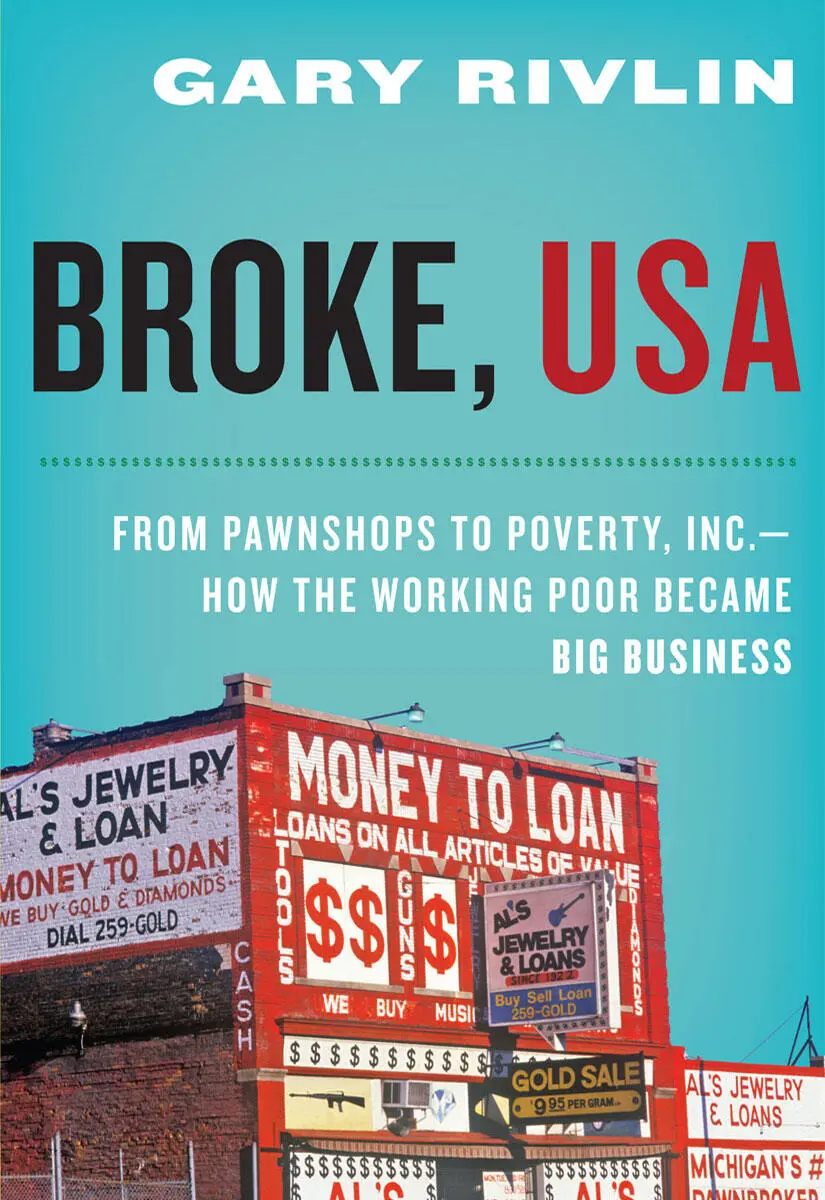
- Название:Broke, USA
- Автор:
- Издательство:HarperCollins Publishers Inc.
- Жанр:
- Год:2010
- Город:New York
- ISBN:978-0-06-199794-5
- Рейтинг книги:3 / 5. Голосов: 1
-
Избранное:Добавить в избранное
- Отзывы:
-
Ваша оценка:
Broke, USA: краткое содержание, описание и аннотация
Предлагаем к чтению аннотацию, описание, краткое содержание или предисловие (зависит от того, что написал сам автор книги «Broke, USA»). Если вы не нашли необходимую информацию о книге — напишите в комментариях, мы постараемся отыскать её.
Broke, USA — читать онлайн бесплатно полную книгу (весь текст) целиком
Ниже представлен текст книги, разбитый по страницам. Система сохранения места последней прочитанной страницы, позволяет с удобством читать онлайн бесплатно книгу «Broke, USA», без необходимости каждый раз заново искать на чём Вы остановились. Поставьте закладку, и сможете в любой момент перейти на страницу, на которой закончили чтение.
Интервал:
Закладка:
“The first time the issue of subprime had gotten anywhere near the kind of attention it deserved was with Fleet,” she said. “Until Fleet, we had never gotten any traction with our issues.”
Keest remembers riding the train with Bruce Marks and arguing over his use of the phrase “predatory lender.” She was worried that it was too inflammatory, that such a loaded term might turn people off to their cause. She also wondered about the focus on Fleet when she knew they were no worse than the others, only larger and more successful. Years later, she laughed at how little she understood the workings of the media then. It had to be Fleet, precisely because it was so big. While its size gave it strength, it also made it vulnerable to public pressure and outrage.
In the months following the CBS broadcast, both the U.S. House and Senate held committee hearings to probe Fleet Finance’s lending practices. Bruce Marks did his part to ensure that the Senate Banking Committee hearing was especially memorable. “Ride an all-expense paid chartered bus to Washington,” read the flyers Marks’s group passed around poor neighborhoods in Boston, Atlanta, and Augusta, Georgia, in the days leading up to the hearing. Roy Barnes picked up most of the tab for those willing to travel north from Atlanta (meals included) and Marks’s organization footed the rest of the bill. So many people took them up on their offer—press accounts put their numbers at between three hundred and four hundred while Marks claimed a crowd in excess of five hundred—that the hearings had to be moved to a larger room. The demonstrators, dressed in their bright yellow “loan shark” T-shirts, broke into chants and song. “It was like a gospel revival meeting,” Marks said in interviews afterward. Defending his bank before the committee, Fleet president John Hamill said that the average annual interest rate on a Fleet Finance loan was 15.9 percent and not 20 percent or more as some were claiming. “I’ve got to tell you,” committee chairman Donald Riegle, Jr., told Hamill, “that 15.9 percent…bothers me and it ought to bother you…. It’s very troubling to me and frankly I think it’s hurting the country.”
The fight lasted several more months. Fleet thought it might out-smart Marks by having a lawyer issue a subpoena requiring him to testify in Boston on the day of its next annual shareholders’ meeting in Providence. They wanted it to be a celebratory day as the bank was about to announce a 113 percent jump in its first-quarter profits in 1993. “We just assumed even an ego that size couldn’t be in two places at one time,” a bank spokesman told the Globe . Marks simply ignored the subpoena and marched along with the two dozen people who showed up to picket its annual meeting.
The final straw came in the fall of 1993, when Marks learned that Fleet’s Terrence Murray had been invited to speak at a breakfast for business leaders sponsored by the Harvard Business School. Marks had about thirty-five people planted around the room that morning. “We got the names of Harvard Business alum and started registering in their names,” he said. “We just took their names. We didn’t ask permission.” Marks sidled up to Murray as people were gathering and told him matter-of-factly that they would make sure he wouldn’t be speaking that morning. Murray was a working-class kid from Providence who had attended Harvard on scholarship. “In front of everyone, Murray got up there and said he was going to resolve the troubles he was having with Fleet Finance,” Marks said. A few days later, the two sat down for the first of a trio of long talks, each lasting three or four hours. “I get a call from Bruce saying he’s meeting with Murray, what would it take to settle my suit,” Brennan said. When Marks phoned him back a few hours later to tell him that Fleet had capitulated and it was a done deal, Brennan wished he had asked for a larger number.
Fleet paid $6 million to settle the separate class-action suit that Howard Rothbloom and Roy Barnes had filed on behalf of Lillie Mae Starr and twenty thousand other Georgians who had received home loans through Fleet Finance. That was very good news for Starr and the other named plaintiffs and also Rothbloom and Barnes, who (along with two other lawyers) split $2 million in fees and another $150,000 in expenses for their efforts. Jack Long in Augusta fared even better, negotiating a $16 million settlement for himself and his clients. Fleet pledged another $115 million to settle claims filed by the attorney general, a portion of which would provide refunds and other relief to those who had done business with Fleet Finance in Georgia. Fleet set aside $800 million for programs aimed at helping low-income borrowers, $140 million of which would be distributed by Marks’s organization. “I want to be the banks’ worst nightmare,” Marks told BusinessWeek in 1993—until they turned into his best friend with a big donation to his group. “What they have put together,” Marks said of Fleet in an interview with the Wall Street Journal , “is a shining example for the entire industry.”
The hearings Congress held to look into Fleet’s lending practices led to the passage of the Home Ownership and Equity Protection Act, or HOEPA, which Bill Clinton signed into law in the fall of 1994. The law laid out a series of additional protections for anyone taking out a “high-cost loan,” defined by the new law as any mortgage carrying an annual interest rate more than ten percentage points higher than the yield on a U.S. Treasury bill (the trigger point in 1994 would have been around 17.5 percent) or points and fees adding up to more than 8 percent of the loan amount. Among other things, the law banned prepayment penalties on high-cost loans as well as balloon payments lasting less than five years and mortgages that allowed the principal owed to grow rather than shrink. The law also granted new authority to Chairman Alan Greenspan and the rest of the Federal Reserve, deputizing them to serve as the regulatory authority charged with monitoring the practices of the subprime lenders.
Bill Brennan felt ecstatic after their victory over Fleet. He thought the HOEPA triggers should have been much lower but he felt that a very strong message had been sent by both the federal government and the media. “I really thought after 60 Minutes no bank would dare to target black communities like Fleet did; that no bank would ever do these horrible things,” Brennan said. The lending practices of its consumer finance subsidiary had cost Fleet nearly $150 million in fines, wiping out two or three years’ worth of profits. The price tag had been almost $1 billion if the bank’s other fair-lending commitments were factored in. The bank had taken a huge public relations hit in the view of a banking analyst quoted in an article Brennan faxed to practically everyone he knew. Given the potential for negative publicity and expensive lawsuits, this analyst said, he imagined that other banks would be reluctant to move into subprime. He was wrong.
NationsBank had already plunged into the subprime pool when it spent more than $2 billion in the fall of 1992 to buy Chrysler First, a consumer finance and mortgage company, from the Chrysler Corporation. At the time, NationsBank, based in Charlotte, North Carolina, was the country’s fourth-largest bank but its people didn’t seem spooked by the potential pitfalls of subprime lending. The potential for controversy might be great—Chrysler First had two hundred consumer lawsuits pending when it was sold—but apparently so too were the profits, because several years later the Charlotte-based giant also bought EquiCredit, then the country’s tenth-largest subprime lender. First Union, Bank of America, HSBC, and Citibank: These were among the name-brand banks that would buy a consumer finance company to cash in on subprime mortgage lending in those first few years after the passage of HOEPA.
Читать дальшеИнтервал:
Закладка:
Похожие книги на «Broke, USA»
Представляем Вашему вниманию похожие книги на «Broke, USA» списком для выбора. Мы отобрали схожую по названию и смыслу литературу в надежде предоставить читателям больше вариантов отыскать новые, интересные, ещё непрочитанные произведения.









Обсуждение, отзывы о книге «Broke, USA» и просто собственные мнения читателей. Оставьте ваши комментарии, напишите, что Вы думаете о произведении, его смысле или главных героях. Укажите что конкретно понравилось, а что нет, и почему Вы так считаете.