Gary Rivlin - Broke, USA
Здесь есть возможность читать онлайн «Gary Rivlin - Broke, USA» весь текст электронной книги совершенно бесплатно (целиком полную версию без сокращений). В некоторых случаях можно слушать аудио, скачать через торрент в формате fb2 и присутствует краткое содержание. Город: New York, Год выпуска: 2010, ISBN: 2010, Издательство: HarperCollins Publishers Inc., Жанр: Старинная литература, на английском языке. Описание произведения, (предисловие) а так же отзывы посетителей доступны на портале библиотеки ЛибКат.
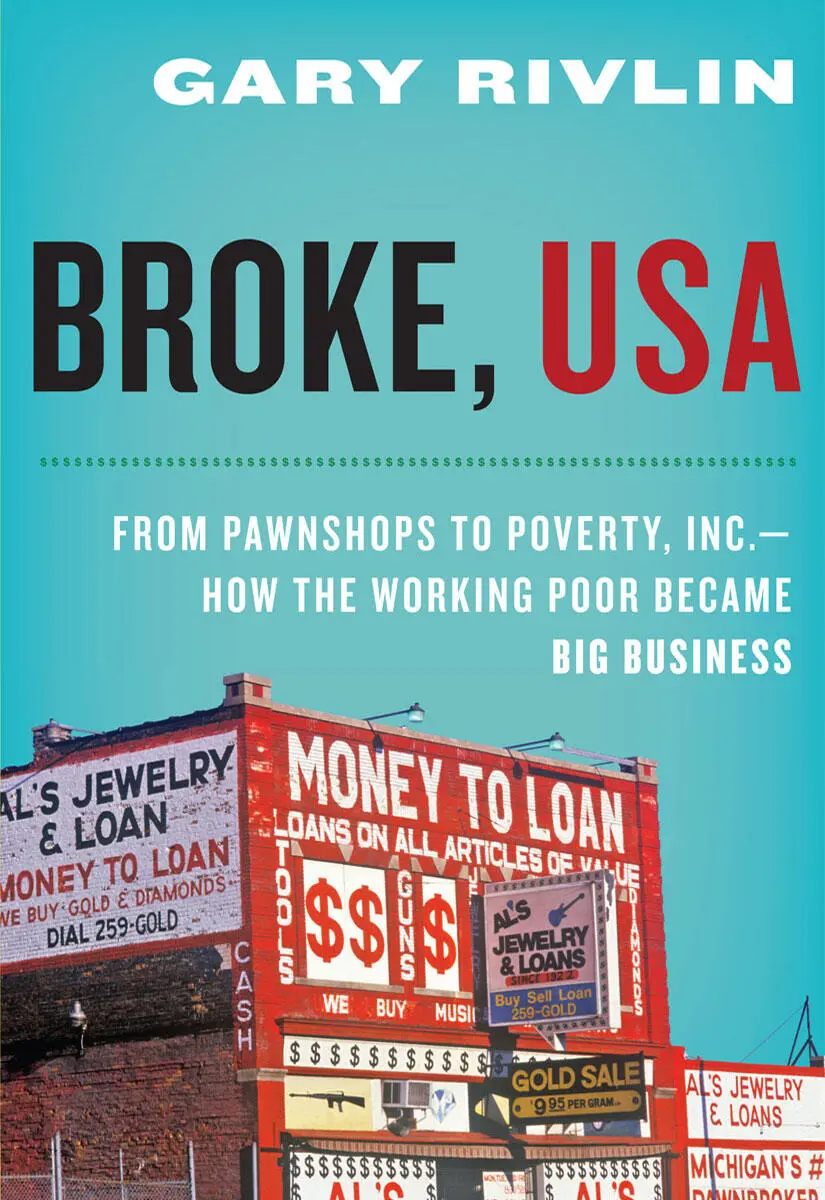
- Название:Broke, USA
- Автор:
- Издательство:HarperCollins Publishers Inc.
- Жанр:
- Год:2010
- Город:New York
- ISBN:978-0-06-199794-5
- Рейтинг книги:3 / 5. Голосов: 1
-
Избранное:Добавить в избранное
- Отзывы:
-
Ваша оценка:
Broke, USA: краткое содержание, описание и аннотация
Предлагаем к чтению аннотацию, описание, краткое содержание или предисловие (зависит от того, что написал сам автор книги «Broke, USA»). Если вы не нашли необходимую информацию о книге — напишите в комментариях, мы постараемся отыскать её.
Broke, USA — читать онлайн бесплатно полную книгу (весь текст) целиком
Ниже представлен текст книги, разбитый по страницам. Система сохранения места последней прочитанной страницы, позволяет с удобством читать онлайн бесплатно книгу «Broke, USA», без необходимости каждый раз заново искать на чём Вы остановились. Поставьте закладку, и сможете в любой момент перейти на страницу, на которой закончили чтение.
Интервал:
Закладка:
None of these reports might have made a difference if not for the CBS News program 60 Minutes. Fleet, the show’s Morley Safer told viewers in November 1992, has “set up what amounts to a loan sharking racket.” The program introduced the nation to people like Raymond Bryant, who had paid $3,500 in fees on a $11,400 loan—more than 30 percent in up-front costs on a loan carrying a 23 percent interest rate. And they heard as well from Charles Hastings, who spent his days cruising black neighborhoods in Atlanta in search of potential borrowers. “I’m not a salaried person,” Hastings told Safer. “I just get up every day and go out and find business.” It was Roy Barnes, the lawyer, who offered the episode’s most memorable quote and the one CBS used to promote the episode. “I don’t know what y’all call it up north,” Barnes said, “but down here in the South we call it cheatin’ and swindlin’.” Shortly after the program ran, the Georgia attorney general announced his office would be investigating Fleet Finance; Bill Brennan’s phone again was ringing off the hook.
People who joined Brennan over the years in his crusade to out the country’s predatory subprime mortgage lenders speak of him as a living legend. “He deserves a ton of credit for showing the rest of us how destructive this lending was,” said Mike Calhoun, the president of the Center for Responsible Lending, the organization that has taken the lead against predatory lending in its various forms. “He got involved before the rest of us, when it was the Wild West of lending and lenders were just grabbing huge amounts of home equity.”
Bill Brennan, however, gives credit to a woman named Kathleen Keest. “Keest is the original brains behind all this stuff,” Brennan said. “She’s our guru. She started figuring out what was going on in the mideighties.” In 1985, Keest moved to Boston to take a job as a staff attorney at the National Consumer Law Center monitoring the various vehicles that entrepreneurs and large corporations were concocting to get rich off warehouse workers, store clerks, and retirees struggling to make ends meet. “I’ve watched entire industries grow up,” Keest said. “And I’ve seen a lot of people get hurt.” In 1996, she took a posting as an assistant attorney general in Iowa, where she played a key role in exposing Ameriquest Mortgage, one of the more reckless subprime lenders in the first half of the 2000s. In 2006, she moved to North Carolina to take a job as a senior policy counsel at the Center for Responsible Lending.
Keest was running a regional legal aid office in Des Moines in 1984 when she picked up her first predatory mortgage case. This was early in what Keest dubs “wave one” of the subprime debacle, when some of capitalism’s scrappier practitioners took advantage of a seemingly sensible set of policy changes. For years many states had a cap—typically around 10 percent—limiting the interest rates banks could charge on a mortgage. Those went by the wayside when the country experienced double-digit inflation through much of the 1970s and the credit markets for people looking to buy a home froze. States were starting to lift those caps and if some locales were foresighted enough to keep in place a floating ceiling on the amount a mortgage lender could charge, those would be wiped out when the federal government, in 1980, passed a law barring the states from imposing limits on the rates a lender could charge on a real estate transaction. Two years later, during President Ronald Reagan’s tenure, the federal government would go further, giving lenders the latitude to sell more creative home loans, from balloon mortgages (in which most principal payments are deferred to the end of the loan period) to adjustable rate mortgages, or ARMs, which can see the interest rates a borrower pays fluctuate dramatically over the life of a loan.
The big consumer finance companies such as Household and Beneficial were among the first to jump on this first wave. Traditionally consumer finance firms had specialized in small, high-interest loans in the neighborhood of $500 or $1,500 to customers needing financing to replace a broken refrigerator or to buy a bedroom set for the kids. But this newly deregulated environment meant they could sell larger loans to these same customers at similar rates. “Once these guys moved up the food chain,” Keest said of the consumer finance companies, “we started seeing countless examples of people who purchased homes in the prime market”—when home loans were still regulated—“only to lose them in the subprime market.” People spoke of a new era of “risk-based pricing,” where interest rates were set based on the risk profile of a borrower, but Keest saw it as “opportunistic pricing”: charge as much as you can despite the security of a person’s home as collateral.
“Who cared if companies were screwing poor people?” Keest asked. “It was the eighties.”
With this first wave a new set of terms entered the lenders’ vocabulary. A lender was said to be “packing” a loan when a salesperson had been able to load it with points and fees and expensive baubles like the credit insurance Household sold Tommy Myers. “Flipping” was a broker’s ability to convince customers to refinance again and again—packing each new loan with additional points and broker fees. Another common gambit was to convince borrowers to consolidate their bills into a single home loan—often not realizing that in exchange for the convenience of a single monthly bill they had suddenly placed at risk their most valuable possession, their home. All of these practices added up to “equity stripping,” the fiendish art of siphoning off the equity people have built up in their homes.
Keest spotted other forms of subprime lending creeping into the culture by the end of the 1980s. Deregulation was one cause but broader economics were a factor as well. The country grew more prosperous during the 1980s and ’90s but the relative wages of the working class fell, expanding the pool of would-be borrowers desperate for the quick cash that could tide them over between paychecks. It was almost inevitable that a raft of clever entrepreneurs would try to fill the gap—for a price.
Keest struggled to keep up with all the new developments in a bimonthly newsletter she wrote and edited for the Consumer Law Center. Keest, a short, slim woman with a long narrow face framed by a pageboy hairdo, remembers the first time she learned about what she dubbed “postdated check loans.” It was 1988 and a reporter in Kansas City called to ask her about the legality of a local company making short-term loans to customers who put up their next paycheck as collateral. To Keest, this was a revival of the “salary buyers” who popped up around the country in the second half of the nineteenth century—the so-called “five for six boys,” since people would borrow $5 on a Monday and pay $6 on Friday. The country had outlawed the salary buyers early in the twentieth century but now in state after state, legislatures were providing carve-outs in their usury laws to legalize this new crop of lenders. “Tennessee was the first place to take it big but then plenty of states followed,” Keest said.
There were always novel credit schemes to keep Keest busy. One of the more creative was the “auto title loan,” which she first heard about in the early 1990s. These were similar to loans made by the country’s pawnbrokers except that a lender would take possession of the title as collateral rather than the vehicle itself, allowing people to continue driving while a loan was outstanding. Even businesses that had been around since well before the 1980s, such as rent-to-own and check cashing, provided plenty of fodder for her newsletter as these industries scored legislative victories that fostered further expansion. She felt that she was fighting a losing battle. The gap between the well-off and the less fortunate was widening and a slew of high-interest, high-fee products promised to exacerbate the disparity.
Читать дальшеИнтервал:
Закладка:
Похожие книги на «Broke, USA»
Представляем Вашему вниманию похожие книги на «Broke, USA» списком для выбора. Мы отобрали схожую по названию и смыслу литературу в надежде предоставить читателям больше вариантов отыскать новые, интересные, ещё непрочитанные произведения.









Обсуждение, отзывы о книге «Broke, USA» и просто собственные мнения читателей. Оставьте ваши комментарии, напишите, что Вы думаете о произведении, его смысле или главных героях. Укажите что конкретно понравилось, а что нет, и почему Вы так считаете.