Gary Rivlin - Broke, USA
Здесь есть возможность читать онлайн «Gary Rivlin - Broke, USA» весь текст электронной книги совершенно бесплатно (целиком полную версию без сокращений). В некоторых случаях можно слушать аудио, скачать через торрент в формате fb2 и присутствует краткое содержание. Город: New York, Год выпуска: 2010, ISBN: 2010, Издательство: HarperCollins Publishers Inc., Жанр: Старинная литература, на английском языке. Описание произведения, (предисловие) а так же отзывы посетителей доступны на портале библиотеки ЛибКат.
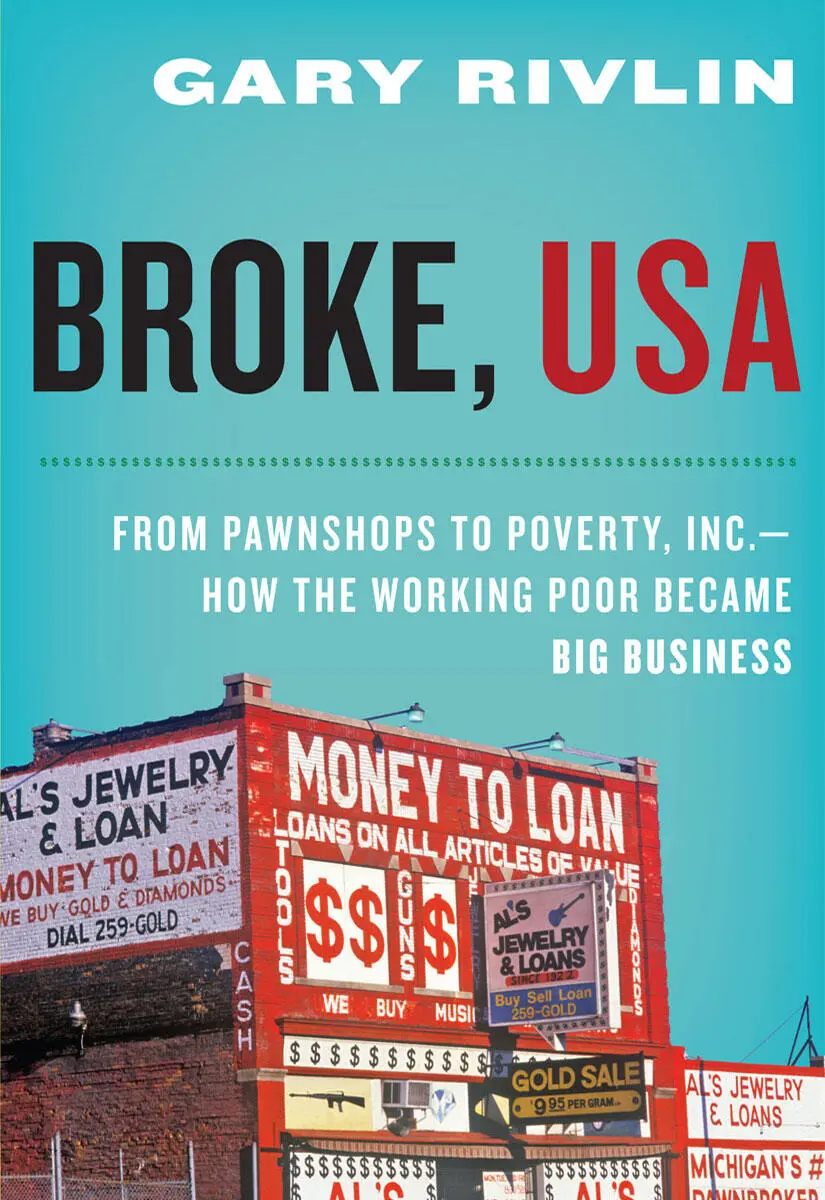
- Название:Broke, USA
- Автор:
- Издательство:HarperCollins Publishers Inc.
- Жанр:
- Год:2010
- Город:New York
- ISBN:978-0-06-199794-5
- Рейтинг книги:3 / 5. Голосов: 1
-
Избранное:Добавить в избранное
- Отзывы:
-
Ваша оценка:
Broke, USA: краткое содержание, описание и аннотация
Предлагаем к чтению аннотацию, описание, краткое содержание или предисловие (зависит от того, что написал сам автор книги «Broke, USA»). Если вы не нашли необходимую информацию о книге — напишите в комментариях, мы постараемся отыскать её.
Broke, USA — читать онлайн бесплатно полную книгу (весь текст) целиком
Ниже представлен текст книги, разбитый по страницам. Система сохранения места последней прочитанной страницы, позволяет с удобством читать онлайн бесплатно книгу «Broke, USA», без необходимости каждый раз заново искать на чём Вы остановились. Поставьте закладку, и сможете в любой момент перейти на страницу, на которой закончили чтение.
Интервал:
Закладка:
The HOEPA legislation wasn’t without its influence. Kathleen Keest uses its passage to mark the start of subprime’s second wave, or what she calls the “HOEPA evasion model.” In Boston, Keest shook her head as she watched the big lenders react to HOEPA. If a high-cost loan was one carrying an interest rate of 17.5 percent, they would loan money at a rate of 17.2 percent and charge 7.9 percent in up-front costs to avoid the 8 percent trigger. To the extent even these small concessions ate into profits, the lenders more than made up the difference pushing overpriced products such as credit life insurance, which pays off a loan in the event of a death.
Fleet exited the subprime mortgage business in Georgia, but the company sold its portfolio to a rival named Associates, so Brennan found himself doing combat with a giant based in Dallas and owned primarily by the Ford Motor Company rather than one based in Providence. If anything, Brennan and Keest said, Associates was more insidious than Fleet. “They just packed loans with credit insurance and other junk, and then flipped people over and over and over,” Keest said. Brennan saw the same thing. Whenever he met a new client coming to him because of Associates, they were invariably on their third or fourth refinancing.
In 1998, Brennan would travel to Washington, D.C., to testify about predatory lending at the Senate’s Special Committee on Aging. He would fly to the nation’s capital again two years later to talk about the same issue, though this time the invitation came from the House. In April 2000, when Andrew Cuomo, then the HUD secretary, was holding hearings to investigate subprime lending, Atlanta was the first stop on his five-city tour and Brennan was one of the featured speakers. “Finally, it’s our day in the sun,” he told a reporter for the Atlanta Journal-Constitution .
It wasn’t to be. Instead the dawning of the twenty-first century marked the start of Keest’s third wave. By this time, a wide cast of players had joined the consumer finance companies, including a new crop of nonbank lenders such as Ameriquest and New Century. Increasingly, mainstream banks were revving up profits by purchasing or starting a subprime subsidiary. Unlike during waves one or two, the lenders were offering first mortgages as well as refinancings. Rather than holding the loans they wrote, they began selling off the mortgages to third parties that would in turn bundle and sell them on Wall Street. They were still frequently selling people loans more expensive than their incomes could handle, but they gambled that home prices would continue to rise at a brisk rate. The homeowner wanting a new mortgage could easily refinance as the home appreciated in worth and, in the event of a foreclosure, the bank would have repossessed a property that had grown in value. Of course, the gamble would prove disastrous if housing values were to fall. Brennan’s message remained consistent throughout: The Fed must aggressively crack down on lending that bears no relation to a borrower’s ability to repay. In particular it galled him that Fannie Mae and Freddie Mac, both created by the government explicitly to foster home ownership by buying and selling home mortgages, acted as a guarantor of some of these alternative subprime products. These twin giants of the mortgage world lent credibility to the subprime field and could cost the government untold billions if everything came crashing down. “Fannie and Freddie, as government-sponsored entities, might very well turn to Congress for a financial bailout similar to the bailout of the savings and loan industry in the 1980s,” Brennan warned when he testified before Congress in 2000. His words were prophetic but seemed to fall on deaf ears.
Brennan works out of a satellite bureau that Atlanta Legal Aid maintains in Decatur, just east of Atlanta. The bookshelves in his office are crammed with books on race, and the pictures on the wall include shots of John F. Kennedy and King. Most striking, though, are the souvenirs of his fights, including the many awards he has collected over the years. He has been honored by his fellow legal aid attorneys, the state bar of Georgia, and various national consumer groups. Black groups have honored him for his work, as have religious groups, women’s groups, and groups representing the elderly. He has so many plaques and awards that he has room only for a small portion in his modest-sized office. The rest sit in a pile in one corner of the room.
In the fall of 2008, the board of Atlanta Legal Aid honored Brennan with a resolution acknowledging his forty years of service to the poor and working poor. He felt pride that day, but the moment mainly made him feel glum. “I find all the awards discouraging,” he said. For Brennan they served as periodic reminders of how hard they had all worked and how little things had changed. “You work on something for twenty years,” he said, shaking his head, “and it’s been worse than it’s ever been.”
Three
Going Big
Allan Jones wasn’t seeking to launch an industry in the spring of 1993 as he sat in the cockpit of his single-engine Piper Saratoga on his way to Johnson City, Tennessee. He only wanted to convince a man to come to work for him.
Jones was still in his early twenties when he took over his father’s small collection agency and built it into a multi-city behemoth—“the largest in Tennessee,” he’ll tell you—but it gnawed at him that he had no presence in the northeast corner of the state. “My final plug on the map,” Jones recalled in a marbly Tennessee drawl. So when he heard that an old friend of his father’s who lived up that way had been let go after years in the business, Jones jumped on the opportunity. He lives in Cleveland, Tennessee, a rural outpost thirty miles north of Chattanooga. He told Steve Hixson, a childhood friend whom he calls “Doughball,” to meet him at the small airport where he kept his plane. “We’re gonna see ol’ James Eaton and see if we can’t get him to come work for us,” he told Hixson.
Hixson and Jones told me the story after work one day. We were at the bar of the Bald Headed Bistro, a restaurant that Jones opened a one-minute walk from his office. Jones, who has made a couple hundred million from the payday business, was sipping what he calls a “Scotch slushie”—the single malt he drinks over crushed ice in a red plastic cup his bartender stocks especially for the boss—and Hixson was on his feet next to Jones, the better to narrate the story. A small crew of regulars, Jones underlings who seem only too happy to drink his alcohol, laugh at his jokes, and listen attentively as the boss runs through a familiar repertoire of old tales, had joined us. The James Eaton story is apparently a favorite for no other reason than that it offers a chance to showcase the imitations of Eaton that Jones and Hixson have lovingly honed over the years. One or the other will raise his voice one or two octaves and then, adopting a kind of mezzo-soprano hillbilly twang, proceed to make the other laugh.
“Ale-ann. Ale-ann, I shore do i-pree-shy-ate y’all comin’ on up he-ya.”
Jones had always admired James Eaton. He was a “real stately” fellow, he said, a bespectacled man who smoked a pipe. “He looked to me kind of like Sherlock Holmes,” Jones said. That made it all the sadder when they found Eaton working in a shack so shabby the paint was peeling off the walls. It was the office of a dilapidated gas station where Eaton had set up a business he called Check Cashing, Inc. “I guess I’ve found myself my man in northeast Tennessee,” Jones told himself.
Jones was not deep into his pitch that day when Eaton excused himself to deal with a customer. A baffled Jones asked Eaton what he was up to and he explained. “Ale-ann, Ale-ann, I’ll tell you what.” It turned out he was loaning cash to people who needed a bridge loan until the next payday. The school janitor who needed $100 today would pay him back $120 when he received his next paycheck.
Читать дальшеИнтервал:
Закладка:
Похожие книги на «Broke, USA»
Представляем Вашему вниманию похожие книги на «Broke, USA» списком для выбора. Мы отобрали схожую по названию и смыслу литературу в надежде предоставить читателям больше вариантов отыскать новые, интересные, ещё непрочитанные произведения.










Обсуждение, отзывы о книге «Broke, USA» и просто собственные мнения читателей. Оставьте ваши комментарии, напишите, что Вы думаете о произведении, его смысле или главных героях. Укажите что конкретно понравилось, а что нет, и почему Вы так считаете.